The Carolina Principles: What the G20 Just Told Healthcare Entrepreneurs and Investors
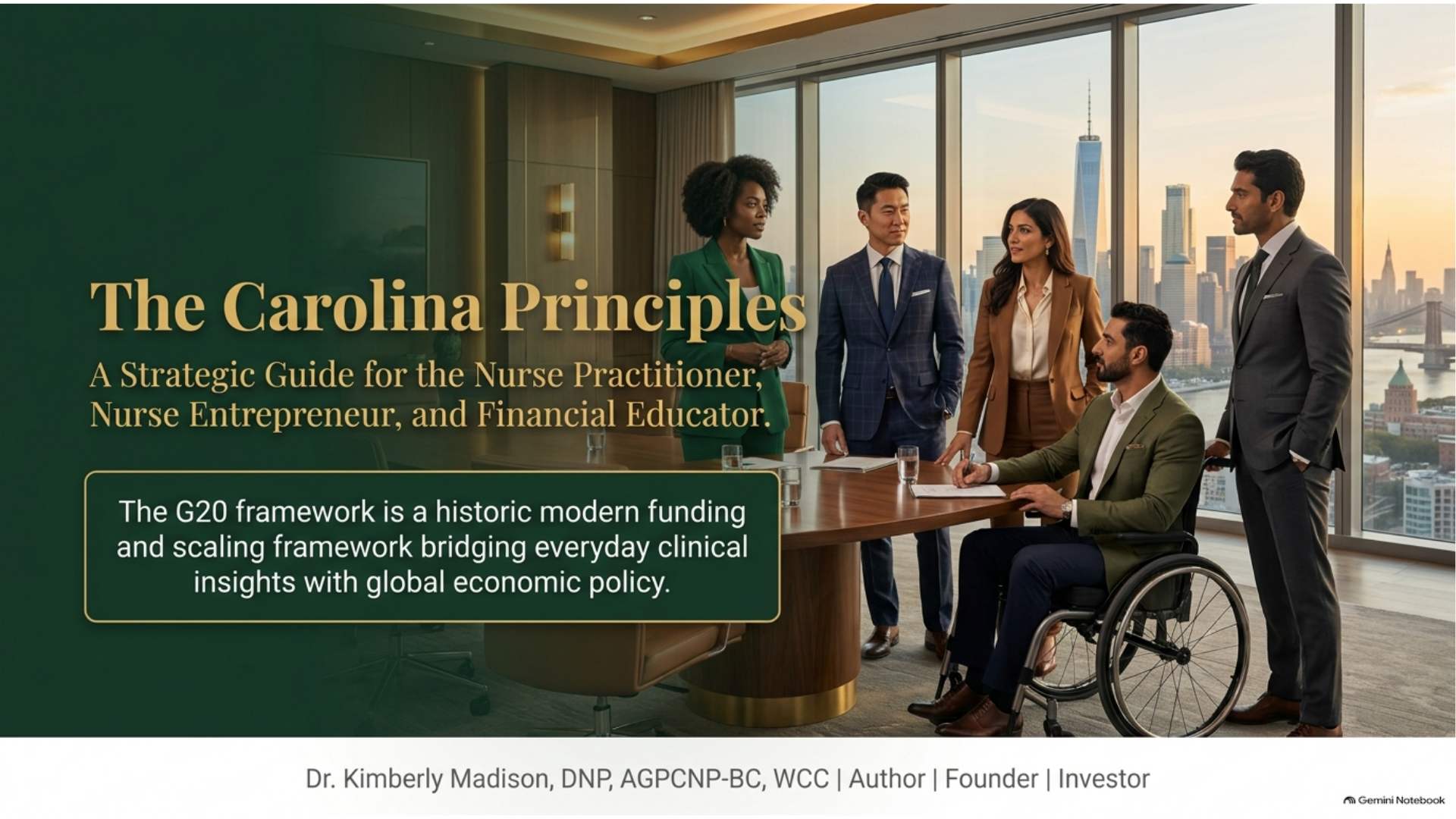
The G20 met in Chapel Hill on September 1 and 2, 2026, and twenty of the world's largest economies agreed on a new framework for funding and scaling new technology. They call it the Carolina Principles. Most breakdowns of this document are written for policy analysts and venture capital firms that already speak the language of technology readiness levels and regulatory sandboxes. We don't build for that audience at Mahogany Dermatology Nursing | Education | Research™. We build for clinicians who read a document like this and ask a different question: where's the opening for us. That's the question this breakdown answers. All 24 points, plain language, with a real starting action attached to each one.
The Carolina Principles: What the G20 Just Told Healthcare Entrepreneurs and Investors
Section I: Advancing Discovery and Strengthening Technology Development
This section is about where ideas come from and how they get funded before anyone knows if they'll work.
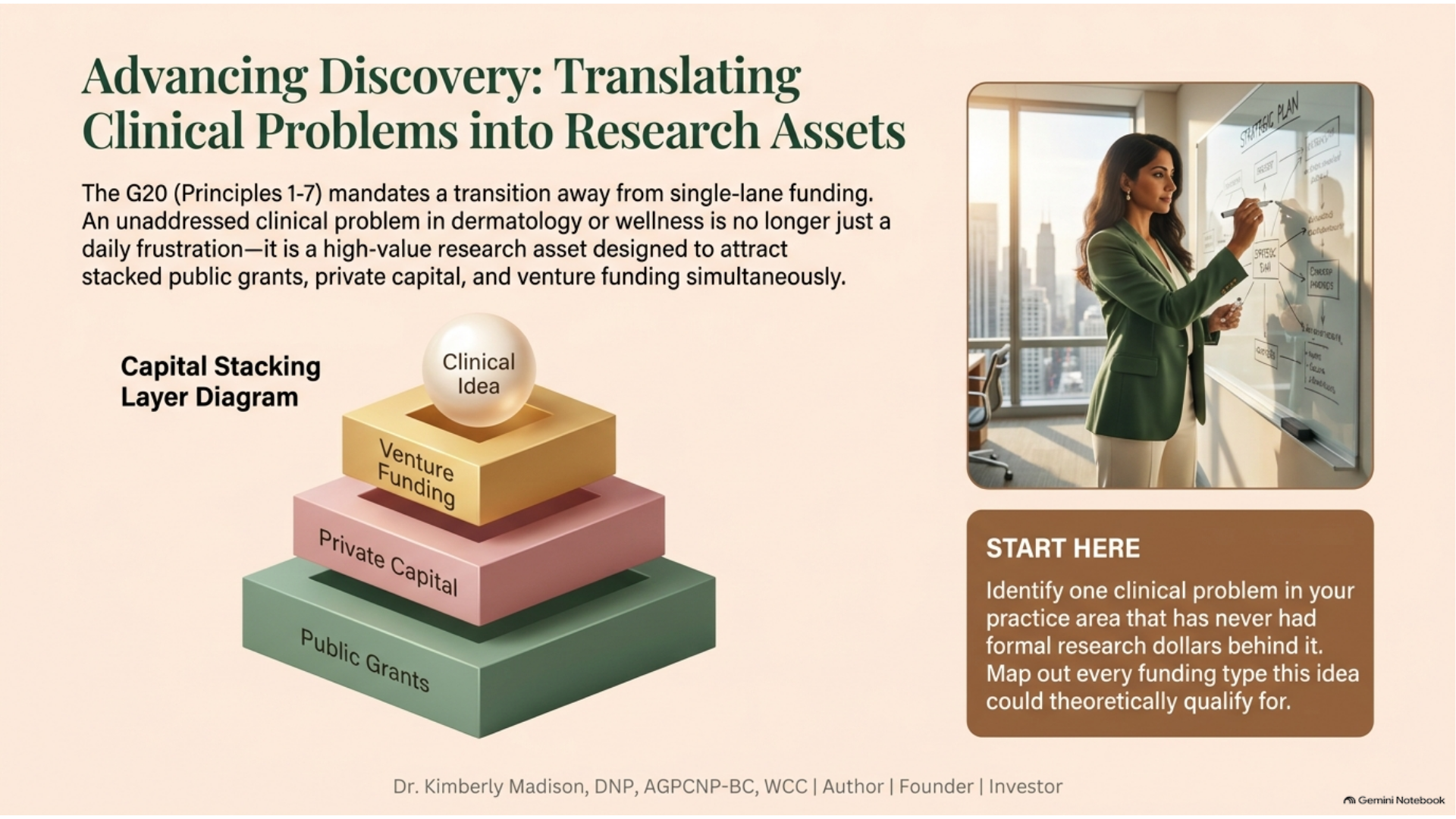
1. Government wants to invest directly in early research to attract private investors later. The thinking is simple: public money proves a concept is worth studying, then private capital follows once the early risk is reduced. Start here: identify one clinical problem in your practice area that has never had formal research dollars behind it, and write down exactly why it matters.
2. Government wants to combine grant money, private capital, and venture funding on the same idea, instead of forcing founders to pick one lane. This is a real shift. Most healthcare entrepreneurs are taught to chase one type of funding at a time. The policy direction is toward stacking multiple types of capital on a single idea, at different points in its growth. Start here: map out every funding type your current idea could theoretically qualify for, even if you've only ever pursued one of them.
3. Government wants shared data and research infrastructure that smaller companies and researchers can plug into, instead of every group building it alone. Start here: find one place where researchers in your specialty already share data or testing tools, and study what it takes to contribute or access it.
4. Government wants less paperwork standing between researchers and the grant money already available. Fewer forms, faster reporting, more people actually applying. Start here: pull up one real grant application in your field and time how long it takes just to understand the requirements, before you've written a single word.
5. Government wants to ask businesses and universities what they actually need before deciding what research to fund, instead of setting priorities from the top down. Start here: ask ten people in your own network one question. What's the clinical problem nobody has built a solution for yet. Start collecting real answers.
6. Government wants a direct pipeline connecting research institutions, small businesses, and investors, so research that already exists gets turned into something people can actually use, instead of sitting unread in a journal. Start here: pick one published study you already know about that never became a product, and find out exactly why it stalled.
7. Government wants the lessons from failed or discontinued projects saved and shared, instead of lost when a project ends. Start here: interview one founder whose idea didn't work, and write down the real reason. Not the polished version people give at networking events.
Section II: Accelerating Validation and Commercialization
This section is about testing something in the real world, and getting paid while you're still testing.
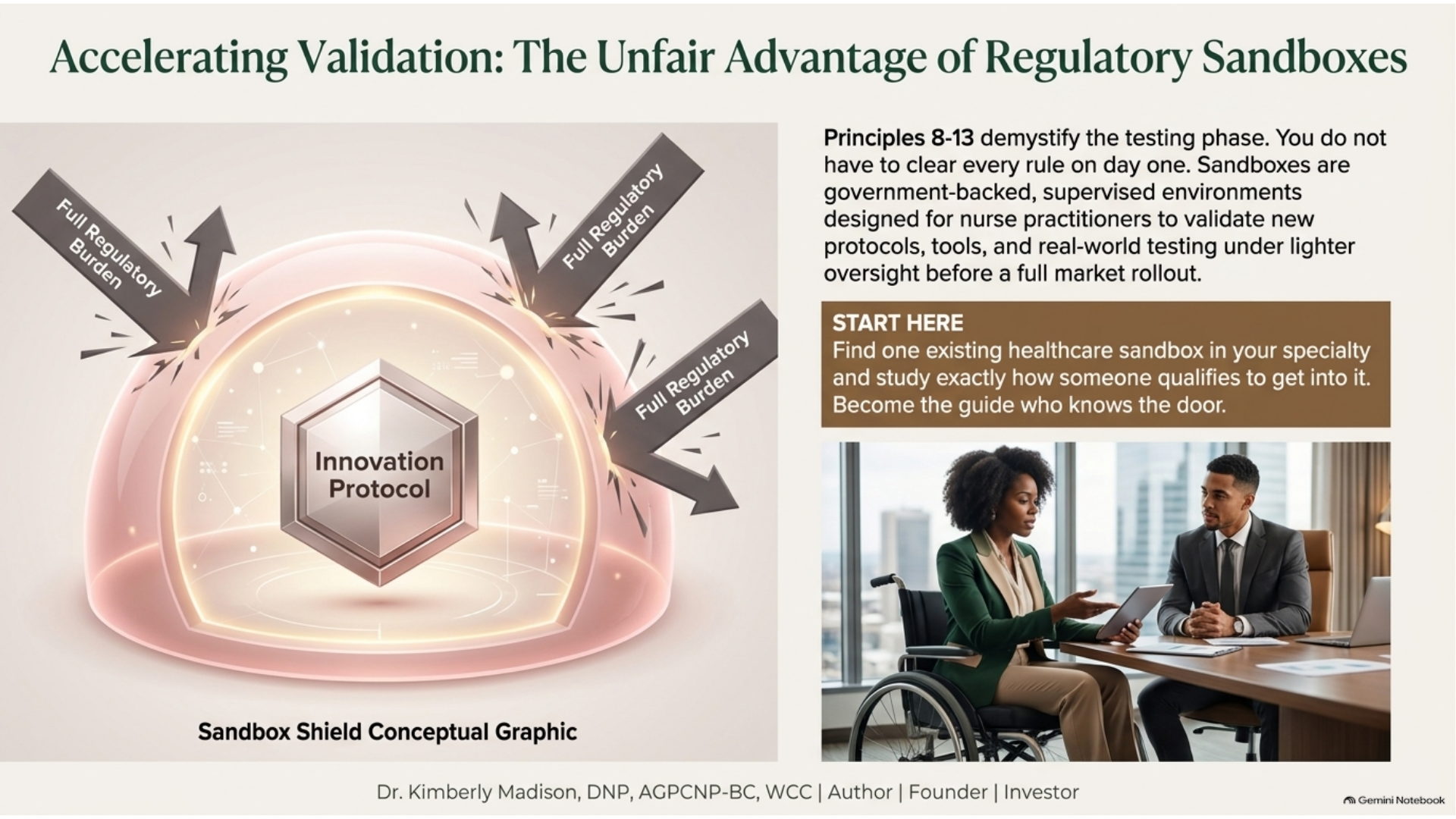
8. Government wants supervised spaces, called regulatory sandboxes, where new tools can be tried with lighter oversight before facing full regulation. Think of it as a practice round before the real game. A new AI skin-screening tool doesn't have to clear every rule on day one. It can run in a small, watched setting first, so everyone learns fast whether it actually works. Start here: find one existing healthcare sandbox and study exactly how someone qualifies to get into it. You start as the guide who knows the door, not the one building a new door.
9. Government wants funding tied to results, not just process, for the specific technical breakthroughs that regular grant structures don't reward well. Start here: identify one technical milestone in your field that funders currently pay for based on effort rather than outcome, and imagine what it would look like priced by result instead.
10. Government wants real-world testing environments built early, with shared standards folded in from the start, instead of testing left until after a product is fully built. Start here: ask one clinic you already know if they'd test an unfinished tool in exchange for early access and honest feedback.
11. Government wants the results from real-world testing to actually shape future rules, instead of writing regulation blind. Start here: find out where regulators in your specialty currently collect feedback from pilot programs, if anywhere at all.
12. Government wants faster approval for small pilot projects, since a supervised trial carries less risk than a full rollout. Start here: find one real example of a healthcare pilot that received expedited approval, and study exactly how they made that case.
13. Government wants clear expectations written down for early adopters, so the first users of something new know exactly what they're responsible for. Start here: interview one provider who was an early adopter of a new health technology, and ask what nobody warned them about.
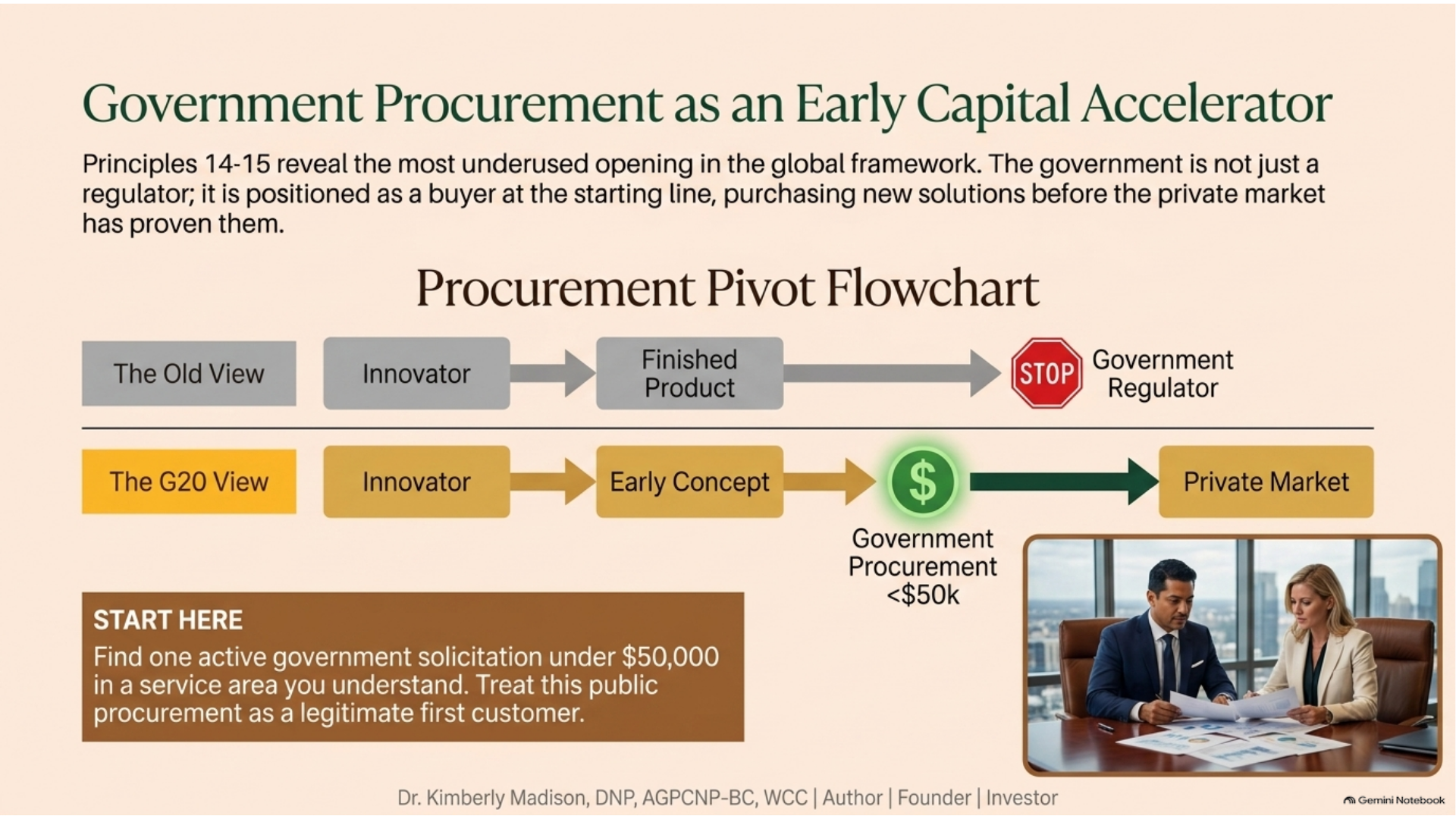
14. Government wants to become an early customer, buying new solutions before the private market has proven them. This is public procurement, and it is the single most underused opening in this entire document for healthcare founders. Government isn't only a regulator standing at the finish line. It's positioning itself as a buyer at the starting line. Start here: find one active government solicitation under fifty thousand dollars in a service area you understand, and walk one entrepreneur through bidding on it, start to finish.
15. Government wants a direct connection between researchers and the private sector, so research gets identified, translated, and moved toward commercialization instead of staying academic. Start here: take one dense research abstract you already have access to, and rewrite it as a one-paragraph business pitch a non-scientist investor could act on.
Section III: Enabling Technology Adoption
This section is about getting people to trust and actually use new technology, once it exists.
16. Government wants existing industry rules applied to new technology first, instead of writing brand new regulation from scratch every time something new appears. Start here: pick one new health tech idea and research whether an existing rule already covers it, before assuming there's a regulatory void.
17. Government wants new rules written only where a real gap exists, not duplicated on top of protections that already work. Start here: pick one thing an entrepreneur in your network worries is illegal, research the real answer yourself, and use that as proof of how much fear and wasted time this saves.
18. Government wants regulatory clarity that stays stable once it's set, even in gray areas where the right pathway wasn't obvious at first. Start here: pick one confusing regulation entrepreneurs in your field already struggle to interpret, and write the plain-language version yourself.
19. Government wants technology judged by whether it works, not by the specific method used to build it. Outcome-based standards, not rigid technical requirements. Start here: study one outcome-based standard already in use in healthcare, and research exactly how a company proved they met it.
20. Government wants old regulations updated once real evidence shows they no longer fit how the technology actually works now. Start here: find one outdated healthcare regulation people already complain about, and research the actual process for requesting a formal review.
21. Government wants the cost of moving too slowly weighed seriously, not just the risk of moving too fast. Waiting has a price too. Start here: find one real example where slow adoption of a healthcare technology caused a measurable harm or a missed opportunity, and document it clearly.
22. Government wants secure, trustworthy infrastructure that different systems and technologies can actually connect to. Start here: pick one common healthcare software system and find out exactly what it takes to integrate a new tool with it.
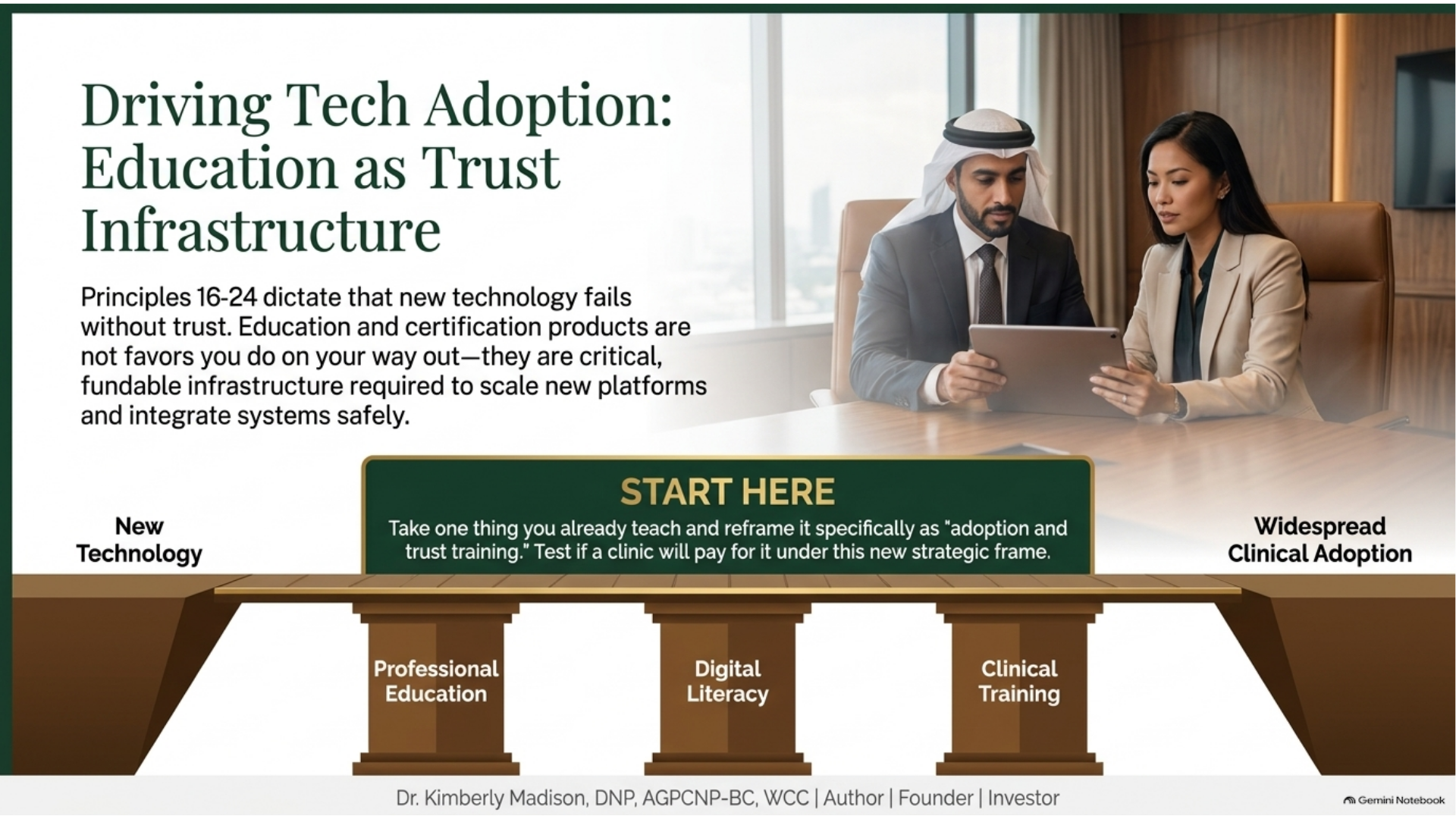
23. Government wants trust in new technology built through training and digital literacy, done in direct partnership with private business, not government alone. This means education and certification products are not an afterthought once a technology exists. They are treated as part of what makes the technology trustworthy enough to scale. Start here: take one thing you already teach, reframe it specifically as adoption and trust training, and see if one clinic or small group will pay for it under that frame.
24. Government wants countries sharing what's already working with each other, instead of every nation solving the same problem alone. Start here: have one real conversation with a healthcare innovator building outside the United States. We've already done this ourselves. Ogirima Obey Ezekiel, Registered Nurse and Founder of AfriDAM AI, is building AI-powered dermatology support for melanin-rich skin in Nigeria, where fewer than 200 dermatologists serve a population of over 200 million people. Alexander Börve, MD, founder of Autoderm in Europe, is solving a version of the same problem for non-specialist clinicians across pharmacy, telehealth, and primary care. Two different continents, two different health systems, the same underlying constraint: not enough specialists, too many patients waiting.
Why This Matters for You
None of this document mentions healthcare by name. It's a general technology framework, written for ministers thinking about semiconductors and AI infrastructure as much as anything clinical. But every principle in it applies directly to the pipeline healthcare innovation already runs on: a clinical problem becomes a research question, the research becomes a tested product, the product finds a first customer, and adoption spreads through training and trust. Wherever you are in your own founder journey, you're already standing somewhere on that pipeline.
If you're still working full time while building your practice on the side, watching every client feel like a favor instead of a business, this document is telling you the clinical problem you notice every single week is worth more than a side hustle. It's a research question with a funding pathway now being built around it.
If you're scaling past your first team hires and feeling like the bottleneck holding everything together, the sections on testing environments and early adopters matter most for you. You don't have to build a brand new sandbox. You can become the guide who already knows how to get other founders into the ones that exist.
If you've already built real revenue and real infrastructure, the procurement and commercialization sections are your next lever. A government solicitation under fifty thousand dollars is a legitimate first customer, not a consolation prize after private funding fell through.
And if you're thinking about legacy, succession, or what your practice is actually worth, the adoption and trust section is where you come in. Training the next generation on how to use what you built is treated in this document as infrastructure worth funding, not a favor you do on your way out.
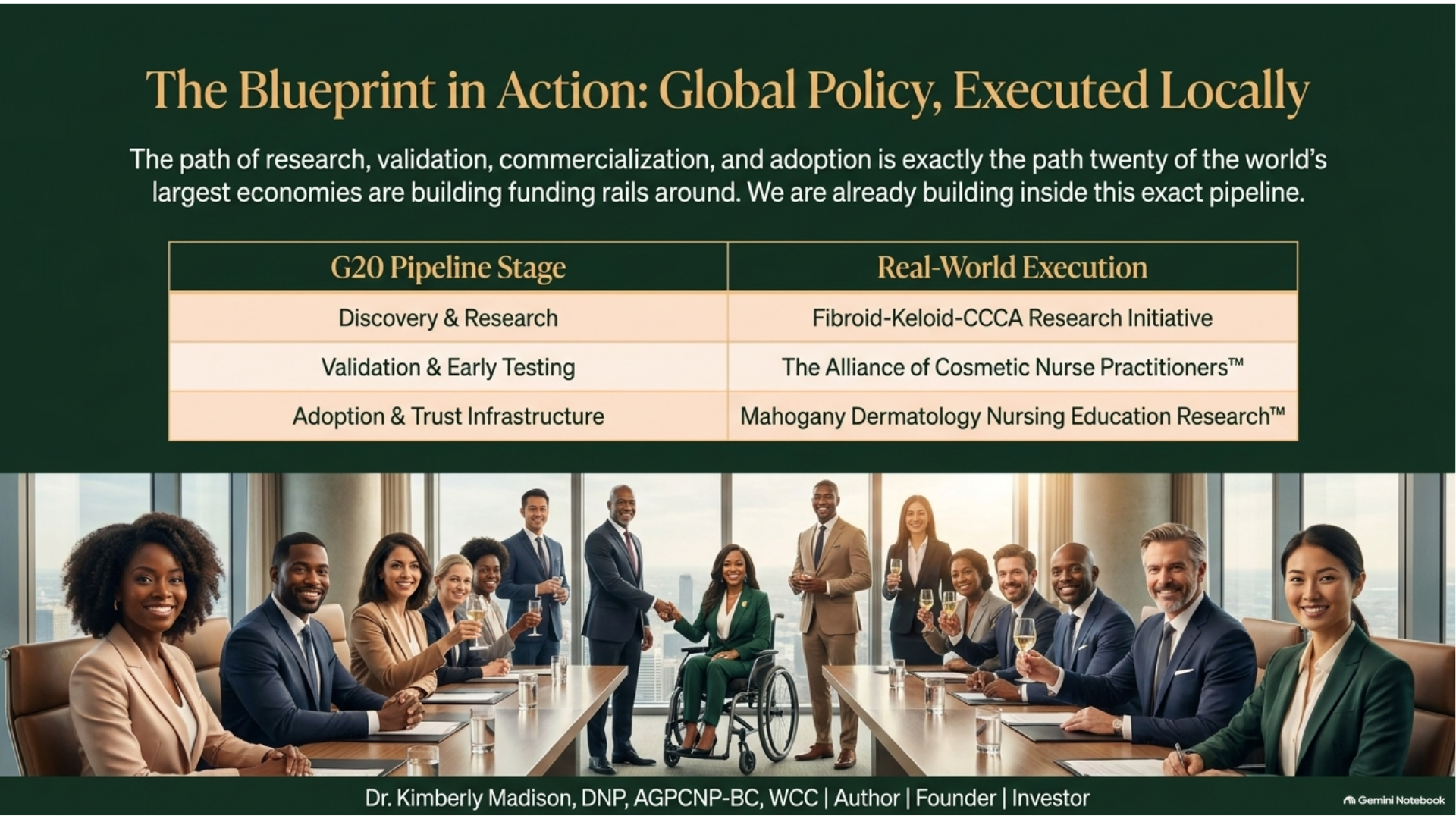
We've been building inside this exact pipeline ourselves. The Fibroid-Keloid-CCCA Research Initiative moved from a clinical observation to an OSF-registered protocol to an ACS Spring 2026 presentation. The Alliance of Cosmetic Nurse Practitioners™ ran a paid founding membership as a real testing ground before OneStadium ever existed as an idea. This document is external confirmation that the path we've already been walking, research to validation to commercialization to adoption, is exactly the path twenty of the world's largest economies are now trying to build funding rails around.
Read documents like this one first. Not last. Next stop, NIVIDIA's Developer's program for those of you ready to take action! Stay tuned.
About the Author
Dr. Kimberly Madison, DNP, AGPCNP-BC, WCC is a Board-Certified, Doctorally-prepared Nurse Practitioner, educator, researcher, and author dedicated to advancing dermatology nursing education with an emphasis on skin of color, business acumen, and digital literacy. She is the founder of Mahogany Dermatology Nursing | Education | Research™ and the Alliance of Cosmetic Nurse Practitioners™, the first dermatology nursing organization in the country built at the intersection of clinical excellence, skin of color care, and financial literacy for nurses. A selected participant in the Harvard Business School Foundry Mindset Bootcamp (2026), Dr. Madison continues to sharpen the entrepreneurial infrastructure behind her mission. Through peer-reviewed research, published books, and a growing community of nurse entrepreneurs, Dr. Madison is building the infrastructure that makes this profession sustainable for the people who choose it.
.svg)

.svg)
.svg)