If you read our recent piece on the Financial Literacy Digital Starter Kit, you already know the first tool in that kit was not an app, a broker, or a budget spreadsheet. It was a question: what is your relationship with money? I told you I would answer that question myself before I ever asked you to answer it. This week, I am going first.
I Never Put A Price On My Education. But, I Should Have.
I watched my mom pay back student loans pretty much my entire life. I thought that was normal. I was on the same trajectory to do the same thing.
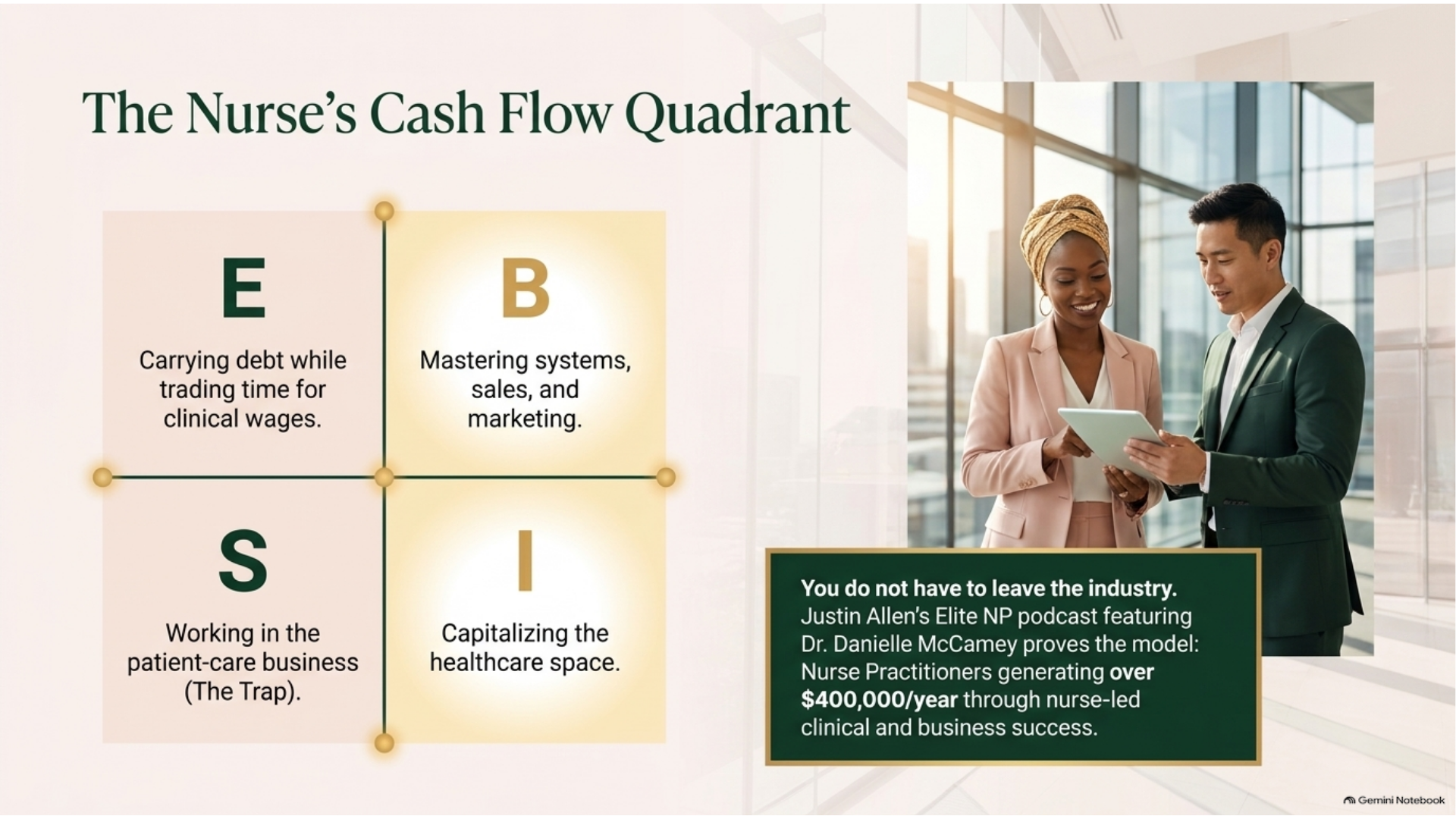
Then I got to NP school. I was learning about business and fnancial literacy and the real path to wealth, which is the path to freedom. At that point I already had six figures of student loan debt. I realized immediately that I was on the wrong path. I had an employee mindset when it came to my path to financial stability. When I realized, I was on the wrong path, I felt severely behind.
That is when I learned about the Cashflow Quadrant: employee, self-employed, business owner, investor. I knew I had to figure out a plan to be both an investor and business owner. By this point, I had learned about a plethora of business options, including franchises and boring businesses (my favorite). Despite listening to 100s of videos and podcasts, I heard about very few healthcare business models outside of business-to-consumer, and even then it was only 5% of the conversation. I thought I was going to have to leave the industry to get there. It was not until I was close to graduation that I discovered Justin Allan, FNP-C, founder of Elite NP, through a podcast interview he did on the same show as Dr. Danielle McCamey, DNP (President, Founder and CEO of DNPs of Color), called the Doctor Nurse Podcast with Dr. Sandra Pagenta, DNP. I heard his episode about a nurse practitioner making over four hundred thousand dollars a year, and I realized there was a path to use everything I had already learned and spent money and years on for the last twenty years, while moving toward wealth.
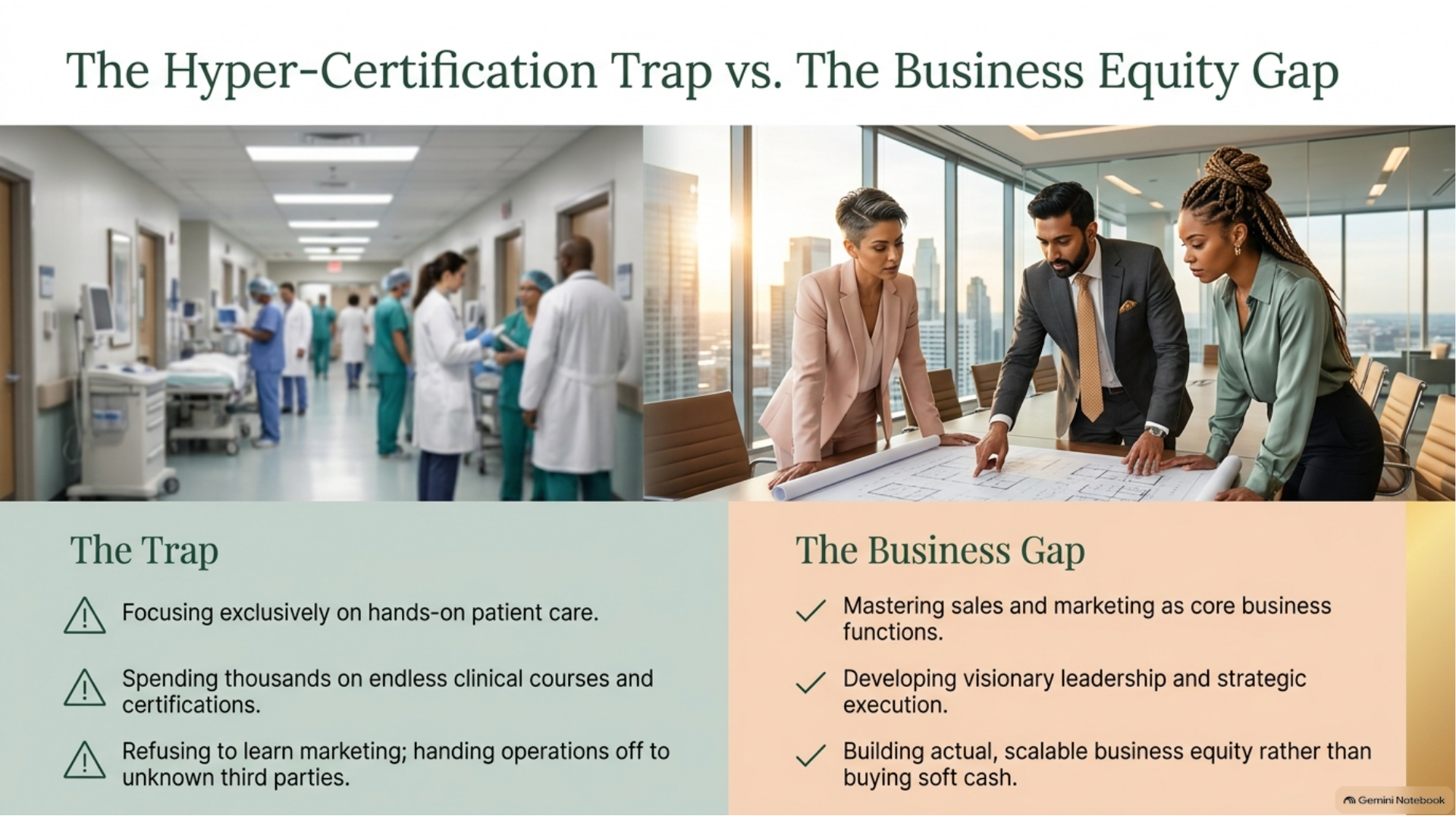
So much of our exposure as nurse practitioners focuses on what we do with our hands and for our patients. I thought the only business I could start was one built around taking care of patients' problems. I kept learning while finishing my DNP degree, through the pandemic as a travel nurse, moving back to the East Coast, and transitioning into my NP role. During that time, I watched my peers start their own businesses. Over the first two or three years, I saw the same pattern. They were spending thousands of dollars on more certifications and courses on how to take care of the patient. They did not want to learn sales. They did not want to learn marketing. They wanted to hand it off to their teenager, or pay someone they did not know, and have nothing to do with it themselves. I saw a really clear gap between what it actually takes to be successful as a business owner and what they understood.
Patients are not the only people with problems; they are the only people we can help, and by the way, nurses are patients too.
I started talking to them, giving them information and ideas, and I started to hear myself talk back. I realized I had actually learned quite a bit through compounding information. I wanted someone to observe my conversations because I knew I was doing something that was helpful, but I didn't know what to call it. That is when I came across coaching. I learned the difference between coaching and mentorship, and at first I did not want to be a coach. But once I started investing in coaching myself and saw how actionable it was, how it moved the needle and got me to execute instead of just accumulating more certifications and more information, I saw the value in it, and I saw where I fit. I realized it was exactly what my profession needed to move from analysis paralysis to wealth and away from burnout - which was affecting so many people that they were leaving the industry simply because they were suffering in silence and working in silos. They thought the only thing they could do was take care of patients and that the only people they could help were patients. So when they got tired of that, they thought their only option was to leave the profession. I knew that was avoidable.
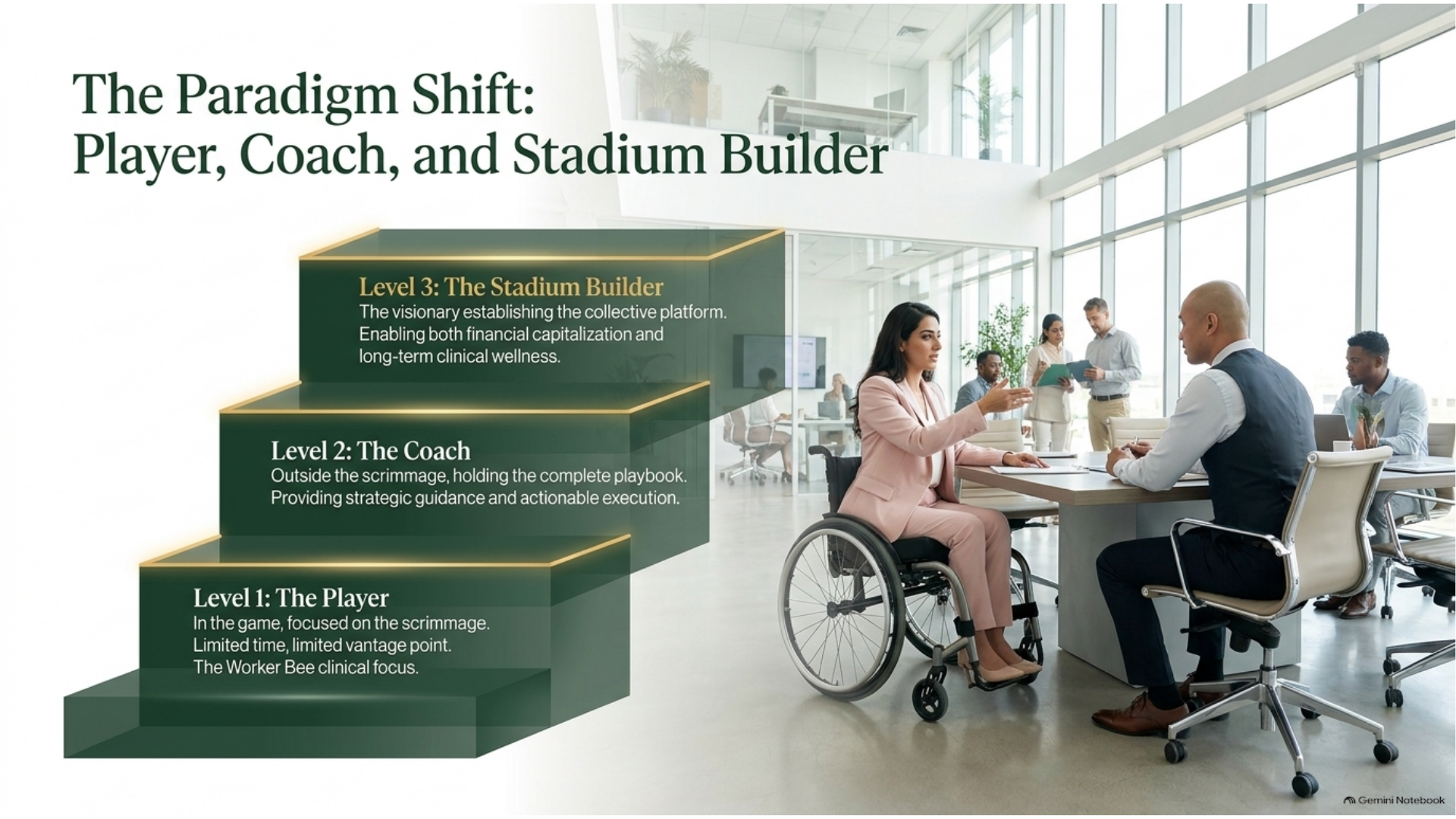
Here is how I think about it. The football player, like the NP, gets the most attention; everyone wants to be that person primarily due to the exposure those roles receive (problem #1). But the NP, like the football player, can only play the game for so long (problem #2). When you look for help, you cannot turn to the person next to you (the other nurse or NP), because they are in the game with you too. So everyone looks to the coach. The coach has the whole playbook and a whole different vantage point. That was me. I was still on the outside. At first, that created imposter syndrome. Later it became my superpower, because I could actually help them from a position they could not help each other from.
From that vantage point, I watched different scrimmages play out. Some nurse practitioners figured it out. Others spent hundreds of thousands of dollars, went bankrupt, and left the industry, taking everything they had sacrificed with them. Because I had already learned the strategies, I knew they needed: how to find people who could keep them in business, the difference between being a visionary and being a worker bee, and actual marketing and sales strategies. Just like we have clinical practice guidelines for patient care, we needed strategies, checklists, and frameworks to take care of our businesses - and the good news was they already existed. We just didn't have the time to take advantage of them because we are so busy living a full-time life, working a full-time job, going back to school, and trading in all of our time for money - simply because we didn't learn how to make our money work for us. Our training and education only taught us to work hard for our money, and we mastered that. Hence the burnout. The pandemic taught us the importance of having ownership of our time and money, which led to a rapid rise in entrepreneurship. But without the proper rest, systems, and understanding of the Cashflow Quadrant, we were just going from burned out at the bedside to burnout and bankruptcy in business.
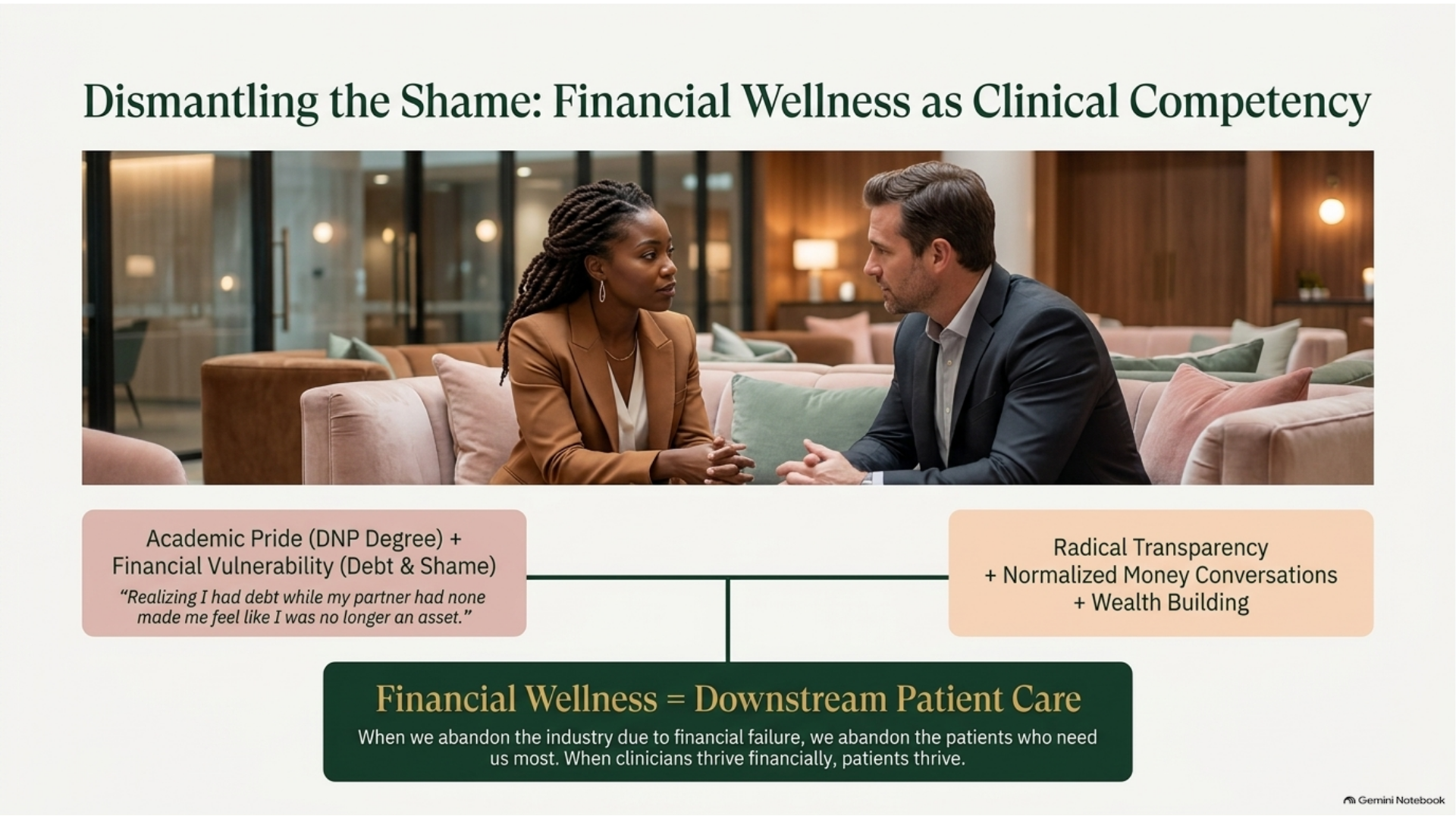
When we abandon the industry, we abandon the patients who need us most. So I poured my time and attention into my clinician friends, because they needed help too.
Watching those scrimmages, I kept asking: what if we all got together in one place? As an investor thinking about capitalization options, the football player makes a lot of money, but the coach makes a little more for a lot longer. And none of it matters, not the player, not the coach, without a stadium for the game to happen in. That is when I started thinking maybe I should be the lady who builds the stadium.
My Relationship With Money
One day, my partner wanted to talk about money. It was not until that moment that I realized I had never talked about money. When we first started dating, I found out he had no debt. Up until that point, I never put a price tag on my education and never thought twice about paying back student loans for the rest of my life. Everything I had been working toward, including getting the highest degree, was so I could be an asset in my relationship and in my family. But when I found out he had no debt, I realized immediately I was a liability. That mind shift completely changed how I saw myself. Then, when he actually wanted to talk about money, I realized I was not ready. Even though I knew I wasn't the only one with a lot of student loan debt, I still think shame crept in. It took me years to get to where I am now, doing this work publicly talking about money, my relationship with it, and calling for Financial Literacy to be the next clinical competency. That conversation with him is why I'm here writing this article, and he is why I even pursued dermatology.
Who you choose to do life with is one of the most important investments you will ever make.
Like many of you reading this, once I learned that financial freedom was the real goal, I felt this sense of urgency, and I have been trying to play catch-up with wealth building ever since. That is why I show up every day for you. The lessons I am teaching you are the ones I had to learn the hardest.
Dr. Kimberly Madison, DNP, AGPCNP-BC, WCC, is a Board-Certified, Doctorally-prepared Nurse Practitioner, educator, researcher, and author dedicated to advancing dermatology nursing education with an emphasis on skin of color, business acumen, and digital literacy. She is the founder of Mahogany Dermatology Nursing | Education | Research™ and the Alliance of Cosmetic Nurse Practitioners™, the first dermatology nursing organization in the country built at the intersection of clinical excellence, skin of color care, and financial literacy for nurses. A selected participant in the Harvard Business School Foundry Mindset Bootcamp (2026), Dr. Madison continues to sharpen the entrepreneurial infrastructure behind her mission. Through peer-reviewed research, published books, and a growing community of nurse entrepreneurs, Dr. Madison is building the infrastructure that makes this profession sustainable for the people who choose it.
.svg)

.svg)
.svg)