Nyla sits in on another patient visit, this time a case of melasma and the visible-light sunscreen gap. What she witnesses becomes the doorway into a much bigger business lesson: the full case for whether Mahogany should spend $60,000 on a new laser, tested from every angle: Net Present Value, the opportunity cost of capital, the Gordon Growth Model, growth opportunities, free cash flow, and real returns after inflation. You'll walk away with a plain-language grasp of how a real investment decision actually gets made, and a clearer picture of why skin of color competency and business literacy have to be taught together.
Chapter Three: The Whole Picture
Nyla walked in with her notebook already open, the fish still swimming across the cover, a highlighter tucked behind her ear like she meant business this time.
Before you sit down," Dr. Avery, DNP said, "I want you back in that exam room. Same kind of case as before, different patient."
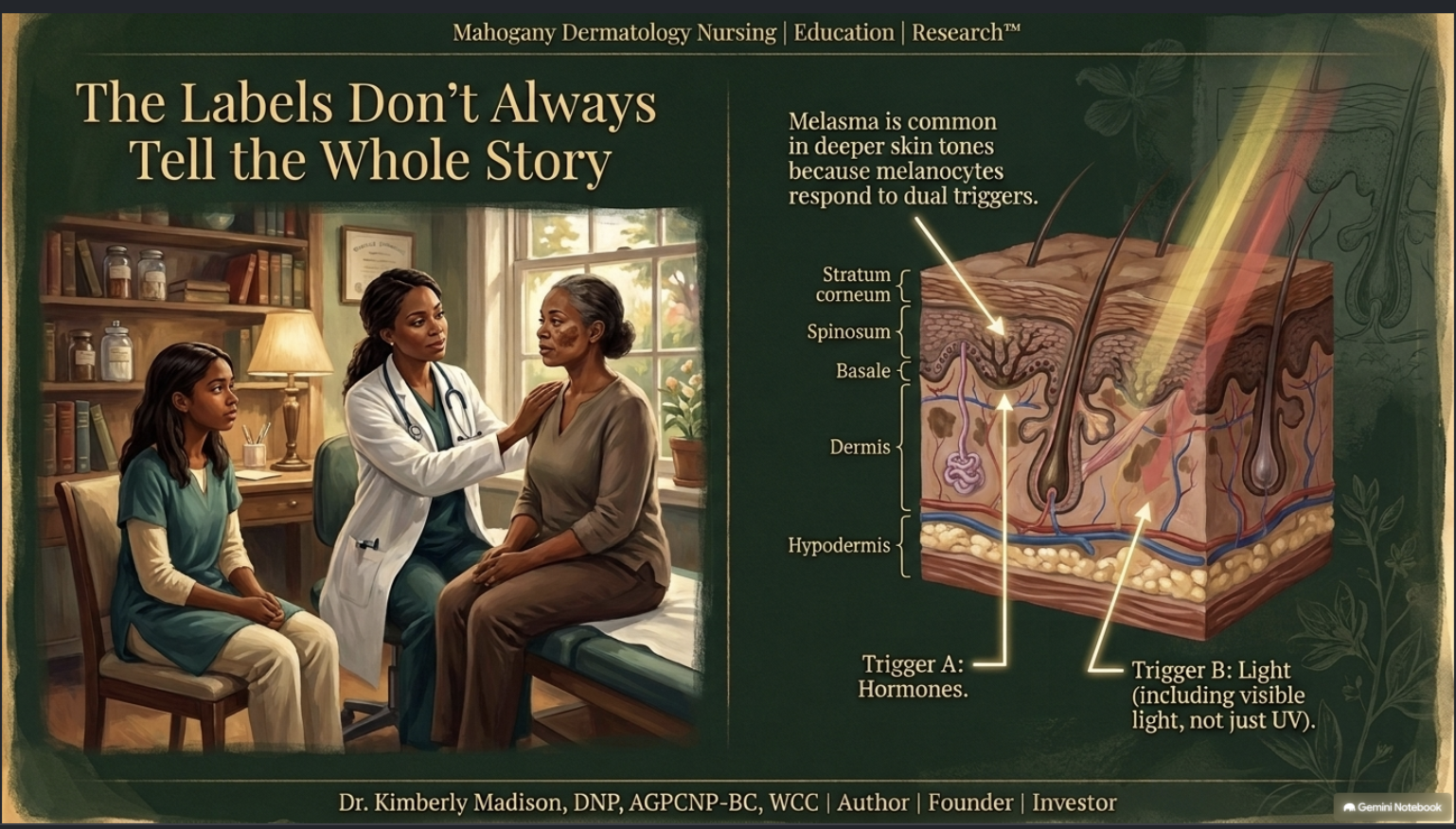
The woman on the table this time had brown patches spread evenly across both cheeks, faint gray-brown along her hairline.
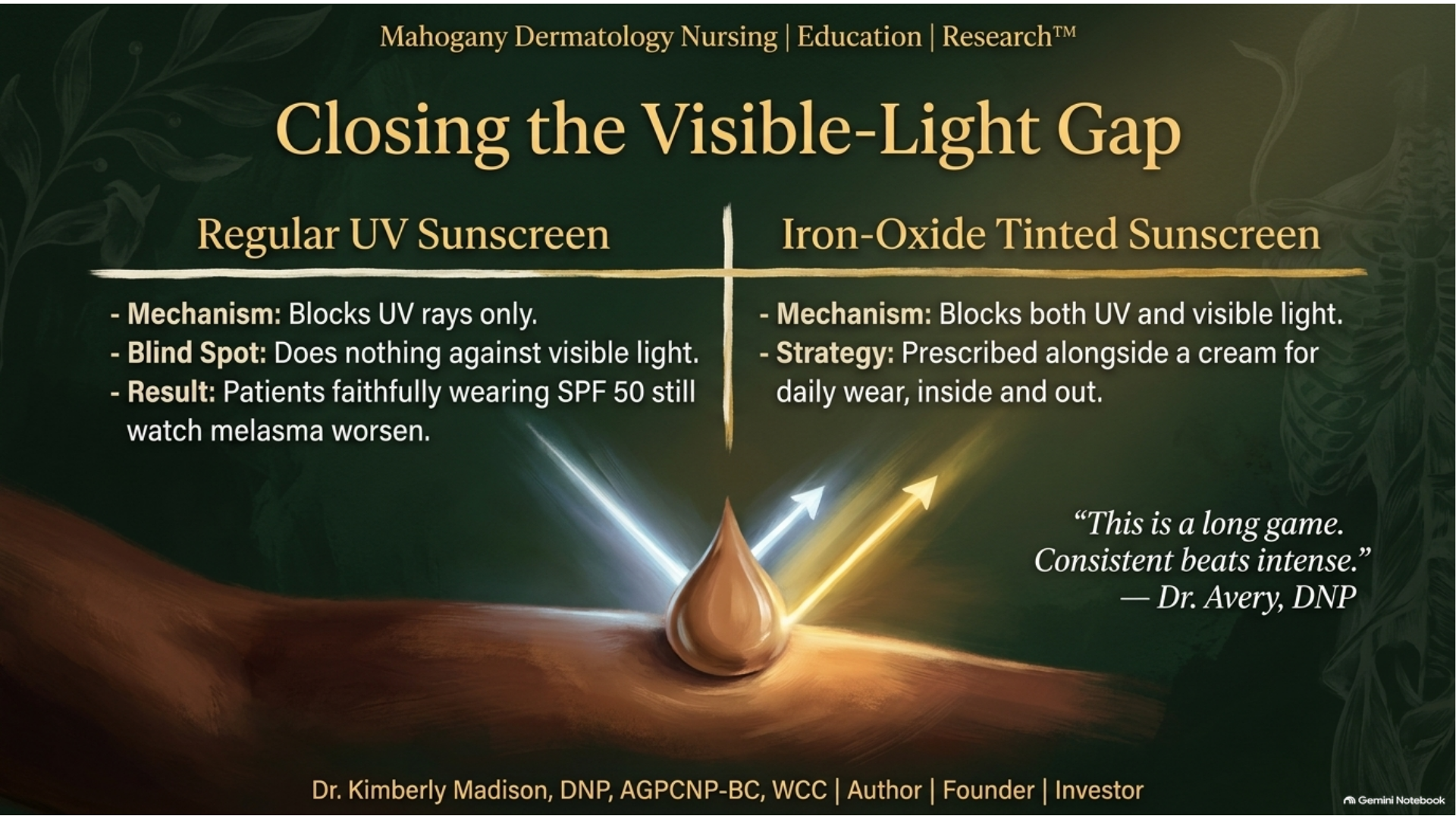
"It's melasma," Dr. Avery, DNP told her, after asking how she was doing and actually waiting for the answer. "Very common, and it tends to show up more in deeper skin tones because the pigment-making cells in your skin, your melanocytes, respond to two triggers at once. Hormones. And light, including the visible kind, not just UV. That's the part most sunscreen labels don't tell you. Regular sunscreen blocks UV. It does nothing against visible light, which is why patients wearing SPF 50 faithfully still watch this get worse. A tinted sunscreen with iron oxide in it blocks both. That's what I'm putting you on today, along with a cream, and I want you wearing it every day, not just outside. This is a long game. Consistent beats intense."
The patient nodded slowly, the way people do when something finally makes sense.
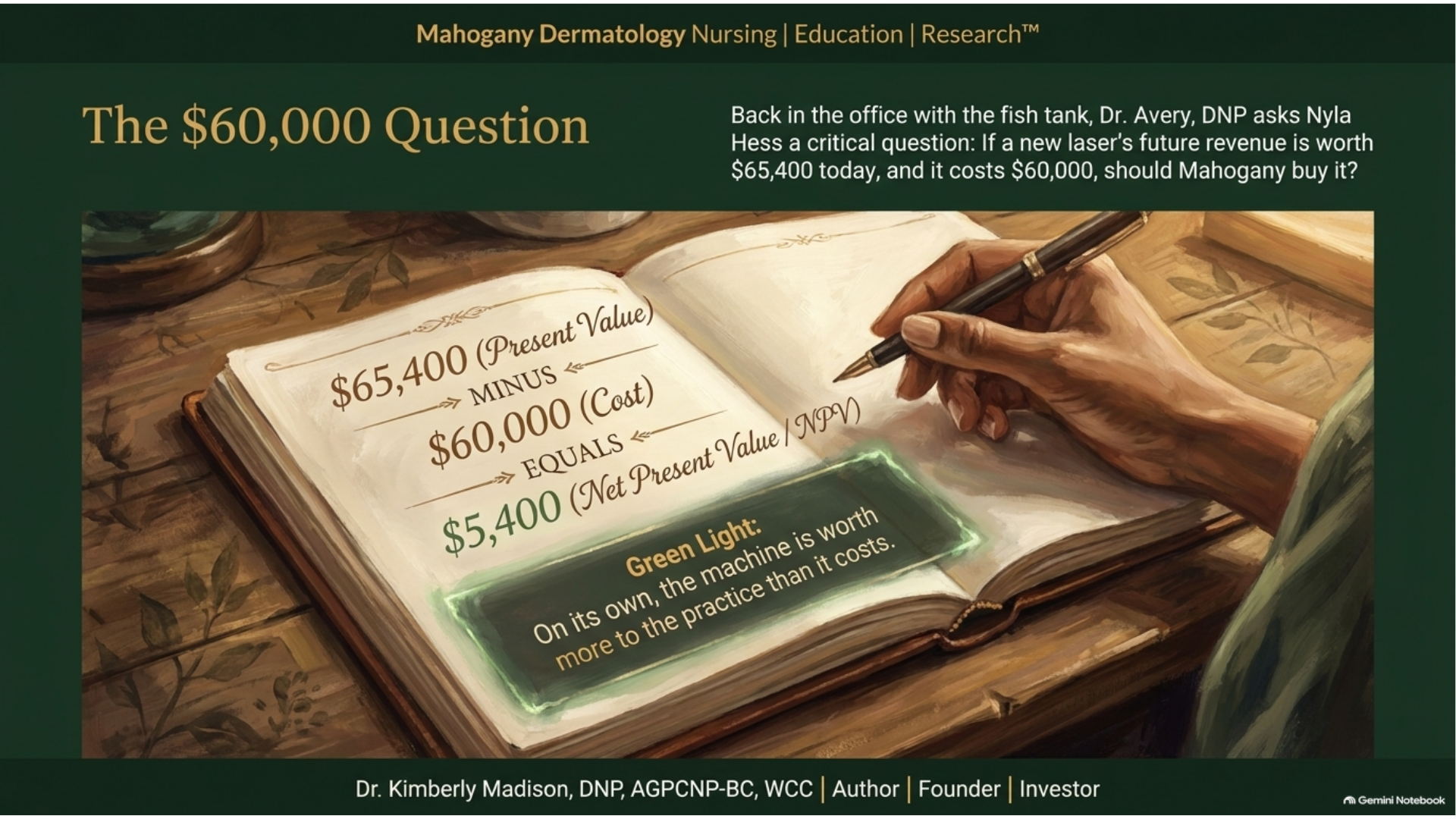
Back in the office with the fish tank, Dr. Avery, DNP closed the door. "Last week I left you with a question. Present value said that laser is worth more to the practice than it costs. Does that mean I should buy it?"
"I've been thinking about it all week," Nyla said. "I don't think 'worth more' is the same as 'should buy it.'"
"Why not?"
"Because there could be something else you could do with that same sixty thousand dollars that's worth even more."
Dr. Avery, DNP smiled. "Now you're asking the actual question. That's called Net Present Value, and here's the full version of it. You don't just check whether the future money is worth more than the cost. You subtract the cost from that present value and see what's left over. Last week we found the laser's future revenue was worth about sixty-five thousand four hundred dollars today. Subtract the sixty thousand it costs, and the laser has a net present value of about five thousand four hundred dollars. Positive. That's a green light, on its own."
"So it is worth buying."
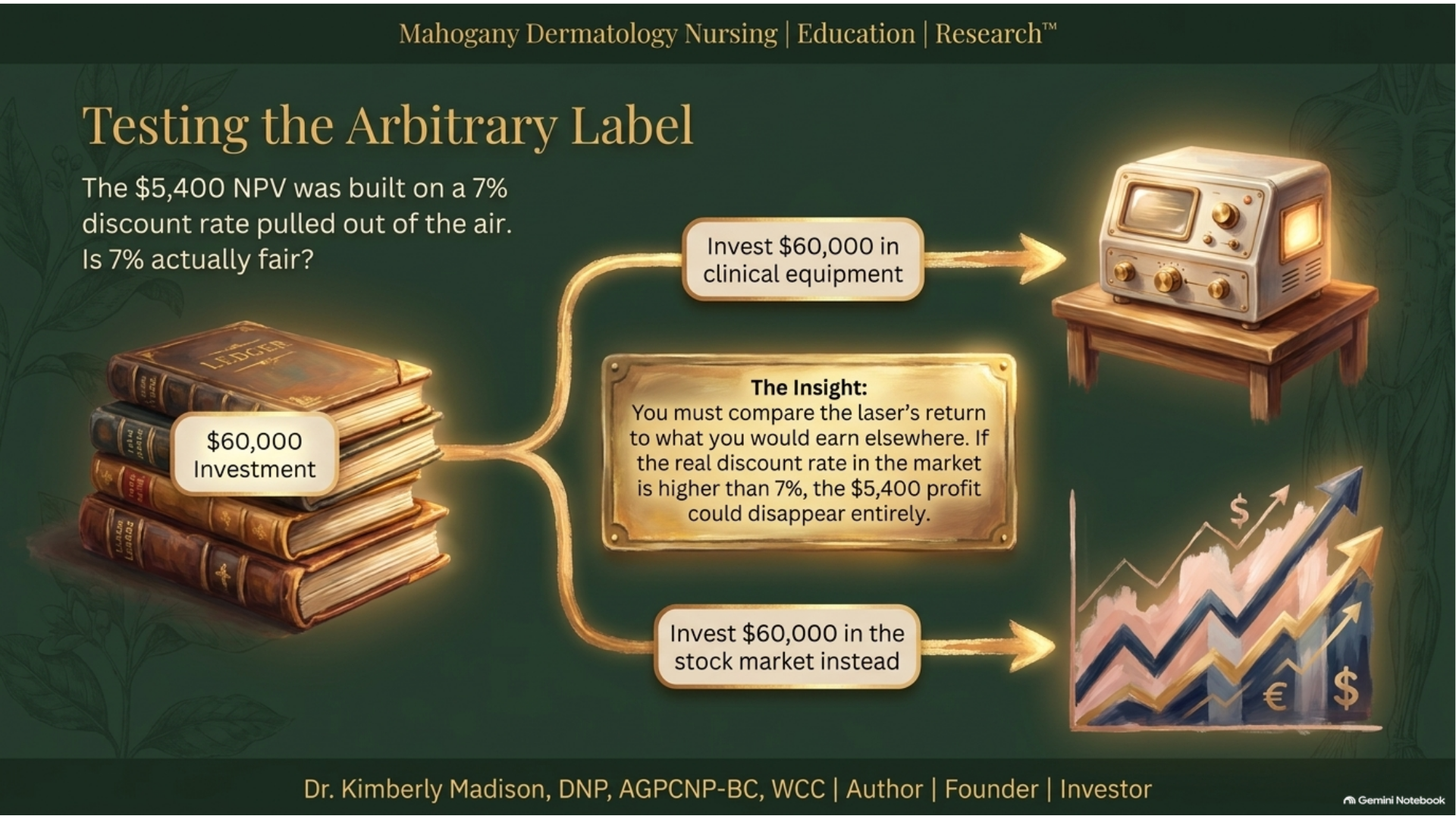
"Maybe. But I built that number on a discount rate of seven percent, and I picked that number out of the air last week. I need to know if seven percent is actually fair, because if the real number is higher, that five thousand four hundred dollars could disappear or go negative."
"Fair compared to what?"
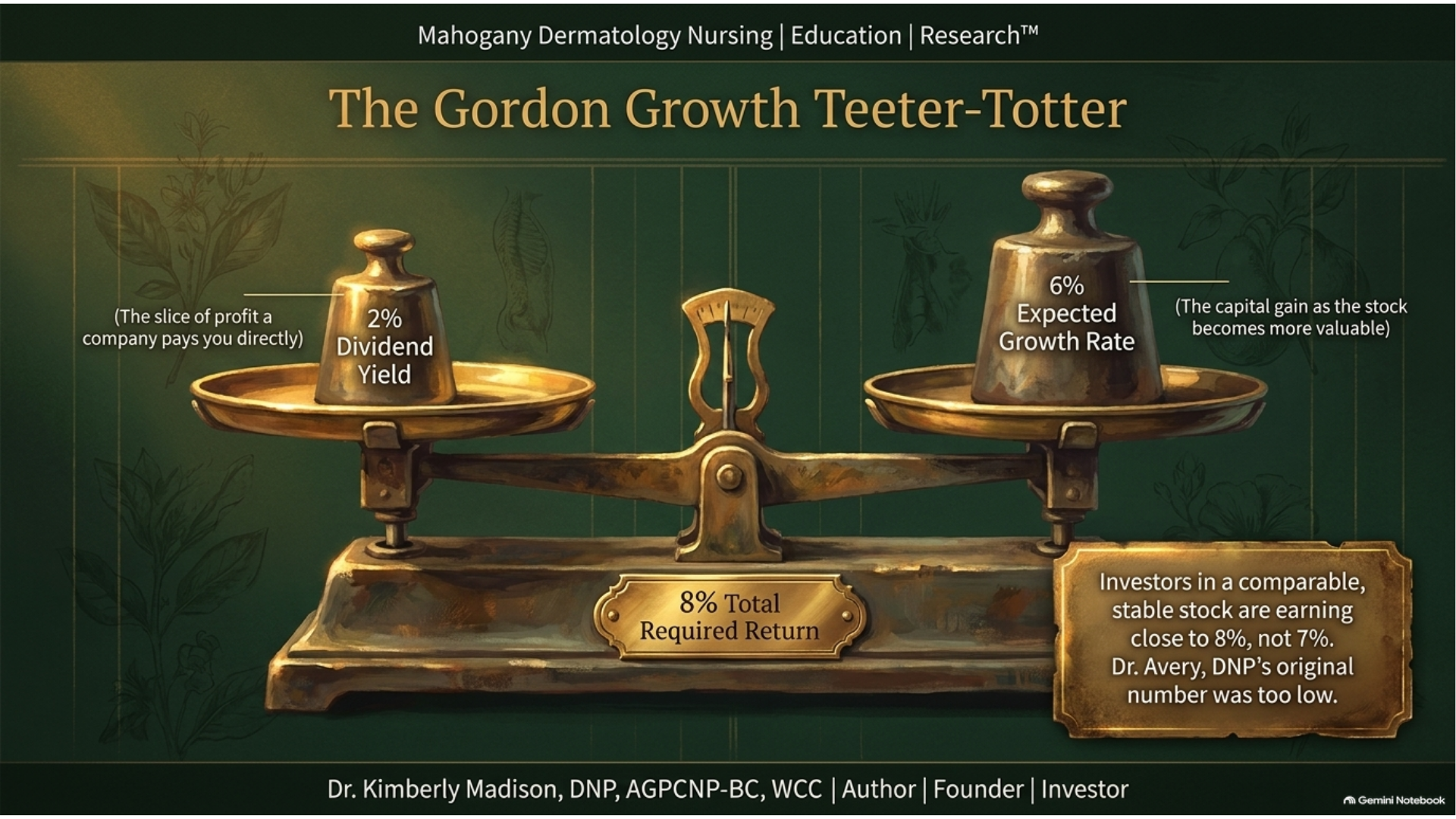
"Compared to what I'd earn putting that same sixty thousand into the stock market instead. That's called the opportunity cost of capital, and here's how investors actually think about it. When you own a share of a company, you make money two ways. The company pays you a slice of its profit directly, called a dividend. And the stock itself can become more valuable over time, which is a capital gain if you sell it higher than you bought it. Add the percentage you get from the dividend to the percentage the stock is expected to grow, and that total is close to what investors are demanding as their return for the risk."
Nyla wrote it down. "Dividend plus growth."
"There's actually a formula built on exactly that idea," Dr. Avery, DNP said. "It's called the Gordon Growth Model, and it says the price of a steady, stable stock equals next year's dividend divided by the difference between the investor's required return and the growth rate. You almost never need to solve it forward for a dermatology practice, but you use it backward, the way I just did. If a comparable stock pays a two percent dividend yield and is expected to grow around six percent a year, investors in that stock are earning close to eight percent, not seven."
"So your original number was too low."
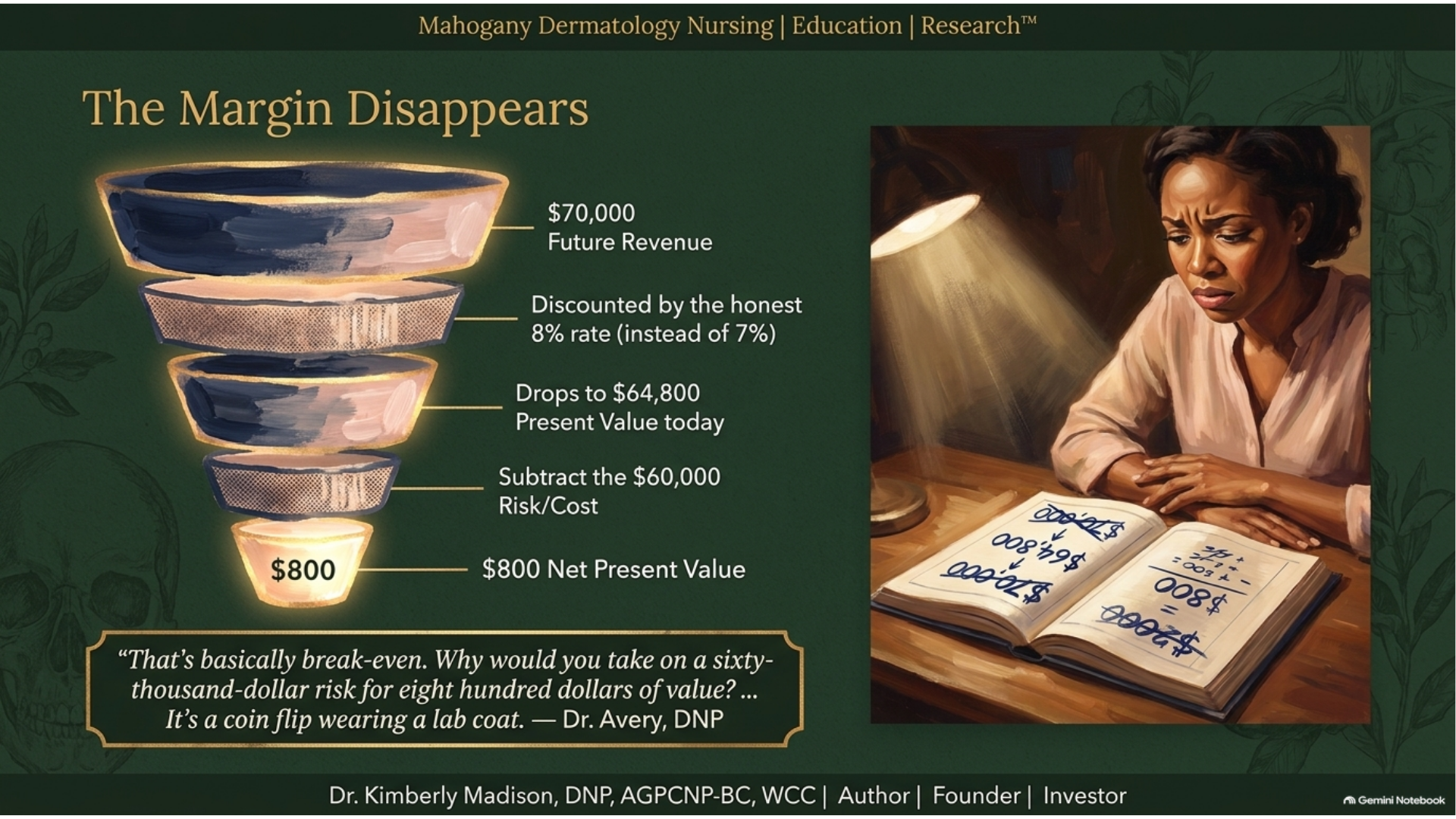
"It was. Redo the math with eight percent instead of seven, and that seventy thousand dollars next year is worth about sixty-four thousand eight hundred today, not sixty-five four. Subtract the sixty thousand cost, and the net present value drops to about eight hundred dollars. Still positive. But barely. The margin I thought I had mostly disappeared the moment I used an honest discount rate."
Nyla frowned at her own math. "That's basically break-even. Why would you take on a sixty-thousand-dollar risk for eight hundred dollars of value?"
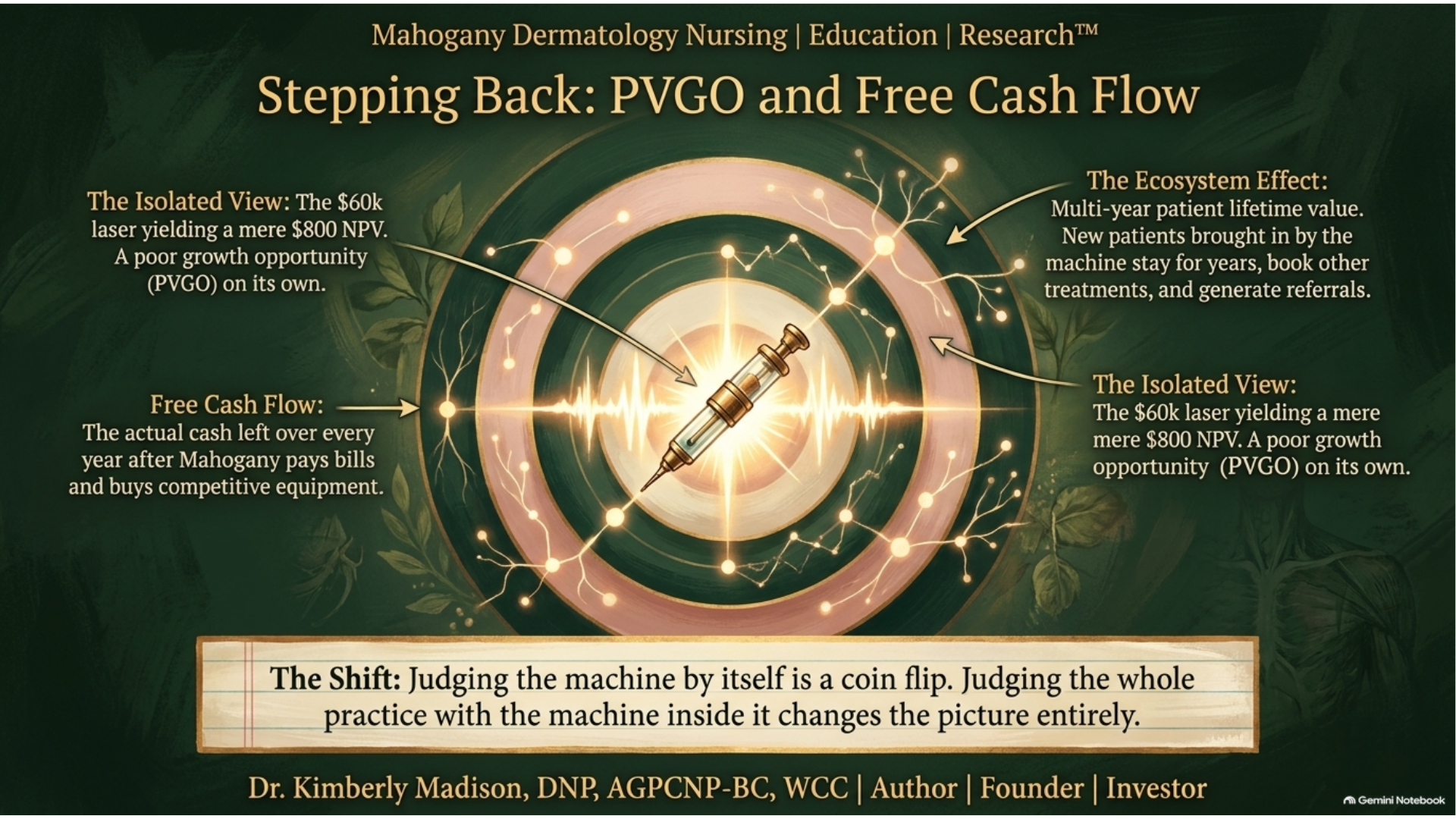
That's the real question sitting underneath all of this," Dr. Avery, DNP said. "And it's not just about this one machine anymore. There's a concept called PVGO, the present value of growth opportunities. It says a company's stock price is really two things stacked together. The value of what it already earns, forever, as is. Plus the extra value created by whatever smart new projects it chooses to fund with the profit it doesn't pay out. A laser that barely breaks even on its own numbers isn't a smart growth opportunity. It's a coin flip wearing a lab coat."
"So don't buy it."
"Not necessarily. Because there's a bigger version of this same math I haven't shown you yet, and it changes the picture. Instead of judging one machine by itself, you can judge the whole practice. That's called Free Cash Flow, and it's the actual cash left over every year after Mahogany pays its bills and buys whatever equipment it needs to stay competitive. If I look at Mahogany's free cash flow over the next several years, including this laser as one expense inside that bigger flow, and discount all of it back to today the same way, sometimes a single purchase that barely breaks even on its own turns out to matter a lot more once you see how it strengthens everything else the practice earns around it. New patients this machine brings in don't just pay for the laser. Some of them stay for years, for other treatments, for referrals."
Nyla sat back. "So the machine by itself looks like a coin flip. But the whole practice with the machine in it might not."
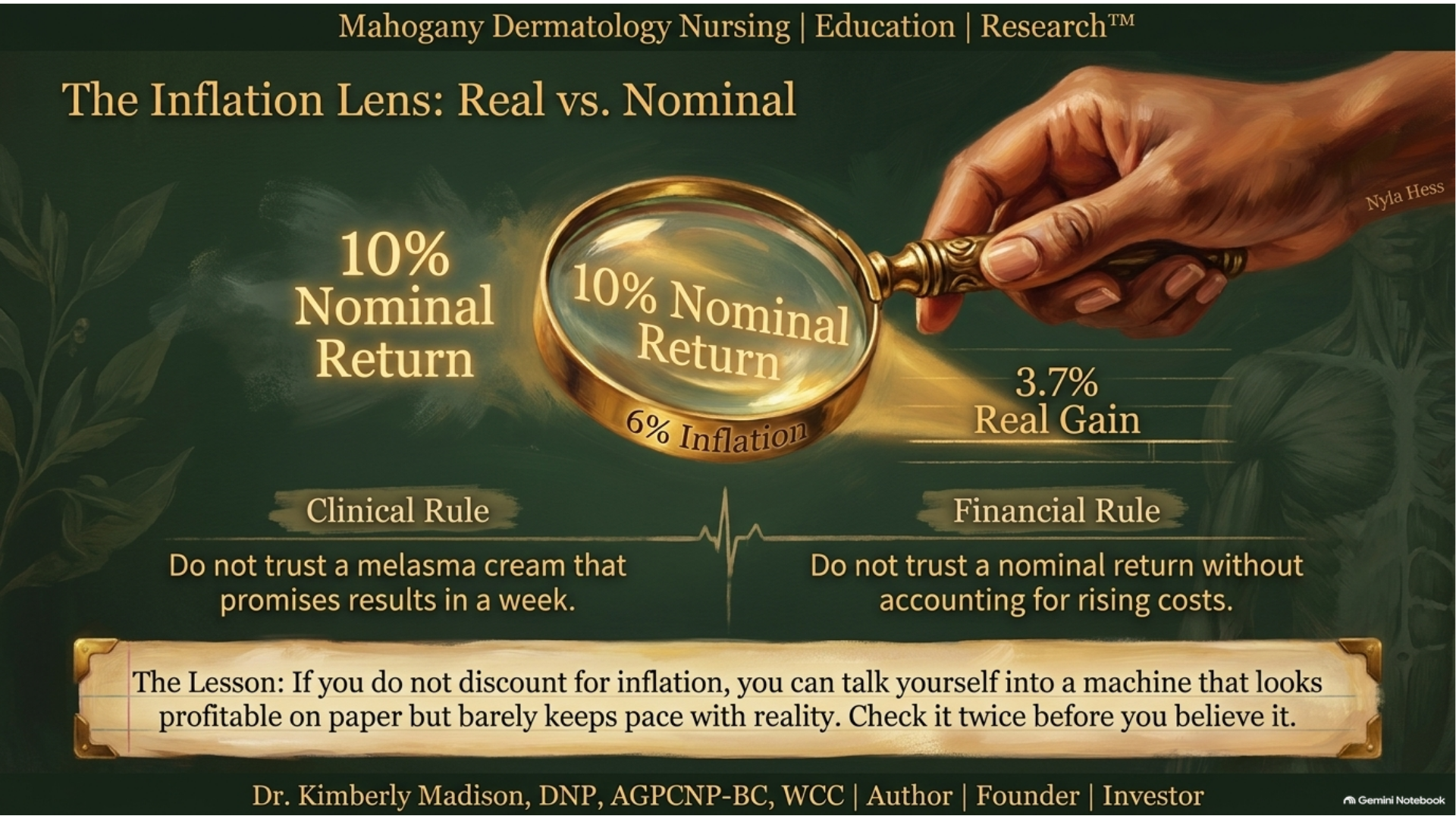
"That's exactly the shift," Dr. Avery, DNP said. "Which is why serious decisions never rest on one number in isolation. There's one more piece before I decide. All of these numbers, the seventy thousand, the eight percent, all of it, are in today's dollars without accounting for inflation. If my return ends up being ten percent but inflation runs at six percent that year, my real gain, what I can actually buy with that money, is only about three point seven percent. Not ten. If I don't check that, I can talk myself into a machine that looks profitable on paper and barely keeps pace with rising costs in real life."
"So you have to check it against inflation too."
"Every time. It's the same discipline as telling a melasma patient not to trust a cream that promises results in a week. If a number looks impressive fast, check it twice before you believe it."
Nyla looked at her notes, four separate numbers circled on one page. "So what's the actual decision?"
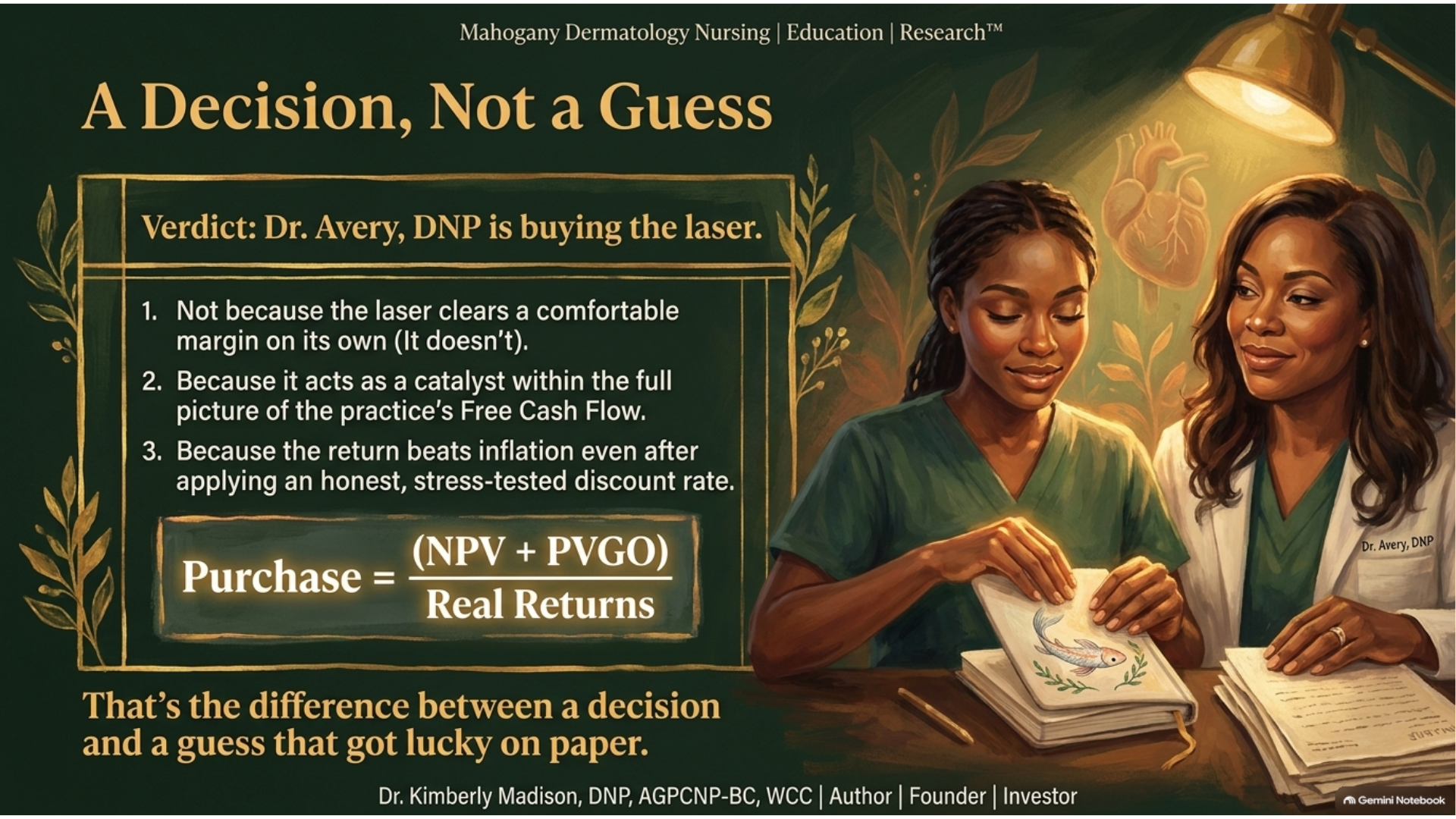
"The actual decision," Dr. Avery, DNP said, "is that I'm going to buy it. Not because the laser alone clears a comfortable margin. It doesn't. But because once I looked at it inside the full picture of the practice's cash flow, and confirmed my return still beats inflation after being honest about the real discount rate, the numbers held up under every test I threw at them instead of only surviving the first one. That's the difference between a decision and a guess that got lucky on paper."
Nyla closed her notebook. "That was a lot more than present value."
"It was the whole toolkit," Dr. Avery, DNP said. "You don't need to memorize every formula today. I need you to remember the habit. Check the discount rate. Check it against the whole picture, not just one piece. Check it against inflation. Then decide."
Behind this chapter: The finance arc in this chapter draws on foundational corporate finance concepts from Brealey and Myers' Principles of Corporate Finance — net present value, the opportunity cost of capital, the Gordon Growth Model, present value of growth opportunities, free cash flow, and real versus nominal returns — applied here to a $60,000 clinical equipment decision rather than a public stock, in keeping with this year's whitepaper,Financial Literacy as a Clinical Competency. The tinted sunscreen guidance reflects Dr. Kimberly Madison's, DNP, published work on visible light and hyperpigmentation in skin of color patients. The broader clinical framing is grounded inThe State of Nursing Education: Pathways, Purpose, and the Future of Cosmetic & Dermatology Practice, and the mentorship model comes from Dr. Madison's book,Nursing Aesthetics: An Introductory Guide for Nurse Practitioners & Entrepreneurs.
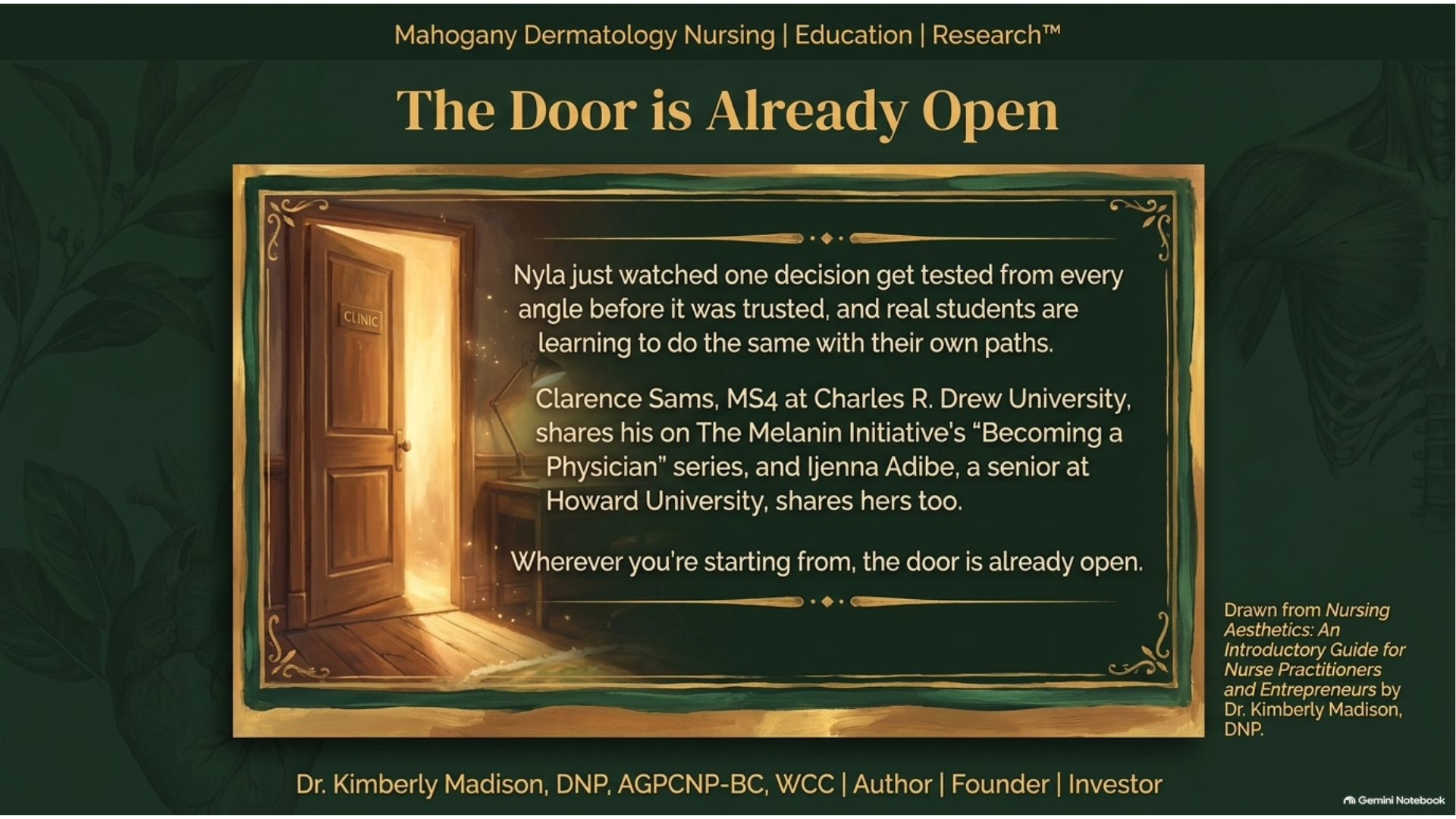
Nyla just watched one decision get tested from every angle before it was trusted, and real students are learning to do the same with their own paths. Clarence Sams, MS4 at Charles R. Drew University, shares his on The Melanin Initiative's "Becoming a Physician" series, and Ijenna Adibe, a senior at Howard University, shares hers too. Wherever you're starting from, the door is already open.
Dr. Kimberly Madison, DNP, AGPCNP-BC, WCC is a Board-Certified, Doctorally-prepared Nurse Practitioner, educator, researcher, and author dedicated to advancing dermatology nursing education with an emphasis on skin of color, business acumen, and digital literacy. She is the founder of Mahogany Dermatology Nursing | Education | Research™ and the Alliance of Cosmetic Nurse Practitioners™, the first dermatology nursing organization in the country built at the intersection of clinical excellence, skin of color care, and financial literacy for nurses. A selected participant in the Harvard Business School Foundry Bootcamp, Dr. Madison continues to sharpen the entrepreneurial infrastructure behind her mission. Through peer-reviewed research, published books, and a growing community of nurse entrepreneurs, Dr. Madison is building the infrastructure that makes this profession sustainable for the people who choose it.
.svg)

.svg)
.svg)