I help healthcare entrepreneurs identify and leverage their intellectual property to make more money without seeing more patients, because truth be told, we're all looking for financial freedom. The problem? We have a stack of certifications, but not a stack of cash. We are high-revenue generators, but still live paycheck to paycheck, have multiple jobs, are sleep-deprived, and working in toxic work environments where you're crying in the car before you clock in. Getting another degree, moving cities, and changing specialties didn't lead to the happiness you thought it would. There's nothing wrong with the profession; you just failed to see that all this time you were working for a job. Jobs are work. If you want real financial freedom, you need multiple streams of income, not multiple jobs. You need help, you can't do it alone. You need faith to believe there is a better way, because there is. In this article, I share the details of Nvidia's Q2 Earnings Report which reveals opportunities for healthcare professionals, entrepreneurs, and investors - using what you already know and where you're already located. This particular version was written for my cohort in the Harvard Business School Foundry. After receiving such positive feedback, I decided to share it with you so you can get a glimpse of what I'm working on while I'm working on it. That's been the theme of my online presence, sharing my journey as a living case study in the hopes that when business courses become part of nursing standard curriculum, students will study our strategies, evaluate what we did well, and where we could have done better so that you can do more, faster than we were able to in this lifetime. In the next article, I speak directly to opportunities in dermatology and aesthetics.
Infrastructure Intelligence Brief · Prepared for the Harvard Business School Foundry Cohort
Reading Nvidia Like an Entrepreneur
Primary-Source Findings from the Q2 FY2027 Earnings Call, for Health-Tech Founders and Builders
Who Nvidia Is and Why This Call Matters
Nvidia makes the computer chips that power artificial intelligence. When a company builds an AI tool, that tool has to run on physical hardware somewhere, usually inside a data center, and Nvidia's chips are the hardware most of the AI industry runs on. That makes Nvidia less like a typical technology company and more like the electrical grid underneath the AI industry. If Nvidia's chips get faster or cheaper, everything built on top of them changes with it.
Four times a year, Nvidia holds an earnings call where its executives report results to investors and answer questions live. This brief comes from the actual transcript of the Q2 fiscal year 2027 call, held August 26, 2026. Reading the transcript directly surfaced details that did not make it into press coverage.
What's New Since the Q2 Call
On this call, Nvidia's Chief Financial Officer, Colette Kress, and its CEO, Jensen Huang, updated a figure they use to describe how much financial value their hardware generates for a fixed amount of electricity. They also confirmed a production milestone in an existing partnership with a chip company called Groq. Both details are pulled directly from the transcript.
Part One: The Numbers, Straight From the Transcript
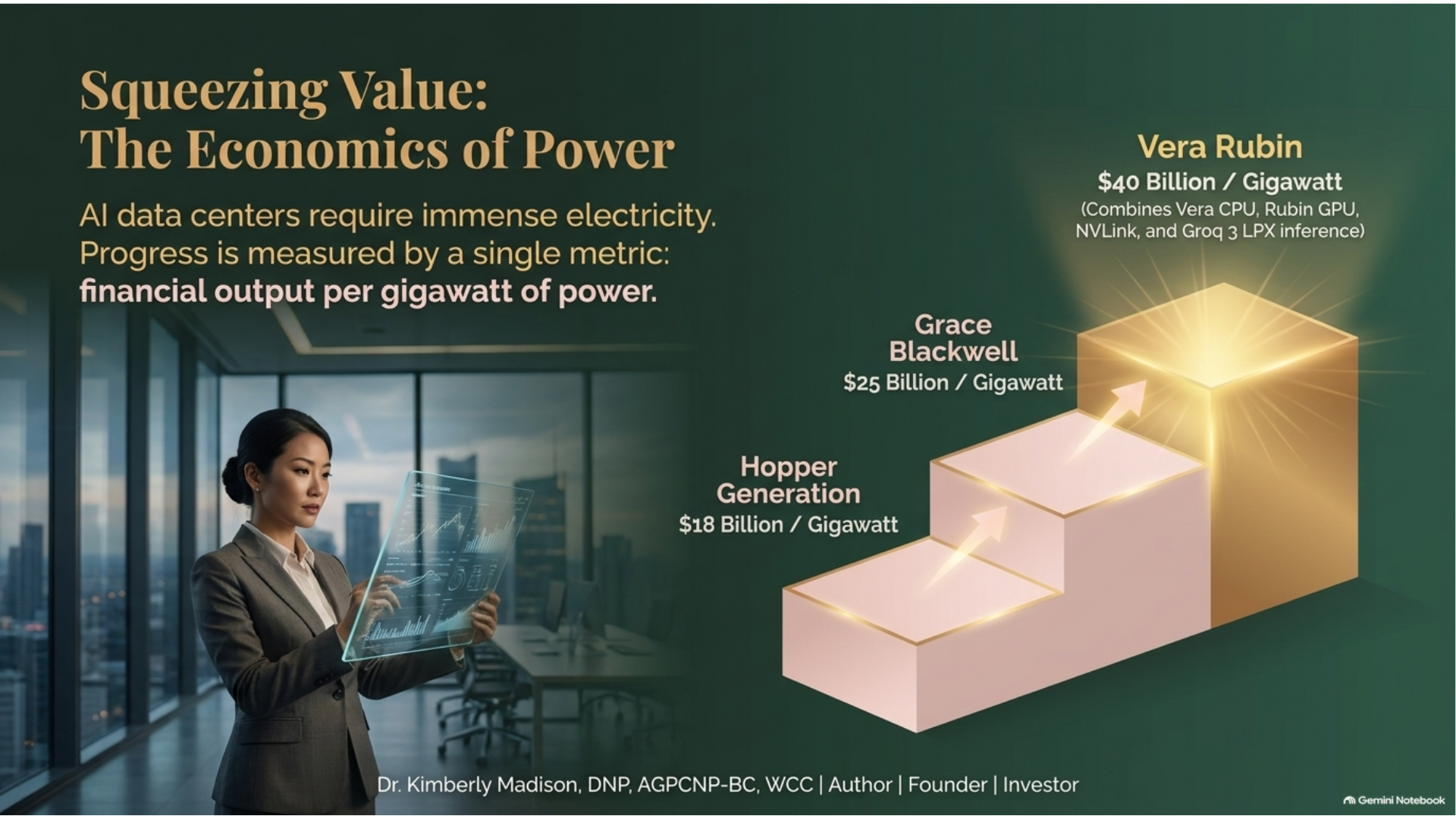
A gigawatt is a unit of electrical power. One gigawatt is roughly enough electricity to power around 750,000 homes at once. Nvidia uses this unit because building and running an AI data center takes an enormous amount of electricity, so the company measures its own progress by how much financial value it can squeeze out of each gigawatt of power its chips use.
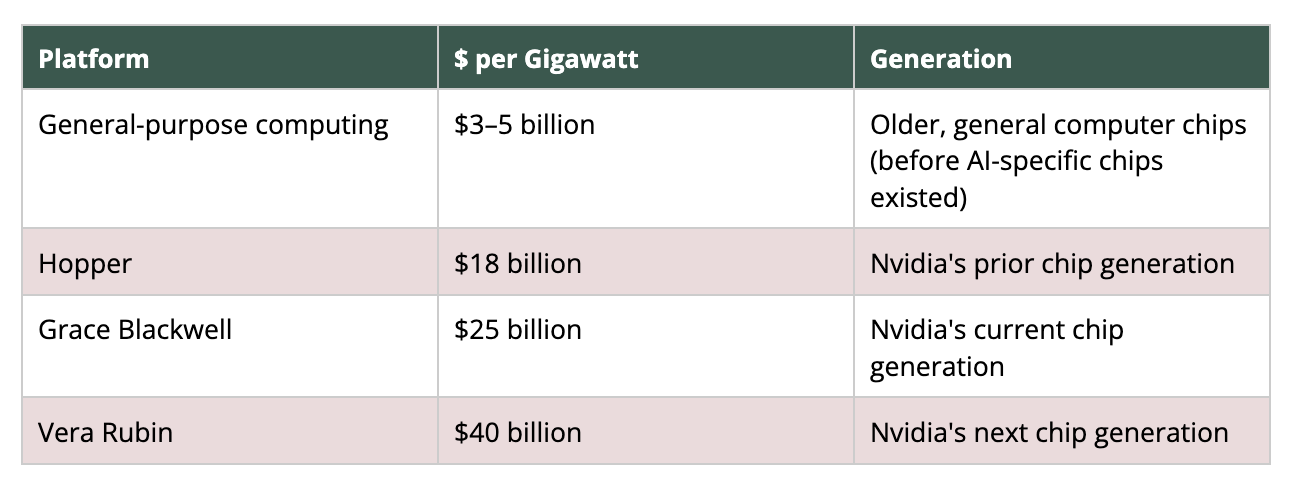
Colette Kress laid out that value across four generations of Nvidia hardware. Each new generation of chips does more work for the same amount of electricity.
In her opening remarks, Colette Kress confirmed this same jump from $18 billion, to $25 billion, to $40 billion of value per gigawatt. She said the $40 billion figure for Vera Rubin comes from several pieces of hardware working together, not the chip alone: a new processor called Vera, a new graphics chip called Rubin, a connector technology called NVLink, a networking technology called InfiniBand or Ethernet, and Groq, the inference chip company Nvidia struck a licensing deal with in December 2025. Jensen Huang repeated this same progression twice during the question and answer portion of the call, and added that the number keeps climbing after Vera Rubin too.
Source: Colette Kress and Jensen Huang, Nvidia Q2 FY2027 earnings call transcript, August 26, 2026, pages 4, 9, and 15.
What each new term means
CPU and GPU: a CPU is the main processor in a computer, handling general tasks. A GPU is a different kind of chip, originally built for video game graphics, that turns out to be very good at the math behind AI. Nvidia's business is built on GPUs.
Vera Rubin: the name of Nvidia's next generation of hardware, pairing a new CPU called Vera with a new GPU called Rubin. Together, this is the platform projected to generate $40 billion of value per gigawatt.
NVLink: a technology Nvidia built to connect many GPUs together so they can work as one large system instead of many separate chips. It works only with Nvidia's own hardware, which is a major reason competitors have a hard time catching up.
Groq: an AI chip company that built a fast inference chip called the LPU, short for Language Processing Unit. Nvidia struck a $20 billion licensing deal with Groq in December 2025, gaining rights to Groq's chip technology and hiring Groq's founder, Jonathan Ross, along with much of its engineering team. Groq continues to operate as an independent company under new leadership. The chip that came out of this deal, called the Groq 3 LPX, entered full production the same week as this earnings call, eight months after the original deal. Jensen Huang said it is nearly four times faster than the next best option at generating AI text responses in real time.
Part One-B: The Technology Underneath the Money
The dollar figures above only make sense once you understand four things Nvidia actually builds and depends on: the chip hardware itself, the semiconductor manufacturing behind that hardware, the memory chips packed onto it, and the software that makes all of it usable. This is the power, the problem, and the opening, in technical terms.
Hardware: what Nvidia actually designs
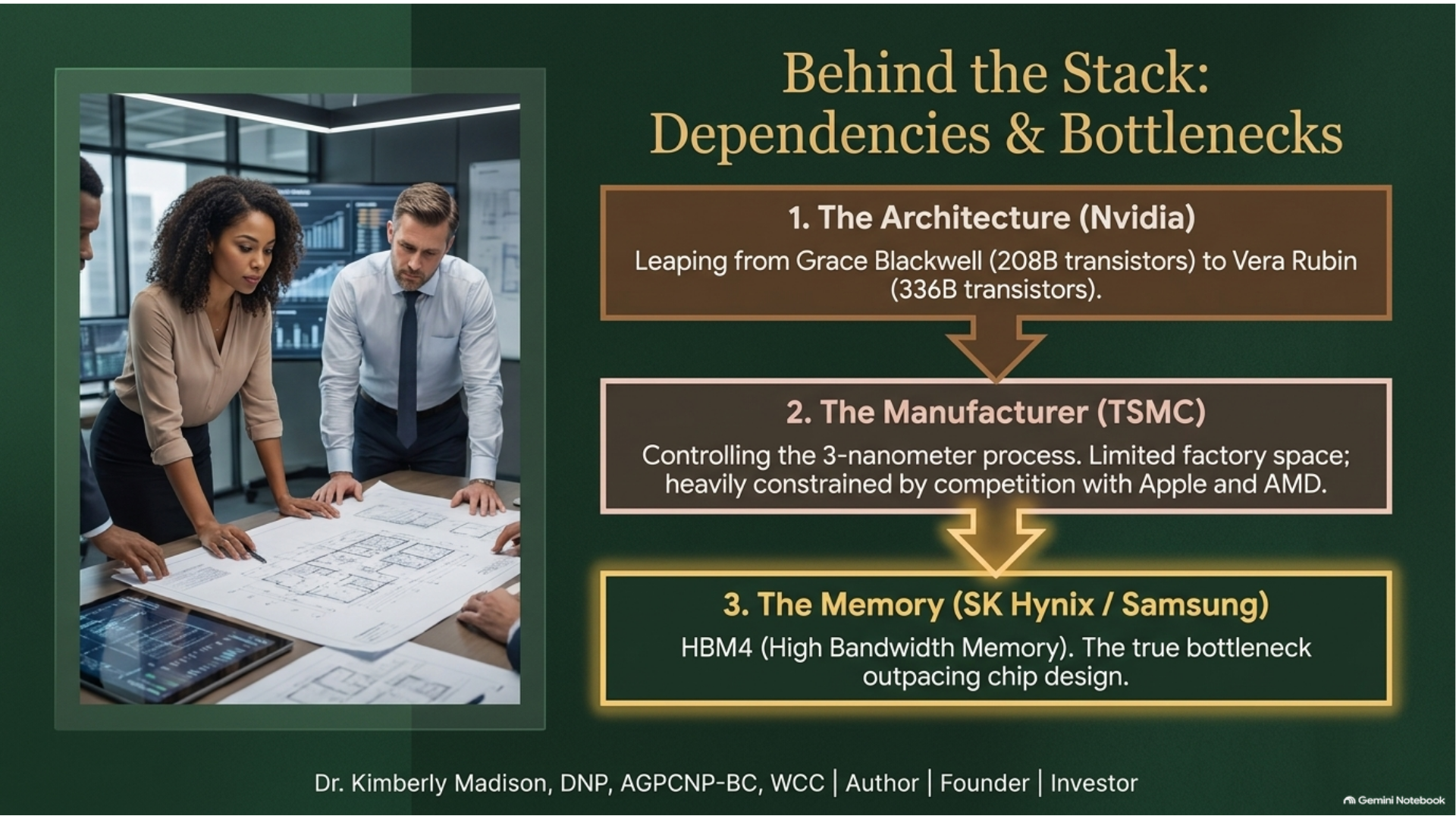
Nvidia does not build one chip. It builds a full system. The current generation, Grace Blackwell, pairs a CPU with a GPU containing roughly 208 billion transistors, tiny electronic switches that are the basic building block of every computer chip. The next generation, Vera Rubin, jumps to a GPU with roughly 336 billion transistors, about 1.6 times more, which is what allows it to run more AI calculations at once. These chips only work as a system because of NVLink, the connector explained above, which lets dozens of these chips act as one machine instead of many separate ones.
Semiconductors: who actually makes the chips
A semiconductor is the physical material, almost always silicon, that a computer chip is built on. Nvidia designs its chips but does not manufacture them. That work is done almost entirely by one company, Taiwan Semiconductor Manufacturing Company, known as TSMC, based in Taiwan. Vera Rubin is being built on TSMC's newest 3-nanometer manufacturing process, meaning the individual features on the chip are measured in billionths of a meter, small enough that more transistors fit onto the same size chip. This is a real dependency to understand: Nvidia's entire roadmap depends on how much manufacturing capacity TSMC can build, and TSMC also manufactures chips for Apple and AMD, so all three companies are competing for the same limited factory space.
Memory: the other bottleneck
A chip that can calculate quickly is only useful if it can also pull data in and out fast enough to keep up, and that is the job of memory chips, not the main processor. Nvidia's newest chips use a type of memory called HBM4, short for High Bandwidth Memory, generation four. Nvidia does not make this memory either. It is built by two companies, SK Hynix and Samsung, both based in South Korea. Reporting from earlier in 2026 describes memory supply, not chip design, as the tighter bottleneck in the entire AI buildout, since demand for HBM4 is outpacing how fast these two companies can produce it at reliable quality. This is the same memory chip story behind the semiconductor stock conversations happening in investment communities right now.
Software: the part that is hardest to copy
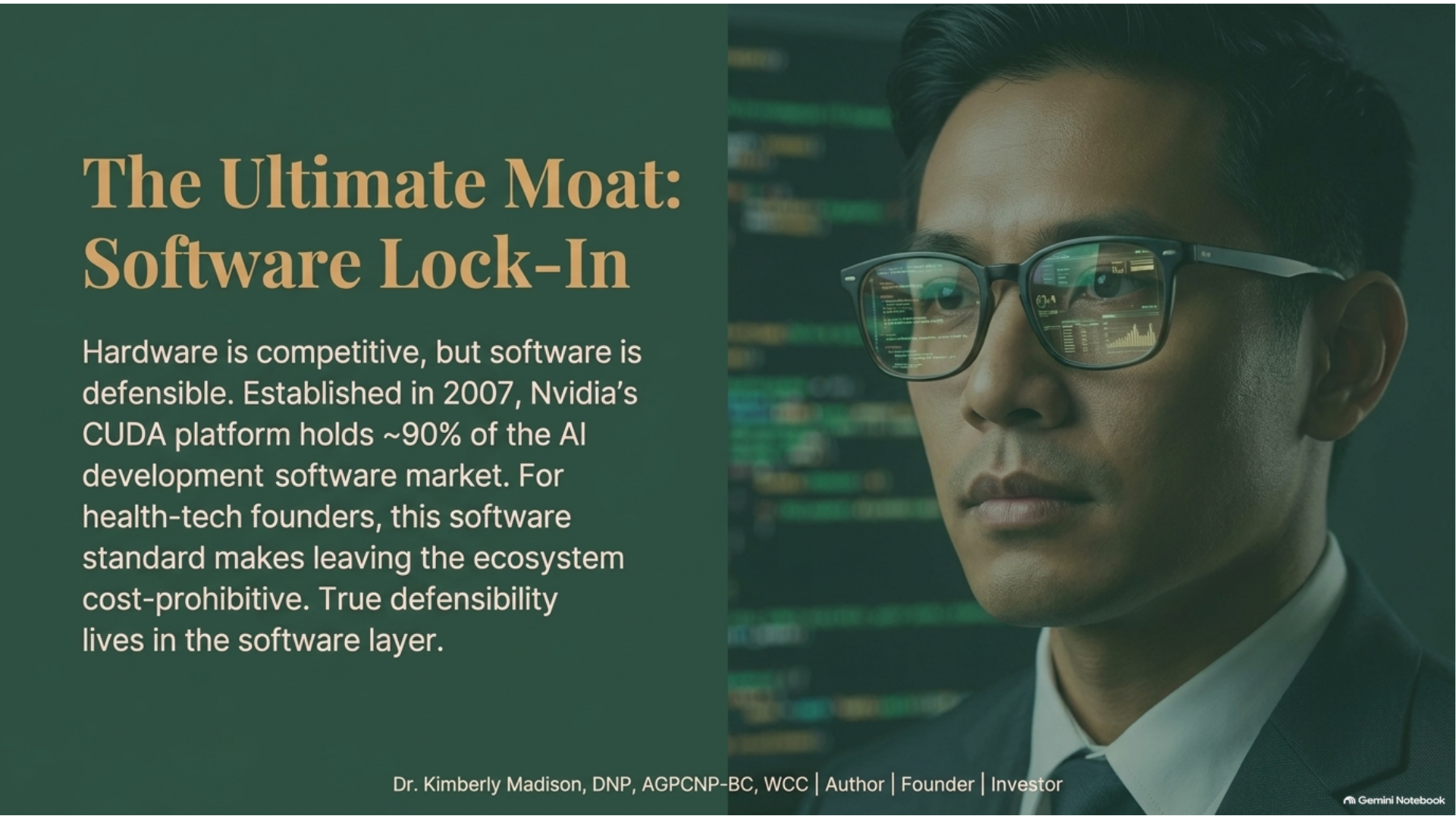
Hardware specifications are not what makes Nvidia difficult to compete with. Software is. Nvidia built a programming platform called CUDA starting in 2007, long before AI was a mainstream business, and it is now the default language nearly every AI developer uses to make a chip actually do useful work. Multiple industry sources estimate CUDA holds somewhere around ninety percent of the AI development software market. Competitors like AMD have built chips that are competitive on paper, but developers who have spent years building on CUDA face a real cost to switch, since production code, libraries, and trained staff are all built around it. This software lock-in, not the chip itself, is the part of Nvidia's business that is hardest for any competitor to replace.
Note: the CUDA market share figure and the framing of memory as the tighter bottleneck are drawn from industry reporting and analysis, not a single confirmed dataset. Treat both as directionally accurate rather than precise before citing them publicly.
Why this matters for anyone building on top of Nvidia
Every founder in this room building a health-tech product that uses AI is, whether they realize it or not, standing on four dependencies: a chip design controlled by one company, manufacturing controlled by one other company, memory controlled by two more, and a software standard that is expensive to leave once you have built on it. None of that is a reason to avoid building AI tools. It is a reason to know exactly which layer of that stack any new business idea actually depends on, since that dependency shapes cost, risk, and how defensible the business becomes over time.
Part Two: Where We Already Benefit
Nvidia is not simply a chip seller to healthcare. It is the infrastructure underneath the AI systems pharmaceutical companies are now racing to build. In October 2025, Eli Lilly announced it was building the most powerful supercomputer ever owned by a pharmaceutical company, using Nvidia hardware. In January 2026, Lilly and Nvidia went further, committing up to $1 billion over five years to a shared research lab built on Nvidia's AI platform for drug discovery, called BioNeMo. In March 2026, Roche answered through its Genentech division with an even bigger system, using more than 3,500 Nvidia GPUs, the largest computing buildout any pharmaceutical company had announced at that point.
This is not only a pharmaceutical story. Every app, platform, and clinical tool being built for nurse practitioners, dentists, physical therapists, physicians, and the health systems that employ them will run on infrastructure priced and shaped by exactly this kind of buildout. A health-tech founder building a scheduling tool, a diagnostic aid, or a documentation product is choosing, whether they realize it or not, to build on top of Nvidia's economics. That is the direct benefit sitting in this room. It is also exactly the kind of technology fluency OneStadium was built to put in front of healthcare business owners, since knowing how the infrastructure works underneath your own product is part of running that business well.
Part Three: The Problem Next to the Benefit
A company's hardware is only half the story. Every AI data center Nvidia's chips power also needs a massive, steady supply of electricity and water for cooling, and most people are not paying attention to that side of the business.
The overlooked thirty percent
A hyperscaler is one of the small number of giant technology companies, meaning Amazon, Microsoft, and Google, that build and run most of the world's largest data centers. Most news coverage of this AI buildout focuses only on these three companies. Industry estimates put hyperscalers at roughly seventy percent of all data center capacity, which leaves an estimated thirty percent spread across other, less visible players. Those players include colocation operators, companies like Equinix and Digital Realty that build data center space and rent it out to many different businesses, enterprise data centers run privately by hospitals and banks, and smaller AI cloud companies like CoreWeave that rent out computing power specifically for AI. This thirty percent gets far less attention and far less safety oversight.
The water and cooling angle
Data centers use large amounts of water to keep their servers cool. Right now, there is no standard, agreed-upon rule for what a safe level of water use or air quality looks like for the communities and workers near these sites. Someone with real clinical and engineering training could be the person who builds that standard and licenses it to city governments, insurance companies, or the data center operators themselves, all of whom will increasingly need to prove they are not harming the towns they build in.
Note: the exact water-volume and market-share figures above are directional, drawn from industry reporting rather than a single named primary source. Verify against a specific dataset (Uptime Institute, Synergy Research Group, or a named operator disclosure) before citing a precise number publicly.
Where the Opportunities Are
Every founder in this room now has two paths open. The first is building on top of the stack, meaning the AI-powered health-tech products most people are already picturing: documentation tools, diagnostic support, scheduling, patient communication. That path is real, and it will keep growing as this infrastructure gets more productive per gigawatt. The second path is building beside the stack, meaning the businesses that will be needed to keep this physical buildout safe, compliant, and trusted as it scales. That second path has far less competition right now, because most people are still only looking at the first one.
Below are five concrete lanes inside that second path, each matched to the kind of founder in this room who could build in it.
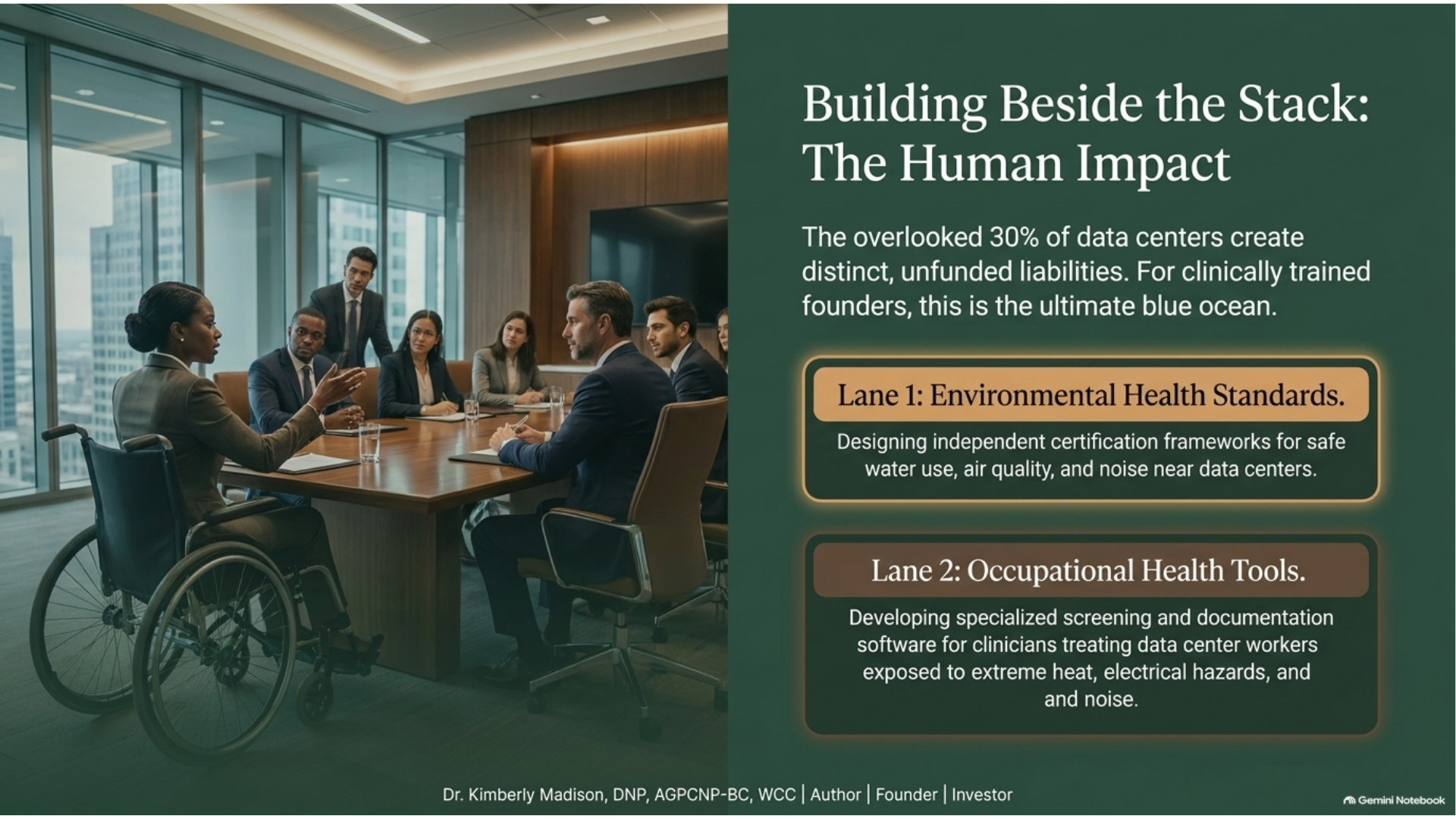
Lane 1: Environmental Health Standards and Certification
The issue: No independent, trusted standard exists yet for what safe water use, air quality, or noise levels look like for communities and workers near a data center.
Why now: This is the same kind of standard-setting opening that created companies like LEED for green building and Energy Star for appliances, except nothing like it exists yet for data center community health.
Business ideas:
Build a certification or scoring framework and license it to data center operators who need to show regulators and neighbors they are safe
Sell the same framework to insurance companies pricing risk on these facilities
License it to city and county governments writing permitting rules for new builds
Lane 2: Occupational Health Tools for Clinicians Who Serve These Workers
The issue: Workers who build and maintain data centers face heat exposure, electrical hazards, and constant noise, and the occupational health clinicians treating them have no data center-specific screening or documentation tool built for this exposure profile.
Why now: Occupational medicine practices and physical therapists already serve construction and industrial worksites, so the clinical relationship exists. What is missing is software built for this specific exposure pattern.
Business ideas:
Build a screening and documentation app for occupational health clinicians who treat data center construction and facilities workers
Package it as a monitoring product staffing and construction firms can require of the clinics they contract with
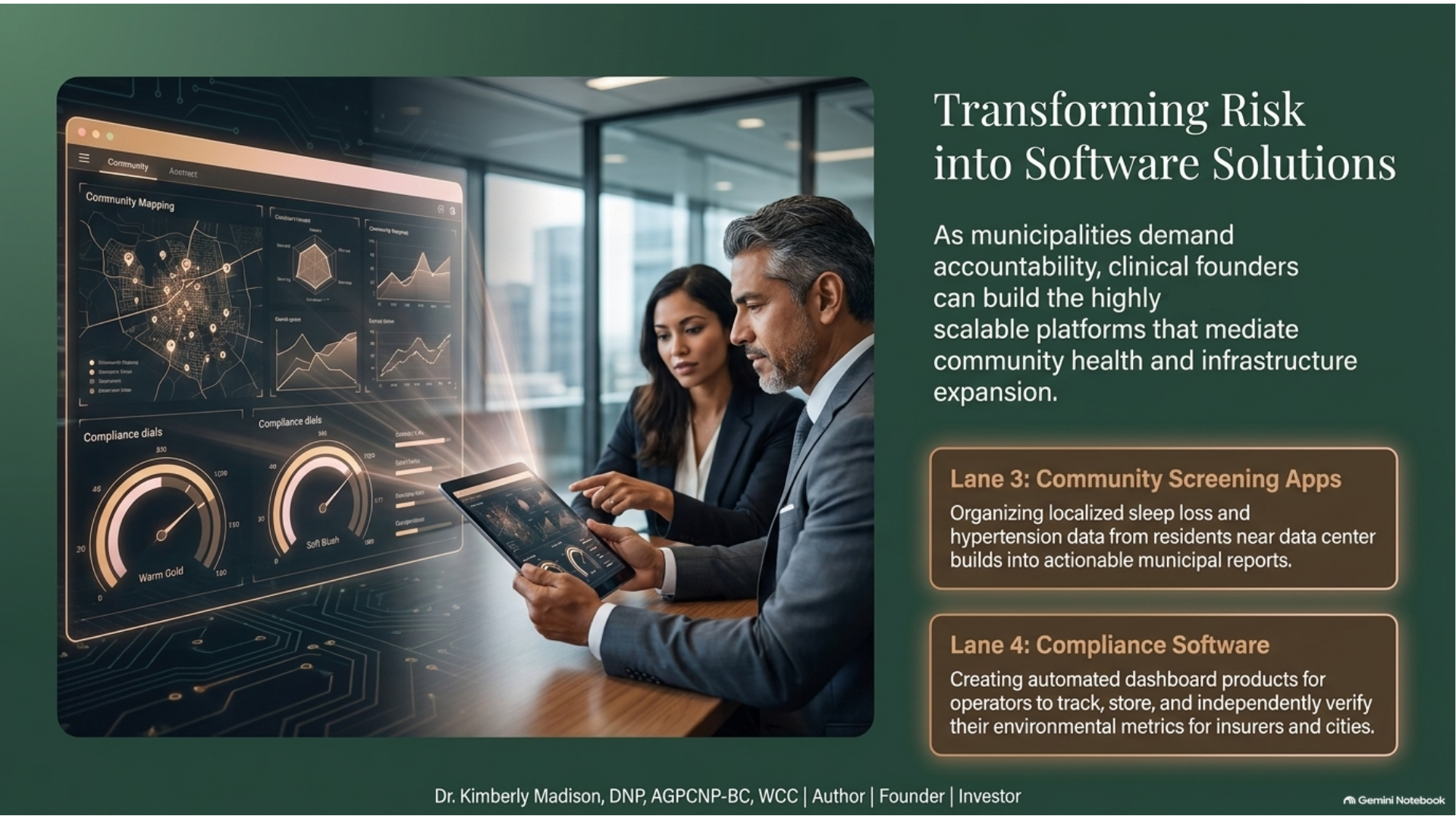
Lane 3: A Health-Tech App for Community Screening
The issue: Residents near new data center builds are reporting sleep loss and higher blood pressure, but no app or platform exists yet to organize screening data from these communities in one place.
Why now: This mirrors mobile health screening models already proven in other underserved settings, built as software instead of a one-time event.
Business ideas:
Build an app that lets local clinics run and track blood pressure and sleep screening for residents near a new build, then export the results into a report
License that same app and its data output to municipalities, who need documentation for permitting hearings
Lane 4: Compliance and Monitoring Software
The issue: Every idea above eventually needs a way to track, store, and report the data being collected, and no dedicated software product for this specific niche exists yet.
Why now: This is a software opportunity sitting directly underneath every other lane in this section, which is often where the largest and most durable business ends up living.
Business ideas:
Build a dashboard product that lets data center operators track and report their own water, air, and noise numbers automatically
Sell the same dashboard to the insurers and city governments who need to verify those numbers independently
Lane 5: Founder Education for Healthcare Business Owners
The issue: Most nurse practitioners, dentists, physical therapists, and other healthcare business owners building or buying health-tech tools have never read a primary source document like an earnings call transcript, and most investment content aimed at them stays surface level.
Why now: This brief itself is proof the audience and the appetite already exist, and it is the exact audience OneStadium is built to serve.
Business ideas:
Build a course or membership teaching healthcare business owners how to read primary financial documents and spot infrastructure-adjacent business openings
Package this same Nvidia case study as a repeatable teaching example for any cohort or classroom
Funding This Work
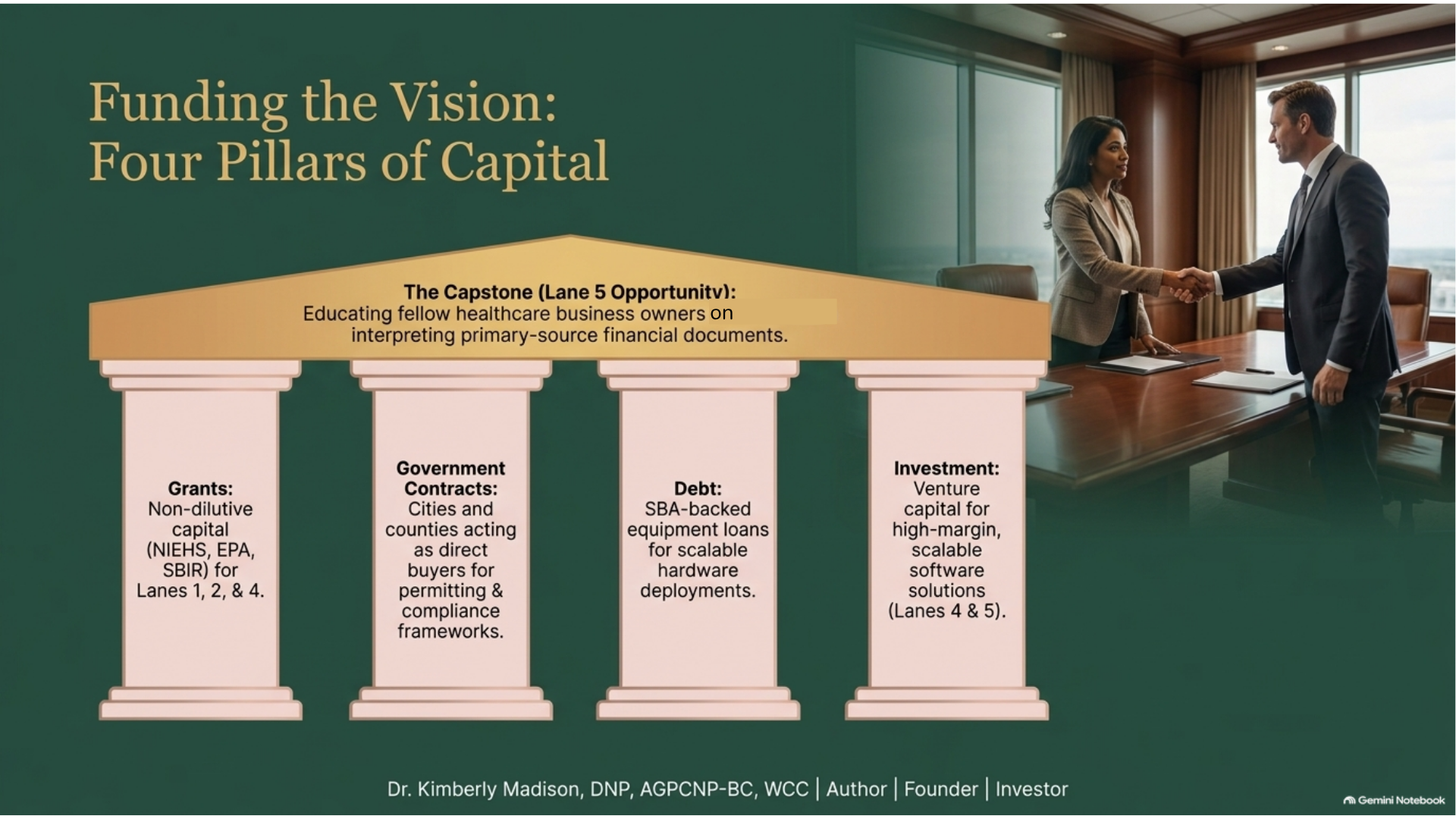
Every lane above can be funded through one or more of four paths: grants, government contracts, debt, and investment. This is the same four-pillar structure OneStadium is built to route healthcare business owners through, so it applies directly here.
Grants: environmental health and occupational safety research is fundable through NIH's environmental health institute (NIEHS), the EPA, and the Department of Energy, all of which fund studies and pilot tools related to industrial site health impacts. A Small Business Innovation Research (SBIR) grant is a strong fit for Lanes 1, 2, and 4, since SBIR funds early-stage technology with a clear commercial path.
Government contracts: city and county governments writing new permitting rules for data centers are a direct customer for Lane 1's certification framework and Lane 4's compliance software, since local government is already the buyer of these services in other industries.
Debt strategies: equipment-heavy ideas, like device or sensor components inside Lane 2's clinical tool, are a fit for an SBA-backed equipment loan once the product has a first paying clinic, rather than raising equity capital for hardware costs.
Investment opportunities: Lane 4's software product and Lane 5's education product are the two most venture-fundable ideas here, since both can scale without matching revenue to headcount the way a services business does.
What's Confirmed, What's Context, and What's a Hypothesis
It matters which parts of this brief you can defend with a source and which parts are a founder's bet. Here is that line, drawn clearly.
Directly confirmed by the earnings call transcript
Nvidia's value-per-gigawatt figures across Hopper, Grace Blackwell, and Vera Rubin, and what the Vera Rubin figure includes
The Groq 3 LPX chip entering full production the week of the call
Nvidia's description of its platform as a full system, not a single chip sale
Industry context that supports the interpretation, not from the transcript itself
TSMC as Nvidia's manufacturing partner, and advanced chip manufacturing capacity being constrained industry-wide
SK Hynix and Samsung as HBM4 memory suppliers, and memory supply being described as a tighter bottleneck than chip design in current reporting
CUDA's estimated share of the AI development software market
The Lilly and Roche AI factory buildout details and dates
Founder hypotheses in this brief that deserve real testing before you build on them
That a viable business exists in certifying or monitoring data center community health, and that operators, insurers, or cities would actually pay for it
That the specific hyperscaler market share estimate (roughly seventy percent) and water-use figures hold up against a named primary dataset
That any of the five lanes above are fundable at the SBIR, government contract, or investment stage without a pilot customer already in hand
Suggested Next Steps
Pick one lane above and spend the next week finding one real person, a data center operator, a city permitting office, a staffing firm, or a clinic that treats these workers, who would pay for it today
Bring the lane you pick to the Foundry cohort as a discussion starter, since more than one founder in this room may be positioned to build the same idea from a different angle, or for a different clinician audience
If a grant path fits your lane, start the SAM.gov registration now, since that step alone can take several weeks before any SBIR application can be submitted
Where This Leaves Us
These new numbers confirm that building an AI factory like Lilly's or Roche's will keep getting cheaper, not more expensive, which means more pharmaceutical and health system players will follow their lead. The open question is not whether this infrastructure keeps expanding. It is who defines the health and safety standard for the communities and workers it expands into, since no one has claimed that role yet.
Primary source: Nvidia Q2 FY2027 earnings call transcript, August 26, 2026. Compiled August 28, 2026 for the Harvard Business School Foundry cohort.
Get to know CEO Jenseng
About the Author
Dr. Kimberly Madison, DNP, AGPCNP-BC, WCC is a Board-Certified, Doctorally-prepared Nurse Practitioner, educator, researcher, and author dedicated to advancing dermatology nursing education with an emphasis on skin of color, business acumen, and digital literacy. She is the founder of Mahogany Dermatology Nursing | Education | Research™ and the Alliance of Cosmetic Nurse Practitioners™, the first dermatology nursing organization in the country built at the intersection of clinical excellence, skin of color care, and financial literacy for nurses. A selected participant in the Harvard Business School Foundry Mindset Bootcamp (2026), Dr. Madison continues to sharpen the entrepreneurial infrastructure behind her mission. Through peer-reviewed research, published books, and a growing community of nurse entrepreneurs, Dr. Madison is building the infrastructure that makes this profession sustainable for the people who choose it.
.svg)

.svg)
.svg)