You Cannot Sit at That Table Yet, And Here Is What Is Missing
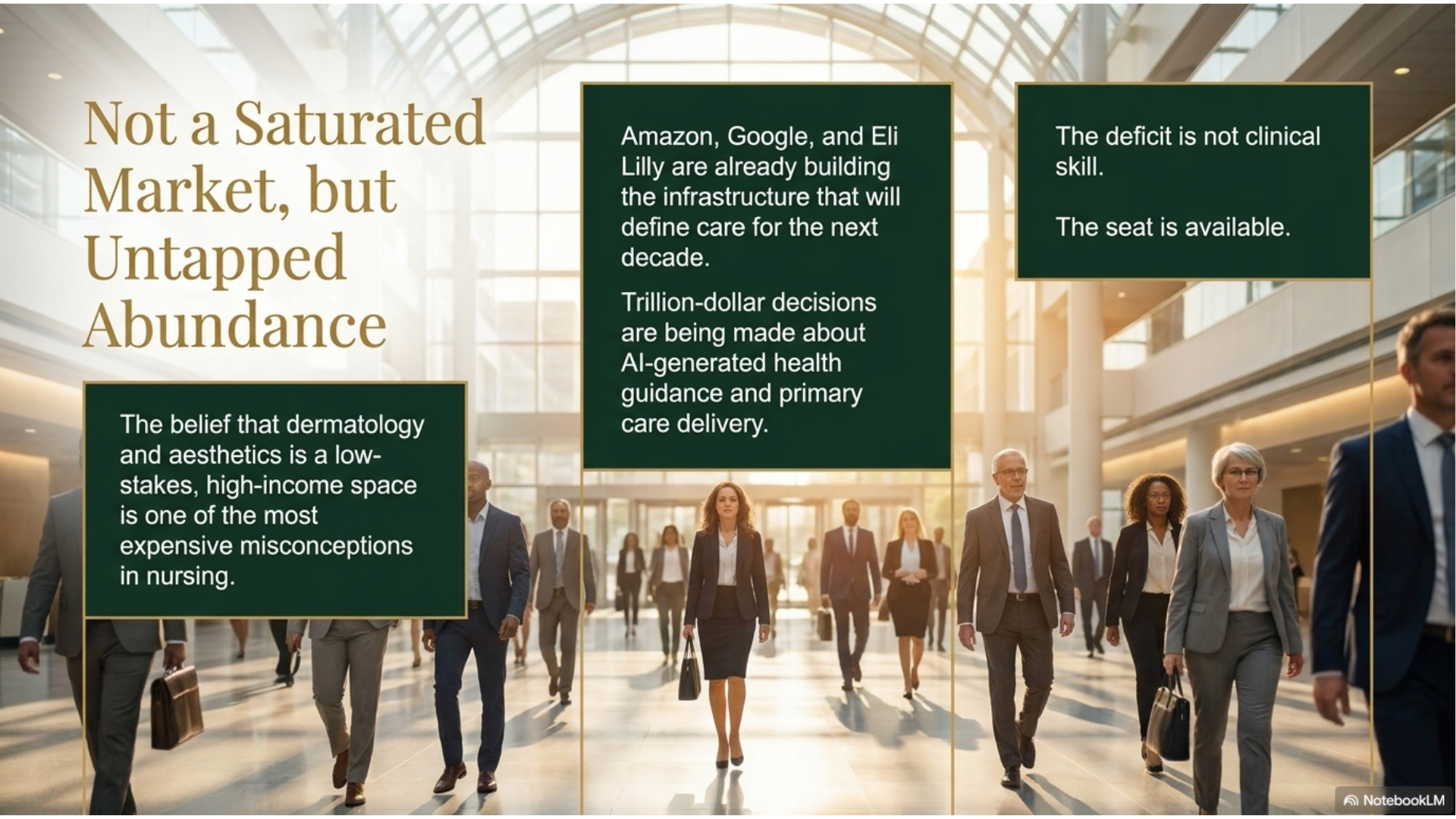
In this article, I want to pick up where "Dear Amazon" left off. That piece made the case that Amazon, Google, and Eli Lilly are already building the infrastructure that will define dermatology care for the next decade, and that nurse practitioners belong in the room where those decisions get made. This article asks the harder question. If the seat is available, are we ready to sit in it. The deficit is not clinical skill. It lives in identity, in financial literacy, in negotiation, and in the residue that toxic workplaces leave behind long after we've left them. Closing that deficit is what turns clinical authority into a real competitive advantage, and what's waiting on the other side of it is an opportunity most NPs are waiting for, but don't know where to start. I'm naming it here, piece by piece, because knowing this terrain is its own nursing superpower.
The identity problem that starts before graduation
The single most damaging phrase in nursing culture is one NPs use to introduce themselves in rooms that matter. "I'm just a nurse." Not "I'm a doctoral-prepared clinician." Not "I'm an advanced practice provider with independent prescriptive authority." Not "I'm the person who holds together the clinical infrastructure of every major health system in this country." Just a nurse. The qualifier comes before the credential, before the title, before the name. And it signals to every executive, investor, and policy maker in the room exactly how much authority to extend, which is none.
This is not humility. Humility is an asset in clinical practice and a liability in a boardroom. In a room where trillion-dollar decisions are being made about AI-generated health guidance, pharmaceutical trial design, and primary care delivery, the person who minimizes their credential is asking the room to underestimate them. The room will oblige every time.
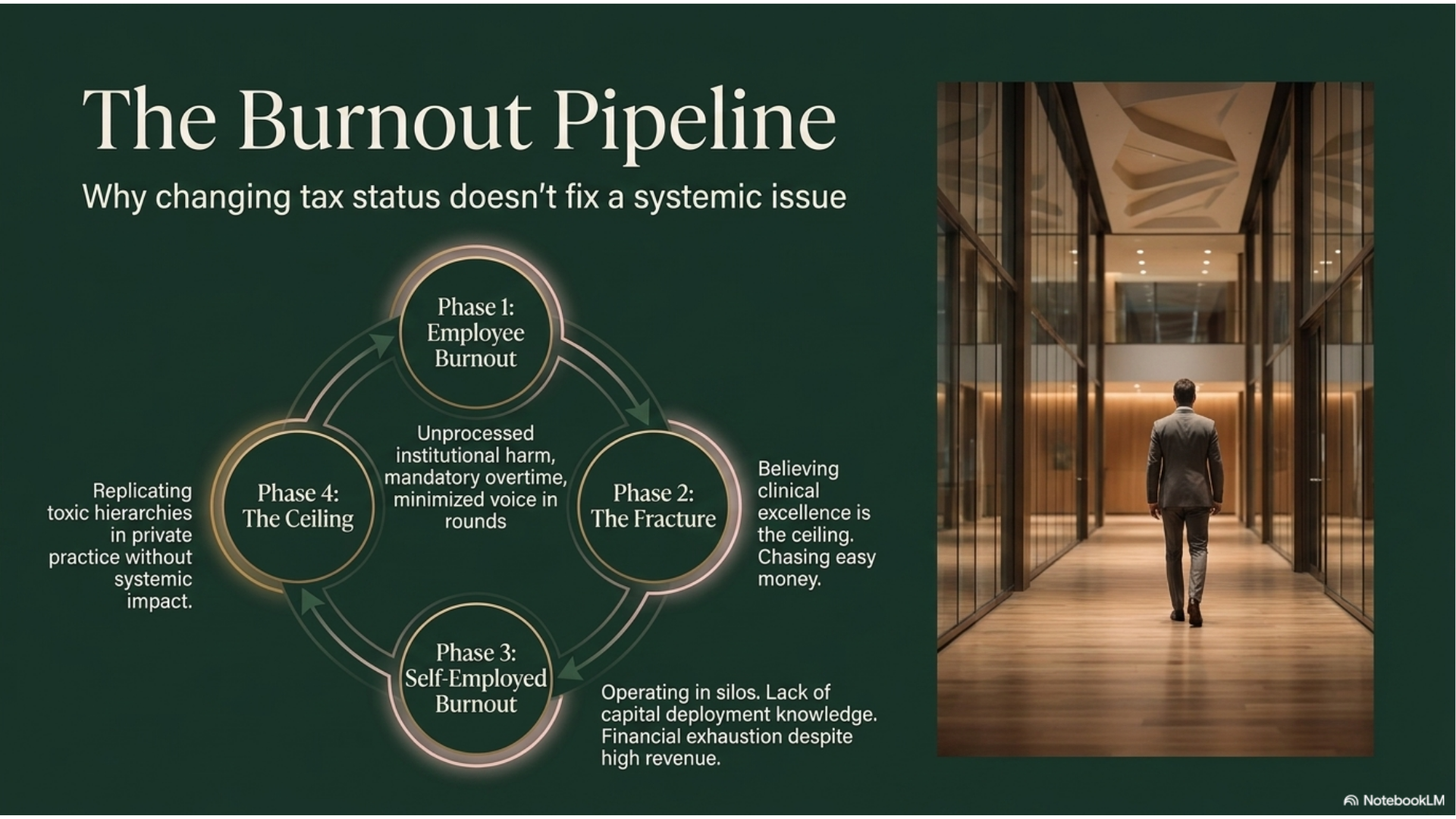
The identity fracture runs deeper than a phrase. Many NPs carry an explicit and implicit message, delivered throughout our training and reinforced in toxic workplace cultures, that clinical excellence is the ceiling of our ambition. That asking for more is overstepping. That the institutional hierarchy, the one that kept nursing deliberately subordinate to medicine for most of a century, is a natural law rather than a constructed political arrangement. We have been passed over, talked over, and underpaid by people with fewer credentials and more confidence for so long that we have begun to mistake the experience of being diminished for evidence that we deserve to be.
It is a lie. And the companies building the future of healthcare need NPs who know it is a lie before we walk through the door.
---
The money conversation we were never taught to have
There is a reason so many NPs say they went into healthcare to help people and then spend the rest of their careers financially exhausted. It is the same reason that nurses generating significant revenue do not know what to do with capital. It is the same reason NPs who charge $500 for a procedure that requires genuine clinical skill, clinical risk, and years of training to execute safely will still preface the quote with an apology. Nobody ever taught us that money is a clinical outcome.
Financial literacy was not in the curriculum. Not in the ADN program, not in the BSN, not in the MSN, not even in most DNP programs that claim to prepare nurses for systems-level leadership. There is no module on capital deployment. No rotation through investment strategy. No case study on business valuation. Nursing education assumed that someone else, a physician, a hospital administrator, a billing department, would handle the economic infrastructure of healthcare, and the nurse's job was to show up and do the clinical work.
The result is a profession full of high earners who think like employees and low earners who feel guilty about wanting to think any other way. NPs entering dermatology and aesthetics are not immune. A troubling number enter the specialty explicitly chasing what they describe as easy money in a short period of time with low stress. That is the depth of financial illiteracy that nursing education produced. They were never taught how to evaluate a business opportunity. They were never taught what clinical risk costs when it is not managed. And they were certainly never taught that dermatology is among the most intellectually complex specialties in medicine, with between 3,000 and 4,000 diagnoses, a physician residency that spans four years after medical school, and a clinical scope that touches every organ system in the body. The skin is not a surface. It is a map, and it is more complex than people appreciate.
The NP who walks into Amazon's health division to negotiate a strategic advisory role, or into Eli Lilly's equity team to inform clinical trial design, needs to know her worth before she names her number. She needs to understand the Cashflow Quadrant. She needs to know the difference between a consulting agreement and a board seat and what each one should cost. She needs to read a term sheet, evaluate an equity offer, and recognize when a room is giving her access without giving her authority. None of that is in the curriculum, however alll of it is required.
---
The negotiation gap that keeps expertise in the room without power
Twenty-five years of watching deals get made teaches one consistent truth: the person who does not know how to negotiate does not just lose money, they lose credibility, positioning, and future leverage all at once. As NPs, we are among the most undertrained negotiators of any credential group in healthcare. That is a predictable outcome of a culture that trained us to accommodate, to advocate for others, and to view asking for what we are worth as professionally inappropriate.
Skilled negotiation is the architecture we need. It is building a structure where both parties can say yes to something real. But you cannot use a framework you don't understand. And you cannot advocate for your seat at a trillion-dollar table if you have never practiced naming the value of your chair.
We are rarely taught how to quantify the value of our clinical expertise in non-clinical terms, the language that boards and investment committees actually speak. We are rarely taught how to structure a pitch that leads with outcomes rather than credentials, with market intelligence rather than personal narrative, with financial upside rather than mission statement. The ask requires knowing what the ask is worth. And that requires financial literacy, market awareness, and a willingness to name a number without apologizing for it.
---
The toxic workplace legacy that cripples boardroom presence
Most NPs who enter dermatology and aesthetics carry an unprocessed archive of institutional harm. The hospital that scheduled mandatory overtime and called it commitment. The collaborating physician who retroactively adjusted billing codes without explanation. The medical director who asked them to operate outside their scope and implied that refusing was a career risk. The colleague who was promoted over them by a system that valued the credential they did not have over the outcomes they consistently produced.
Toxic workplace culture does not stay in the hospital when the NP leaves. It follows you into every negotiation, every pitch, every room where someone needs to hear you say: this is what I know, this is what it is worth, and this is what I am asking for. The internal monologue shaped in environments where speaking up had consequences does not quiet down just because the environment changed.
The NP who has been talked over in morning rounds for ten years has learned to make his voice small. The NP who has been told he should be grateful for his position has learned to attach gratitude to conditions that do not warrant it. The NP who has watched his clinical judgment get second-guessed by administrators with no clinical training has learned to frame his expertise as opinion rather than authority. Every one of those learned behaviors is a direct liability when he sits across from a Google health policy director and needs to make the case that his presence changes the quality of their decisions.
This is not a motivation problem. These are NPs who trained relentlessly, who passed every exam, who built practices from nothing, who led teams through impossible clinical moments. The deficit is not in our effort or our intelligence. It is in the mirror we were handed, which was not built to reflect who we actually are.
---
The dermatology and aesthetics myth that is costing lives
The belief that dermatology is a low-stakes, high-income specialty with minimal complexity is one of the most expensive misconceptions in nursing. It attracts providers who have not done the clinical due diligence. It creates practices staffed by NPs who purchased a weekend injectable course and have never formally studied the disease states presenting on the skin in front of them. And it produces outcomes, adverse events, missed diagnoses, untreated inflammatory skin conditions in patients who came in for cosmetic services, that harm patients and destroy practices.
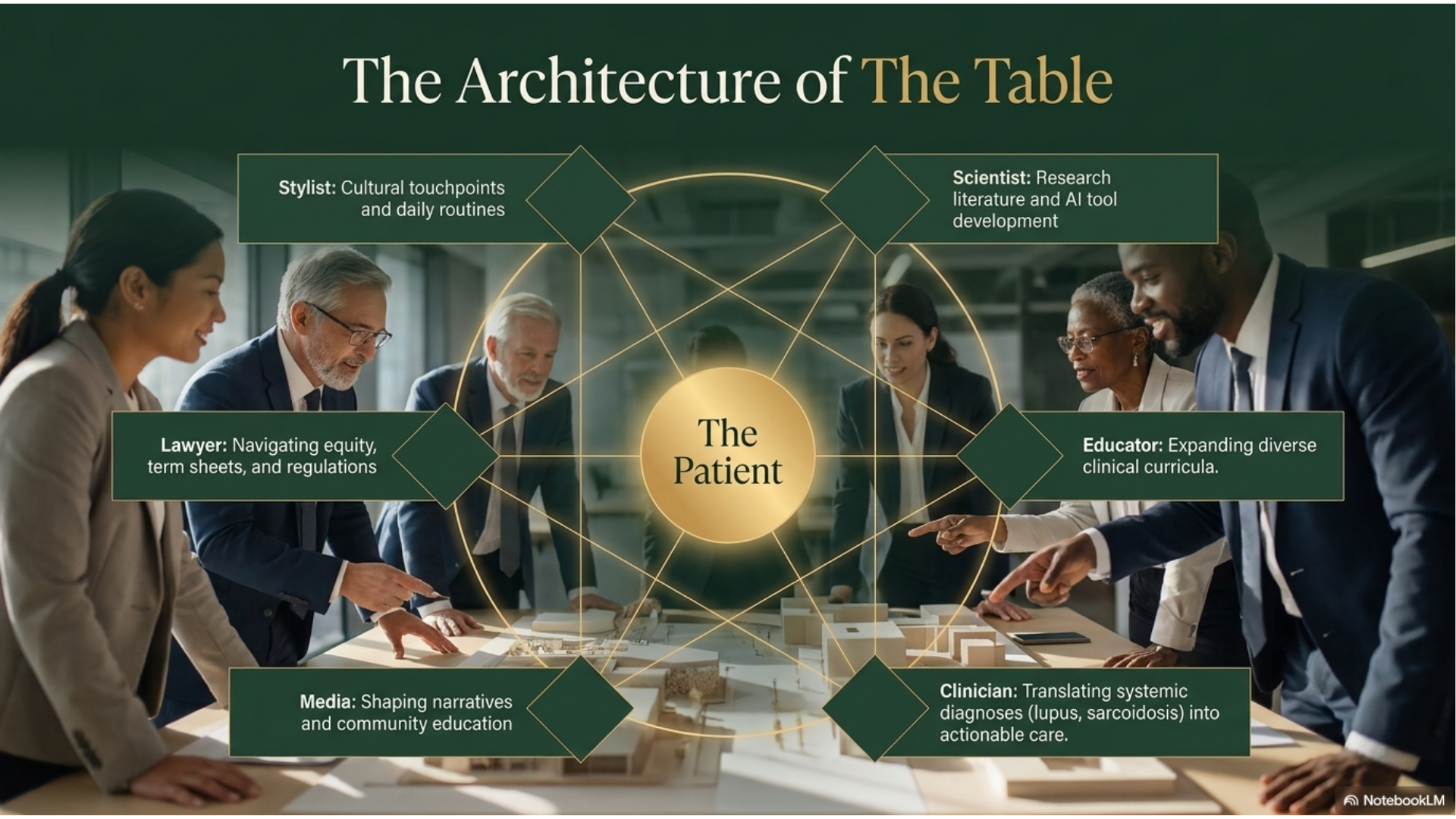
Dermatology has the highest number of distinct diagnoses in medicine. The physician pathway through it is four years of residency after medical school. The skin is not a surface. It is a diagnostic interface for every major organ system. Lupus presents on the face. Sarcoidosis presents on the skin. Addison's disease, liver disease, thyroid dysfunction, and dozens of autoimmune conditions have cutaneous manifestations that an undertrained provider will dismiss as cosmetic concerns or refer away without ever connecting the dermatologic presentation to the systemic diagnosis underneath it.
Aesthetics carries its own clinical weight that the industry has spent years minimizing. When a non-medical owner runs a medspa without a clinical director present, when billing is managed by someone who does not understand procedure coding, when a provider administers a neurotoxin or filler without adequate training in vascular anatomy and complication management, the consequences are not aesthetic. They are medical. Blindness from filler embolism. Necrosis from vascular occlusion. Systemic infection from contaminated product. Psychological harm from procedures on patients who had no informed consent process a clinically trained provider would recognize as adequate.
The absence of oversight in aesthetics is a patient safety crisis operating in plain sight while the industry markets itself as a luxury experience. The lack of diversity in dermatology education, training, research, regulations, and marketing is a clinical outcomes problem. Conditions that present differently on diverse skin types are routinely misdiagnosed when the clinician was trained on a curriculum built from a single skin tone. Amazon's virtual dermatology platform, Google's AI skin condition guidance, and Eli Lilly's community education programs are all operating in a field that the people designing them do not fully understand. They need NPs at the table who do.
---
What being table-ready actually requires
Clinical depth beyond the credential. Graduate education is the floor, not the ceiling. Table-ready NPs have studied dermatology as a complete medical specialty — the full diagnostic breadth, the organ-system connections, the presentation variations across diverse skin types, the research literature in their area of focus. They can speak to the clinical complexity of what they know and name the evidence base that grounds it.
Financial literacy as a non-negotiable competency. Understanding capital deployment, business valuation, investment strategy, and the economics of healthcare is not optional for NPs who want to lead inside corporate health structures. These companies make decisions in the language of return on investment, market penetration, and long-term valuation. The NP who cannot speak that language will be heard as a clinical resource to be consulted and dismissed rather than a strategic voice to be seated.
Negotiation as a practiced skill, not a personality trait. Asking for what you are worth is a skill. Structuring a pitch that leads with the problem you solve and the mechanism by which you solve it is a skill. Knowing when to hold a number and when to restructure the offer is a skill. These are teachable, learnable, and urgently needed across the profession.
Identity reconstruction after institutional harm. The NP who has been diminished by toxic workplace culture does not heal from it by being promoted. She heals from it by being in rooms where her expertise is treated as the asset it is, by receiving mentorship from people who benefit from her being in business, and by building the financial infrastructure that makes her presence in any room a choice rather than a necessity. Financial wholeness and professional identity are not separate projects. They are the same project.
A perspective shift on what helping people means at scale. Every NP entered this profession to help people. That is the foundation. The problem is a definition of helping that stops at the treatment room door, that measures impact one patient at a time, that cannot conceive of the exponential reach that comes from shaping the AI tool delivering health guidance to one billion daily queries, or informing the clinical trial that determines how a medication is studied in diverse populations for the next decade. Helping people at the scale these companies operate requires sitting at the table where those decisions are made. And sitting at that table requires believing, without qualification, that you belong there.
The career you worked this hard for is supposed to work for you. The patients you have given everything to serve deserve for your expertise to reach further than a single exam room. Both of those things are true simultaneously. And both of them require you to stop calling yourself just a nurse.
"And both of them require you to stop calling yourself just a nurse."
---
Amazon is already treating your patients' skin conditions through a virtual clinic. The financial infrastructure deficit that keeps us out of boardrooms is the same problem that keeps NP practices from surviving past year three. Visit the Mahogany Dermatology Nursing Bookstore to see our latest quarterly financial literacy e-books to get started on taking a seat at the table.
---
About the Author
Dr. Kimberly Madison, DNP, AGPCNP-BC, WCC is a Board-Certified, Doctorally-prepared Nurse Practitioner, educator, researcher, and author dedicated to advancing dermatology nursing education with an emphasis on skin of color, business acumen, and digital literacy. She is the founder of Mahogany Dermatology Nursing | Education | Research™ and the Alliance of Cosmetic Nurse Practitioners™, the first dermatology nursing organization in the country built at the intersection of clinical excellence, skin of color care, and financial literacy for nurses. A selected participant in the Harvard Business School Foundry Mindset Bootcamp, Dr. Madison continues to sharpen the entrepreneurial infrastructure behind her mission. Through peer-reviewed research, published books, and a growing community of nurse entrepreneurs, Dr. Madison is building the infrastructure that makes this profession sustainable for the people who choose it.
.svg)

.svg)
.svg)