2025 Physician and Advanced Practitioner Incentives: The Implications for Aesthetic Nurse Practitioners and Entrepreneurs
Every year, a report comes out that puts a price tag on you. The 2025 Review of Physician and Advanced Practitioner Recruiting Incentives from AMN Healthcare shows NP starting salaries jumped 9.6% to $180,000 this year, with signing bonuses hitting a record $12,869. For the fifth year running, NPs were the most recruited provider type in the country, ahead of every physician specialty. Whether you're reading this as the one being recruited or the one doing the recruiting, this report is speaking directly to you. If you're employed, it's the exact benchmark to bring into your next salary conversation. If you're building a practice and hiring your own NPs, it's what "competitive" looks like right now, whether you're trying to match it or beat it with something the big systems aren't offering. But there's a number buried in this year's data that matters to both of you for different reasons. While salaries and signing bonuses climbed, NP loan repayment fell by more than a third, from $78,333 to $50,000. Employers are paying more to get NPs in the door and less to help pay off the debt that got them there. For the employed NP, that's a negotiation point you should not let go unasked. For the founder, that's a gap in the market you can build your hiring strategy around. In this article, I discuss the implications for nursing, including aesthetics, and provide detailed recommendations for a DNP Project, PhD nurse-led research, and entrepreneurs. Read or listen below.
See our review from last year to see the trends: 2024 Physician and Advanced Practitioner Incentives: The Implications for Aesthetic Nurse Practitioners and Entrepreneurs. Click here.
2025 Physician and Advanced Practitioner Incentives: The Implications for Aesthetic Nurse Practitioners and Entrepreneurs
Navigating today's healthcare landscape requires understanding the forces shaping the workforce, particularly the competitive world of physician and Advanced Practice Provider (APP) recruitment. The 2025 Review of Physician and Advanced Practitioner Recruiting Incentives from AMN Healthcare cuts through the complexity, offering critical data points on starting salaries, bonuses, and other incentives used to attract talent across various medical specialties. This comprehensive report is a vital resource for anyone looking to benchmark opportunities or strategize recruitment and retention, providing insights into the evolving demand for roles like Nurse Practitioners.
This report is written for the hospitals, medical groups, and health systems doing the recruiting, a benchmarking tool so employers know what's "customary and competitive" to offer someone they want to hire. If you're a practice owner hiring your first or fifth NP, this report is written directly for you, and you should use it exactly as intended. But if you're the NP being recruited, or the one evaluating your own compensation, this same report is describing what's being spent to attract and keep you. Every figure in it, the starting salary, the signing bonus, the loan repayment, describes what an employer pays to get someone into a job and, increasingly, what they're no longer willing to pay to keep them once they're there.
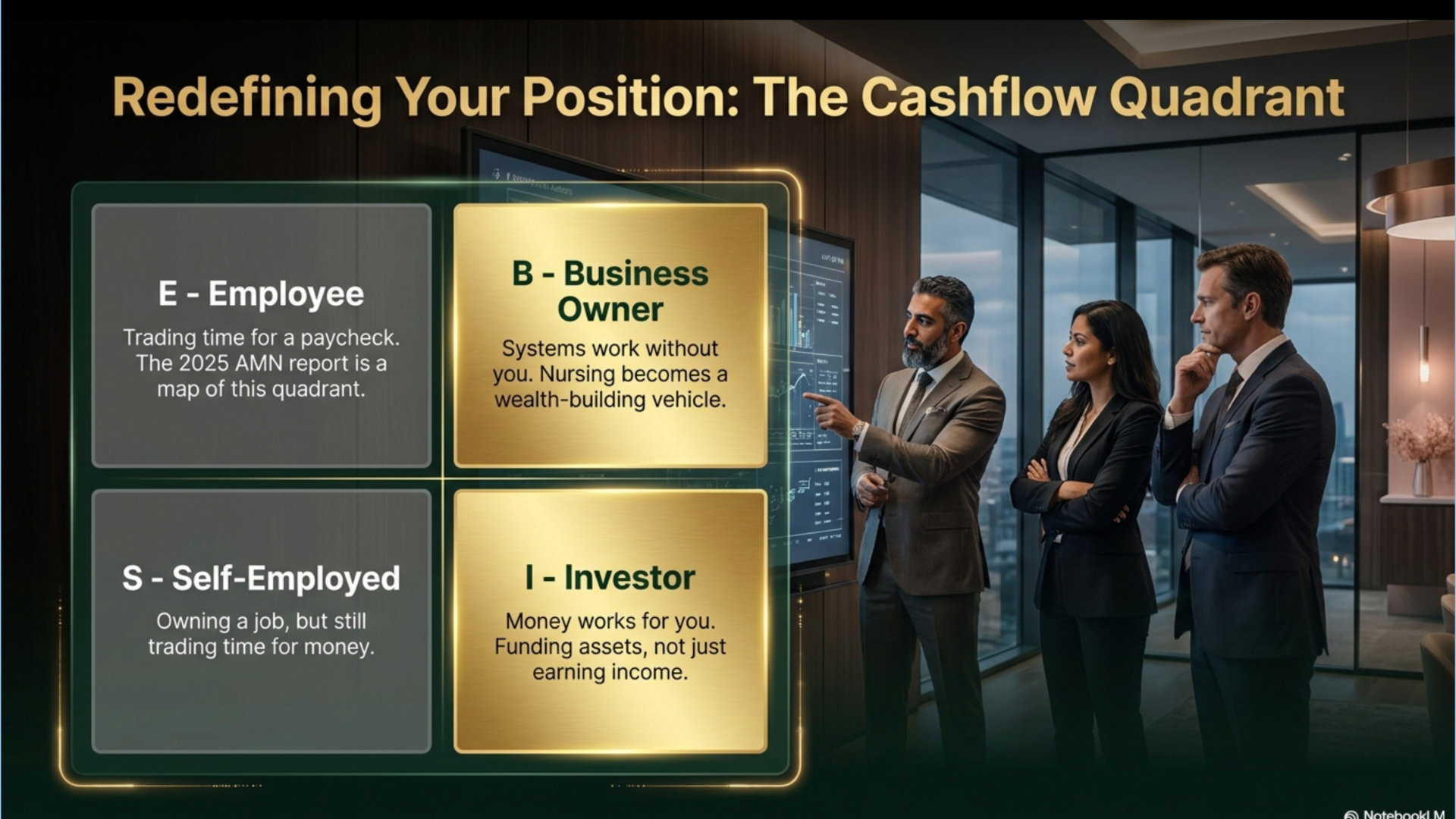
In Robert Kiyosaki's Cashflow Quadrant framework, that entire report lives in one quadrant: E, for Employee. It has nothing to say about the other three, and that's exactly why I want to walk through all four here before we go any further.
E is Employee. You trade time for a paycheck. This report is a map of that quadrant, and only that quadrant.
S is Self-Employed. You still trade time for money, but you own the schedule. Most solo aesthetic NPs start here.
B is Business Owner. The business works whether or not you're the one seeing the patient, and the business doesn't have to be clinical at all. It can be a practice, but it can just as easily be an app, a consulting firm, a law practice, a real estate venture, a design business, anything you build using what you know. It can also mean leveraging your own nursing expertise, speaking, writing, teaching, consulting, being a guest expert, building an audience, into income that doesn't require seeing another patient or picking up another shift. This is a non-negotiable piece of actually building wealth instead of just earning income.
I is Investor. Your money works without you. This is where the income the other three quadrants generate actually gets put to work.
Most of us were trained to live entirely in E, and this report is proof of exactly how well-documented and well-optimized that quadrant is for everyone except the person standing in it. The rest of this article covers what the 2025 Review actually found. But I want you reading it with B and I in the back of your mind the whole time, not just E.
If you're newer to nursing and still have questions about how this all works, what the path from a bachelor's degree to a doctorate actually looks like, and specifically what that journey looks like for anyone who wants to practice in dermatology and aesthetics, our 2025 Whitepaper on the State of Nursing Education: Pathways, Purpose, and the Future of Cosmetic & Dermatology Practice, walks through that path in full. You can find it, along with the rest of our books and resources, at the Mahogany Dermatology Nursing bookstore.
Key Findings from the 2025 Review
The 2025 Review is based on a representative sample of 1,420 permanent physician and APP search engagements conducted by AMN Healthcare's Physician Solutions division from April 1, 2024, to March 31, 2025. Unlike surveys tracking total compensation, this report focuses specifically on the incentives offered to attract providers to new positions.
Several overarching trends stand out:
NP Salaries Climbing Sharply: The average starting salary for NPs increased 9.6% year-over-year, from $164,000 to $180,000. This is on top of last year's 8.6% increase, meaning NP starting salaries have climbed roughly 19% in just two years.
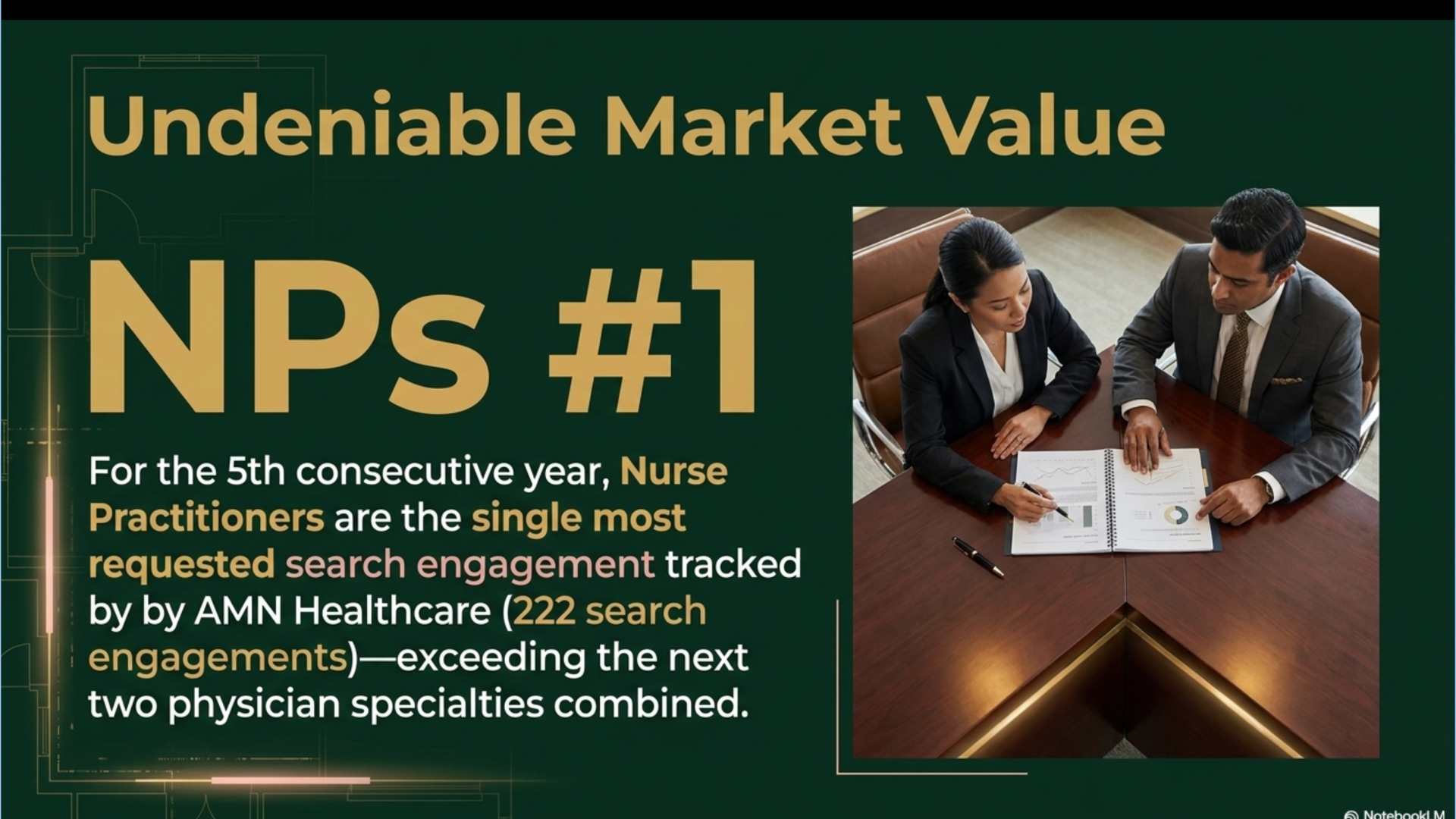
NPs Remain the Single Most Requested Search: For the fifth consecutive year, Nurse Practitioners were the single most requested search engagement of any type tracked by AMN Healthcare, physician or APP, with 222 search engagements, more than the next two specialties (family medicine at 134 and anesthesiology at 103) combined.
Specialist Demand Intensifying: Specialists now account for 78% of physician search engagements, up sharply from 63% the year before. Primary care physicians account for just 22%.
Signing Bonuses Rising Fast: Physician signing bonuses jumped 23% year-over-year to $38,215. NP and PA signing bonuses jumped even further, up from $11,758 to $12,869, the highest average signing bonus for NPs and PAs ever tracked in the Review's history.
Loan Repayment Shrinking for NPs Specifically: While signing bonuses and salaries rose, educational loan repayment offered to NPs and PAs actually fell, from $78,333 to $50,000, even as physician loan repayment only dipped slightly (from $117,217 to $104,200). The Review itself flags this as an anomaly worth watching, calling it a possible "one year aberration" given that it runs counter to the broader trend of rising NP incentives.
Evolving Practice Settings: Hospital-based recruiting rose to 34% of engagements (up from 28%), and Academic Medical Center recruiting rose to 28% (up from 22%). Medical group recruiting, often private-equity backed, held steady at 24%. Notably, solo/partnership/concierge recruiting cratered to just 1% of engagements, down from 6% the year before, a sharp reversal from the modest uptick reported in 2024.
Recruiting is Concentrated in Larger Communities: Seventy percent of search engagements were conducted in communities of 100,000 people or more, and AMN Healthcare's Physician Solutions division worked in 47 of 50 states during the Review period.
Contract Structures: Sixty-six percent of physician and APP contracts featured a salary plus production bonus, up from 62% last year. RVUs remained the dominant productivity metric, featured in 65% of bonus-eligible contracts, while quality metrics were included in only 16%, down from 26% the year before, showing quality-based compensation losing ground rather than gaining it.
These findings underscore a healthcare market defined by persistent shortages, an aging population driving specialist demand, and a widening gap between how aggressively NPs are being recruited and how generously their debt is being repaid once they arrive.
Nursing Implications: Navigating Demand and a Widening Value Gap
For Dermatology Nurse Practitioners and other Advanced Practice Registered Nurses (APRNs), the 2025 Review offers both an affirmation of value and a warning. The fifth consecutive year at the top of AMN Healthcare's most-requested list, ahead of every physician specialty tracked, speaks to how indispensable NPs have become in filling healthcare gaps. The near 20% two-year climb in average starting salary is real, tangible proof that demand is translating into dollars.
But the loan repayment figure tells a more complicated story. Signing bonuses for NPs reached a record high. Starting salaries rose nearly 10% in a single year. And yet the average educational loan repayment offered to NPs and PAs fell by more than a third, from $78,333 to $50,000, even as the same benefit for physicians barely moved. Employers appear willing to pay more upfront to attract NPs, but less willing to help retire the debt that got them there in the first place. That's a critical data point for negotiation: don't assume a rising salary offer means every incentive in the package is rising with it. Ask about each line item separately.
The report also highlights the continued shift of NPs into specialty medicine, with dermatology explicitly named among the specialties where NPs are mentored by physicians to help provide services and patient education, already documented in the same national dataset used to benchmark physician salaries, not a hypothetical growth area.
Implications for Aesthetic and Dermatology Nurse Practitioners & Entrepreneurs
Dermatology Named Directly, and Increasingly Recruited By Private Equity: Dermatology appears explicitly in the Review's list of specialty recruitment engagements this year. The report also notes that private equity companies have driven an 86% increase in corporate-owned physician practices between 2019 and 2022, specifically targeting high-revenue specialties including dermatology, gastroenterology, and urology. This is a strong signal that the aesthetic and dermatology NP market is being actively shaped by well-capitalized outside players, not just organic patient demand.
Dermatology Access Is Measurably Worsening: For the first time, this Review includes wait-time data showing the average time to schedule a dermatology appointment has grown to 36.5 days, up 50% since 2004. That access gap is precisely the opening an aesthetic or medical dermatology NP entrepreneur can fill, particularly one offering skin of color expertise in an underserved area.
NP Demand Sits Alongside Specialist Demand, Not Beneath It: With specialists now representing 78% of physician search engagements and NPs sitting at the very top of the overall demand list, the market is validating both tracks simultaneously. An NP building a dermatology-focused practice is stepping into a market that recruiters are chasing from two directions at once.
The Recruiting Incentive Gap Is a Pricing Data Point: The falling NP/PA loan repayment figure, set against rising salaries and signing bonuses, tells aesthetic NP entrepreneurs something important about the employed-NP market they may be competing against or recruiting from: employers are increasingly front-loading compensation rather than offering long-term debt relief. If you're building a practice and hiring your first NP, this is useful benchmarking data for what's now considered competitive.
Solo Practice Recruiting Nearly Disappeared: The collapse of solo/partnership/concierge recruiting to just 1% (from 6%) is worth sitting with, though it's worth naming precisely: this category tracks physicians being recruited to start or join their own private practice, not NPs directly. The Review notes that 77% of physicians are now employed by a hospital, health system, or corporate entity, up from 26% in 2012. That consolidation matters for NPs too, since it shapes what kind of practice environment is even available to join or work alongside. It does confirm that the traditional employer-built pathway into independent practice ownership is narrowing, for physicians first, with downstream effects on NPs. Direct entrepreneurship, rather than an employer-sponsored bridge into ownership, is increasingly the more realistic route for anyone, physician or NP.
Detailed DNP Project Idea: Auditing the NP Incentive Gap in a Specific Setting
The 2025 Review's most striking finding for nursing is not the salary increase but the divergence between rising NP salaries/signing bonuses and falling NP loan repayment. A compelling DNP project could take this national divergence and test whether it holds true locally, then use the findings to build an evidence-based recruitment and retention proposal.
Project Idea: Auditing the Gap Between Recruitment Incentives and Retention Incentives for Nurse Practitioners
Problem: National data shows NP starting salaries and signing bonuses rising sharply while loan repayment benefits fall, suggesting employers may be prioritizing initial attraction over long-term debt relief and retention. Within [Specific Healthcare System/Practice Setting], it is unclear whether current NP incentive packages reflect this same imbalance, and if so, whether it is contributing to turnover.
Purpose: To determine whether a local NP incentive package mirrors the national pattern (rising salary/signing bonus, falling loan repayment) and to propose a rebalanced package that improves both recruitment and long-term retention.
Objectives:
Analyze current NP compensation packages within the target setting against the 2025 Review's national benchmarks: starting salary ($180,000 average), signing bonus ($12,869 average), relocation allowance ($9,016 average), CME allowance ($2,083 average), and educational loan repayment ($50,000 average, down from $78,333 the prior year).
Survey current NPs within the setting on which incentive, if offered again, would most affect their decision to stay long-term versus leave for a competing offer.
Identify whether the setting's incentive structure over-indexes on upfront signing incentives relative to sustained debt relief, mirroring the national trend.
Develop a rebalanced incentive proposal that maintains competitive signing bonuses while restoring or increasing loan repayment support, informed by both the survey data and national benchmarks.
Pilot the rebalanced package with new NP hires over a defined period and track offer-acceptance rates and 12-month retention compared to the prior incentive structure.
Significance: This project translates a national anomaly in workforce data into a local, testable retention strategy, directly addressing whether the market-wide pattern of front-loaded, short-term incentives at the expense of long-term debt relief is helping or harming NP retention in a specific setting.
PhD Nurse-Led Research Opportunity: Examining the NP Incentive Divergence Nationally
The 2025 Review's finding that NP signing bonuses climbed to a record high while NP loan repayment fell by over a third is, as the Review itself notes, a possible one-year aberration. But it could equally be the early signal of a genuine structural shift in how healthcare employers compete for NPs. This is an empirical question a nurse scientist is well positioned to answer.
Research Question: Does the divergence between rising signing/starting incentives and falling loan repayment incentives for Nurse Practitioners, observed nationally in the 2024/25 recruiting cycle, represent a one-year anomaly or the beginning of a sustained structural shift in NP recruitment strategy, and what effect does this divergence have on NP retention and career satisfaction?
Background: AMN Healthcare's 2025 Review documents NP starting salaries rising 9.6% year-over-year, NP/PA signing bonuses rising from $11,758 to $12,869, and NP/PA loan repayment falling from $78,333 to $50,000, all within the same 12-month recruiting cycle. There is limited to no existing published research on whether this specific divergence pattern, front-loaded incentives replacing long-term debt relief, predicts NP turnover or satisfaction differently than a more balanced incentive package would.
Research Design: A longitudinal, mixed-methods approach could track a cohort of newly hired NPs across multiple settings and employer types (hospital, medical group, urgent care/retail, academic) over 24-36 months.
Quantitative: Compare 12- and 24-month retention rates between NPs recruited under front-loaded incentive packages (high signing bonus, low or no loan repayment) versus more balanced packages (moderate signing bonus, substantial loan repayment). Track whether starting incentive structure predicts early departure independent of salary level.
Qualitative: Conduct semi-structured interviews with NPs who left a position within 24 months of hire to explore whether the structure of their incentive package (not just its total value) influenced their decision to leave, and whether outstanding educational debt specifically factored into retention decisions.
Potential Findings: The research could reveal whether employers are inadvertently trading short-term recruiting wins for long-term retention losses by shifting incentive dollars away from loan repayment, a benefit tied to multi-year retention commitments, and toward signing bonuses, which carry no such obligation once vested.
Significance: If the 2025 divergence proves to be a genuine strategic shift rather than a one-year blip, this research would give health systems and policymakers concrete evidence on which incentive structures actually retain NPs long-term, informing recruitment strategy at a moment when NPs remain the single most recruited provider type in the country.
Recommendations for Entrepreneurs: Building in a Market That's Recruiting NPs Aggressively and Retaining Them Poorly
The 2025 Review reveals a market defined by two simultaneous, seemingly contradictory forces: NPs are more in-demand than any other provider type tracked, and the incentive package built to keep them once hired is, by the Review's own numbers, getting weaker in at least one major respect. Both facts create opportunity for nurse entrepreneurs.
Build the Retention Offer Employers Aren't: If NP loan repayment is falling nationally while signing bonuses rise, a nurse entrepreneur building a practice and hiring other NPs has a clear differentiator available: offer meaningful, sustained loan repayment support as a retention tool while competitors chase candidates with upfront signing bonuses alone. This is a concrete, benchmarkable way to compete for talent without simply outbidding larger systems on salary.
Address the Dermatology Access Gap Directly: With dermatology appointment wait times up 50% since 2004 and now averaging 36.5 days, and with dermatology explicitly named among the specialties being aggressively acquired by private equity, there is a documented, worsening access problem that an independent aesthetic or medical dermatology NP practice, particularly one built around skin of color expertise, is positioned to solve locally, and not just theoretically. My own systematic review with Jade Trevino, BSN, RN, published in JCAD, found that AI-assisted dermatology care with NP and RN task-shifting reduced wait times by up to 40-53% in provider shortage areas, with task-shifting shown to be safe and effective. The access gap this Review documents is exactly the gap our research was built to close (Madison and Trevino, 2026).
Benchmark Your Own Hiring Against the Real Numbers: Whether you're hiring your first associate NP or your fifth, the 2025 Review gives you exact, current figures to benchmark against: $180,000 average starting salary, $12,869 average signing bonus, $9,016 average relocation allowance, $2,083 average CME allowance, and $50,000 average loan repayment (where offered). Use these numbers directly in your own hiring conversations rather than guessing at what's competitive.
This Report Doesn't Track Independent NP Founders, So Here's What to Build Instead
Three ways to stand out in a competitive and saturated market: stop looking where everyone else is looking, identify problems that Botox cannot solve, and help legacy companies expand their total addressable market (TAM) using your nursing superpower:
One, hyper-niche your injectable training with anatomy depth. Everyone teaches Botox. Add advanced anatomy study on top of what you already offer, and the NP up the street teaching the same basic technique stops being your competition, because you're not offering the same thing anymore.
Two, build toward an alopecia specialty clinic. Invest in the additional education, the administrative setup, and the conference hours it takes to go deep here. Alopecia patients are already showing up to visits that run longer and require more attention than almost anything else in the chair, and there's a real gap in care waiting for someone to fill it properly.
Three, pick one gap or combine all three: skin of color, women's health, and nutrition. Those are among the biggest gaps in nursing education and training right now, and almost no one is teaching any of them well, let alone together. Go deep on just one, or stitch all three into a single specialty, and either way you've built something that stands out instead of fitting into the same lane as everyone else.
Summary
The 2025 Review confirms what many of us already feel in this profession: NPs have never been more in demand, and the market is finally paying for that demand with double-digit salary growth and record signing bonuses. But the same data shows employers pulling back on the one incentive most directly tied to the debt so many of us are still carrying, educational loan repayment. That gap between what NPs are offered to arrive and what they're offered to stay is a strategic opening for anyone building an independent practice, not just a workforce curiosity, and it's a data point worth bringing to your next salary negotiation regardless of which side of that conversation you're on.
You will never be able to reclaim your joy in nursing or experience the freedom you thought nursing would give you if you don't have time. You must stop trading your time for money, and start thinking about using nursing to fund your investment account.
That shift starts with treating financial literacy the way we already treat clinical competency, something assessed, diagnosed, and built deliberately rather than left to chance. Read the whitepaper at cosmeticnp.org/financialliteracy for the full framework.
References
AMN Healthcare. (2025). 2025 review of physician and advanced practitioner recruiting incentives: An overview of the salaries, bonuses, and other incentives customarily used to recruit physicians, physician assistants, nurse practitioners and CRNAs. AMN Healthcare. Access here.
Madison, K., & Trevino, J. (2026). AI-assisted dermatology in provider shortage areas: A systematic review of access and wait time outcomes. Journal of Clinical and Aesthetic Dermatology, 19(5-6 Suppl 1), S16-S23. Access here.
About the Author
Dr. Kimberly Madison, DNP, AGPCNP-BC, WCC is a Board-Certified, Doctorally-prepared Nurse Practitioner, educator, researcher, and author dedicated to advancing dermatology nursing education with an emphasis on skin of color, business acumen, and digital literacy. She is the founder of Mahogany Dermatology Nursing | Education | Research™ and the Alliance of Cosmetic Nurse Practitioners™, the first dermatology nursing organization in the country built at the intersection of clinical excellence, skin of color care, and financial literacy for nurses. A selected participant in the Harvard Business School Foundry Mindset Bootcamp (2026), Dr. Madison continues to sharpen the entrepreneurial infrastructure behind her mission. Through peer-reviewed research, published books, and a growing community of nurse entrepreneurs, Dr. Madison is building the infrastructure that makes this profession sustainable for the people who choose it.
.svg)

.svg)
.svg)