Giving Nurses a Voice in Research: What I Learned Completing My Systematic Review
What does it take to go from idea to evidence? From curiosity to contribution? From sitting in the audience to shaping the conversation? This month's reflections aren't about what we learned in a classroom or found in a textbook. They're about what we discovered by doing the work that most nurses never get the chance to do: systematic research that gives our profession a voice in the scientific literature. September was a month of completion. Jade and I completed the final stages of her first systematic review, a research process so rigorous, so methodical, that it demands not just clinical knowledge but strategic thinking, meticulous documentation, and the confidence to question what's been published. What we learned wasn't just about PRISMA guidelines or database searching. It was about the philosophies that transform nurses from knowledge consumers to knowledge creators, and the mindset shifts that turn literature review into leadership. Whether you're considering a DNP, mentoring research fellows, or wondering if nurses have a place in academic publishing, these lessons will show you what it actually takes to complete a systematic review, why this work matters for advancing nursing practice, and how research literacy becomes the foundation for clinical authority.
Jade Trevino’s Perspective: Deep Dive Into Research
This month, my focus was almost entirely on putting the final touches on my very first systematic review. The paper is titled: AI-Assisted Dermatology in Provider Shortage Areas: A Systematic Review of Access and Wait Time Outcomes. This project has been a true labor of love. It’s a topic that resonates deeply with me. Over my 13 years in dermatology, I’ve worked in several practices, and no matter where I was, I kept seeing the same issue: long wait times for patients needing dermatology care. Access to dermatology is a challenge everywhere, and there’s no simple solution. I wanted to understand the roots of this problem, so I turned to the research.
Generally, the people conducting this type of research are those with advanced degrees such as MDs, PhDs, or DNPs. Their education required them to do this work. For me, this started as a passion project, but it was also a requirement for my year-long Mahogany internship. As a Registered Nurse, my only previous research experience came from my bachelor’s program, and it was pretty basic. I dove into this project with an open mind, but without the formal research training that many have. Along the way, I learned a lot—not just about the topic, but about myself. This month’s reflection is about those lessons, and my advice for anyone thinking about diving into the deep end of research.
Lesson 1: We Need More Nurse-Led Research
As I mentioned, research is often left to those with “fancy letters” behind their name, but it doesn’t have to be that way. One of the principles Dr. Madison teaches is that nurses must have a voice in healthcare. Nurses have a different, more holistic perspective because of how closely we interact with patients. Our unique viewpoint means we often notice problems and solutions others might miss. Sometimes, to get closer to the answer, you just need to ask a nurse. If nurses were included in more conversations, patient care would improve. But how do we enter those conversations? Through research. By conducting and publishing our findings, we make sure our voices and insights are heard. It opens new doors for nurse leadership.
Advice:
Don’t wait for permission to start researching a problem you care about. Your perspective is valuable, and your experience at the bedside gives you unique insights. Start small, ask questions, and know that your work can make a real difference.
Lesson 2: It’s Challenging, But Not Impossible. I Can Do Hard Things.
Research, especially for beginners, can feel overwhelming. Every step of this systematic review was a first for me. I had to learn about Boolean search terms, inclusion and exclusion criteria, PRISMA flow diagrams, and more. Every piece required its own mini-lesson before I could even move forward. But these weren’t roadblocks; they were just challenges to work through. I rediscovered resilience and self-belief. This project reminded me that I can do hard things.
Advice:
When you hit a wall, break the problem down into smaller steps. Focus on progress, not perfection. Remind yourself of the challenges you’ve already overcome. This is just the next one.
Lesson 3: Use Your Resources—People and Technology
As I wrapped up the review, I realized my in-text citations were all in APA, but the journal required AMA. With over 30 pages and 30 references, fixing them by hand was daunting. Venting to a DNP student co-worker, I learned I was using my citation software incorrectly. She quickly taught me a shortcut that saved me hours. That moment drove home the value of asking for help and learning from those around me. We don’t have to do this alone, and technology is there to support us if we use it wisely.
Advice:
Leverage your network and available tools. Ask for help. There’s no badge for struggling in silence. Sharing knowledge is part of the process, and the right support can make even the hardest tasks manageable.
Lesson 4: Give Yourself Grace
This review took nearly a year. Honestly, I thought it would take three or four months. Not meeting my own expectations was tough. I felt as though I was letting Dr. Madison down. It reminded me of my first year as a nurse, struggling with time management. My leader asked, “Who told you that you had to be perfect by now?” The answer was me. I had set that expectation myself. Here I am, years later, learning that same lesson again. It’s okay to let the process unfold naturally and give yourself grace along the way.
Advice:
Let go of unrealistic timelines and perfection. Progress in research, and in life, is not always linear. Be kind to yourself. You’re learning and growing, and that’s the real achievement.
Lesson 5: Embrace AI Responsibly
There’s plenty of debate about AI in research, but when used ethically, the right tools can save time and energy. I’ve learned that it’s okay to use technology to work smarter, as long as you maintain integrity and transparency.
Advice:
Be curious and open to new tools, but use them wisely. Learn the basics of AI and research technology, then use them to enhance (not replace) your critical thinking and ethical standards.
Looking Ahead: Goals for Next Month
With my first systematic review complete and ready for publication, I am looking forward to new opportunities ahead.
Launch: Mahogany Dermatology Nursing Bookstore
Upon returning from my month-long sabbatical in August, we launched the Mahogany Dermatology Nursing Bookstore! I’ve shared before, that when I first graduated from the BSN to DNP, program and George Washington University, I spent the first few months exploring different specialties. That summer, I studied nutrition, explored integrative medicine, and considered enrolling in the Integrative Health and Lifestyle Certificate program at the Andrew Weil Center for Integrative Medicine at Arizona University; I even attended their virtual open house. I first learned about integrative medicine during NP school when I completed a rotation at a clinic in Virginia. At the time, while I appreciated the education (I prefer integrative modalities as a patient), I felt it wasn’t going to prepare me sufficiently for board exams. However, now, I’m so grateful for that opportunity. There’s been an increase in consumer demand for integrative approaches, and we see more clinicians (nurses, NPs, doctors, and mental health specialists) transitioning or adding on more integrative services. My interest in integrative medicine, more specifically integrative dermatology, was reinvigorated when I attended the LearnSkin Conference (Integrative Dermatology Symposium) last month.
During the summer of exploring nutrition and integrative medicine, I discovered my favorite book to recommend: Nutrition Made Clear by Professor Roberta Anding, MS, RD/LD, CSSD, CDE, who is a registered dietitian, board-certified specialist in sports dietetics, and Assistant Professor at Baylor College of Medicine. With over 40 years of experience, she has served as a sports dietitian for the Houston Texans (12 years), Houston Ballet (15 years), and is currently in her fifth year with the Houston Astros. She also works with Rice University's athletic programs. She is a National Spokesperson for the Academy of Nutrition and Dietetics, has been recognized as Texas Distinguished Dietitian, and she has received multiple teaching awards, including Educator of the Year from the Texas Dietetic Association. She holds a Master of Science in nutrition from Louisiana State University. The book is basically an 18-hour FREE nutrition course! I recommend the audiobook where you can listen to her live lectures. It’s a book you can read from cover to cover or use as a reference manual. She covers all the macro and micronutrients in a way that is engaging and practical.
I leaned into nutrition as my platform, created a social media handle, hired a web designer to create my logo and website, and hosted a virtual cooking class! Not too long after that, I asked myself: What would you do if you could do anything for free? My answer? Write! What will you write about? That led me to revisit my interest in dermatology. I contacted my web designer and told him I had a new idea.
I sold my digital products on Etsy for 1-2 years. I highly recommend it as a starting point, as it’s a great marketplace for nursing-related products and helps you get started sooner rather than later, waiting for your website to be completed and for your audience to find you. The launch of the Mahogany Dermatology Nursing Bookstore is one step closer to a childhood dream I’ve had of owning my own bookstore/library.
You can click this link here to see the latest additions to the shop. We’d be honored to help you market your next publication, as we’ve done with The Space Nurse, Christine Rincon, PMHNP student, MSN, RN, CCRN, and one of the Founding Members of the Alliance of Cosmetic Nurse Practitioners, Dr. Celia McIntosh, DNP, RN, FNP-C, PMHNP-BC, CCRN, CNRN, CEN, SCRN.
Dermatology Nurses Association
Over the summer, I was invited to join the Dermatology Nurses’ Association as the Co-Chair of the Education Advisory Council. September was my first official meeting. We meet once a month to discuss the current educational needs of the members, review/update continuing education content in the CE Center, and discuss how we can help further the mission of the organization. The Education Advisory Council oversees all educational initiatives within the Dermatology Nurses' Association and ensures compliance with ANCC educational standards. The Council's mission is to advance the competency of nurses caring for dermatology patients by providing access to high-quality educational programs across multiple formats, supporting dermatology practice throughout the continuum of care, from pediatrics to geriatrics, and spanning clinical practice, surgical dermatology, phototherapy, patch testing, cosmetic dermatology, and other specialized areas of the field. I want to extend a sincere thank you to Dr. Delaney Stratton, PhD, DNP, Trudy Adamson, MSN, RN, Linda Markham, BSN, RN, DNC, Marianne Woody, FNP-BC, Mary Fish, RN, Mitzi Paulsen, BA, BSN, RN, and Veronica Fromann, RN, BSN, MA, DNC for the warm welcome! We’re always looking for volunteers. If you’re interested in joining or have questions, please don’t hesitate to contact me.
Alliance of Cosmetic Nurse Practitioners + The Melanin Initiative: Collaborate for Alopecia Awareness Month
September is Alopecia Awareness Month, and it was also the official start of the Alliance of Cosmetic Nurse Practitioners’ Alopecia Residency, the first of its kind in nursing. Members of the Alliance get exclusive access to our ACNP podcasts, which supplement our weekly business and skin of color cosmetic workshops. The Alopecia residency kicked off with a deep dive into skin of color, including the evolving definition, advanced anatomy, the head-to-toe examination, determining the differential, and the art of culturally sensitive intake. Founding Members received a study guide designed for adult learners to help reinforce their understanding and as a tangible resource to reference as needed. To celebrate Alopecia Awareness Month, the Alliance of Cosmetic Nurse Practitioners collaborated with The Melanin Initiative podcast to use the latest data and the power of AI to answer questions about pumpkin seed oil (and other integrative approaches to hair loss), discuss an integrative approach to hair loss, and address community questions about central centrifugal cicatricial alopecia or CCCA. We welcome you to listen here and on your favorite podcast app. While you’re there, please subscribe and leave us a 5-star review!
Published: The Root Cause Regimen: An Integrative Guide to Hair Health for Skin of Color
I joined a patient support group for central centrifugal cicatricial alopecia or CCCA. Almost immediately, one of the first themes I noticed was the number of patients who implemented integrative approaches into their routine and recommended them to one another as well.
Some of the recommendations that the patients were telling one another, I was not well-versed in. I had to ask myself: why didn’t I learn this in nursing school? Then, I started to notice a pattern:
• The agenda at conferences is largely dictated by the pharmaceutical brands sponsoring the event. This is evidenced by the number of conferences that teach the same topic, give or take 20% of the variation you will see.
• In nursing and medical school, we get an average of 3-4 credits of nutrition. That’s it. In contrast, we have been exposed to pharmacology for decades. NP school curriculum is centered around helping students achieve a high passing rate on boards. Boards are largely about pharmaceutical treatments. In order to receive your license and certification to practice, you have to pass boards. To maintain your license and certification, you have to earn continuing education credits, including pharmacology hours, to continue to practice.
So, then I thought. What if we received only 3-4 credit hours of pharmacology and decades of nutrition? I bet our conversations with patients would be drastically different. Our recommendations, the lens through which we approach wellness and disease, and our communities would be completely different.
When I’m in rooms with people who practice more integrative approaches to their life, they use words like healing and food is my medicine. In contrast, when I’m recommending and administering western medicine, I’ve heard countless patients say, this medicine is killing me, the side effects are worse than the disease itself, and if the medicine is good for me, why haven’t I gotten better? Patients say they feel like a guinea pig, and we’re just practicing on them. It’s not too often that I hear them use the word healing.
Inspired by the community and my experience at the LearnSkin conference, the Alliance of Cosmetic Nurse Practitioners released our first publication: The Root Cause Regimen: An Integrative Guide to Hair Health for Skin of Color. Hair loss is a crisis of identity for patients, particularly women of color, where scarring alopecias like CCCA, Traction Alopecia, and Discoid Lupus Erythematosus (DLE) are disproportionately common. "The Root Cause Regimen" was written directly for the patient, but its strategic value to your dermatology and cosmetic practice is immense: it serves as your premier, evidence-based patient education tool that addresses the gaps in care.
Why This Patient Guide Elevates Your Practice
1. Systemic & Integrative Authority: The guide immediately elevates your consultation beyond surface-level aesthetics. It educates the patient on the critical links between their hair loss and systemic issues, including the Gut-Brain-Skin Axis, metabolic health, hormonal influence (e.g., perimenopause), and psychological stress. This framework primes the patient for the holistic, comprehensive treatment plan you can deliver.
2. Master Complex Clinical Communication: Use the guide to efficiently communicate the urgency of complex diagnoses. Patients learn the necessity of diagnostic tools like trichoscopy and biopsy, and why early intervention is vital for preventing irreversible scarring in conditions like CCCA.
3. Facilitate Patient Advocacy and Compliance: The core message is empowerment; it equips the patient to ask informed questions and advocate for themselves. This leads to better adherence, as the patient understands the why behind the treatment plan.
4. Actionable Home Regimen: The guide provides a structured Three-Phase Framework and clear reference material on actionable steps the patient can take at home, including:
o Nutritional Support: Key lab tests to request (Ferritin, Vitamin D, TSH) and evidence-based natural product options (Pumpkin Seed Oil, Rosemary Oil).
o Lifestyle Safety: Clear guidance on mitigating mechanical and chemical risk factors in hair care.
o Mind-Body Connection: Steps for addressing stress and seeking mental health support.
By distributing "The Root Cause Regimen," you save consultation time, standardize your educational message, and immediately position yourself as the ultimate authority in evidence-based, culturally sensitive hair restoration. You can download your complimentary copy in the Mahogany Dermatology Nursing Bookstore.
Deeper Than Aesthetics: My Reflections on My First Year of Aesthetic Nursing
What’s more exciting than launching a bookstore? Sharing my passion for writing with other people. I’m beyond grateful that this year we welcomed four new contributing authors to the blog:
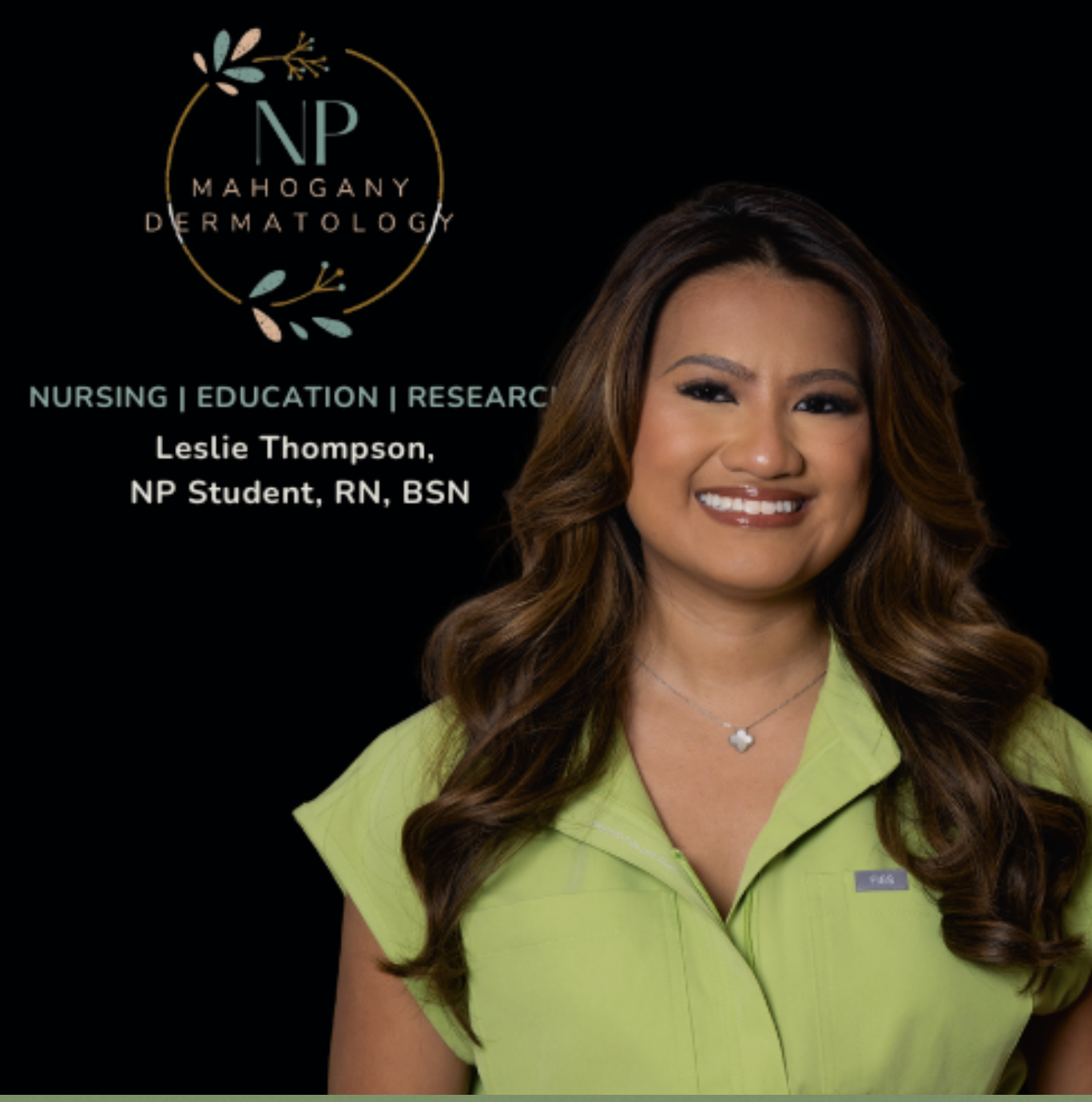
Leslie published her first article, Deeper Than Aesthetics: My Reflections on My First Year of Aesthetic Nursing. It is a must-read for every Nurse Practitioner founder, especially those who remember the overwhelming feeling of their first year in practice.
• The Content: Leslie takes you behind the curtain, offering an honest look at the steep learning curve and the professional shift required to move into the cosmetic world. Her work directly tackles the reality that success requires far more than just technical skill, it demands lifelong learning and a clear sense of professional identity.
• The Lesson: She grounds her reflections in the truth that many new entrepreneurs feel: the initial fear of doing something wrong and the difficulty of navigating a market that often lacks clear, ethical guidance.
Next Step: Don't Miss Leslie's Skin of Color Conference 2025 Deep Dive
Leslie is dedicated to bringing evidence-based insights back to our community. Later this month, she will publish her comprehensive review of the Skin of Color Update (SOCU) 2025 Conference.
This review is strategic intelligence for your practice. It will break down:
• Clinical Nuance: The protocols and latest research acknowledge how dermatologic and aesthetic cases differ across ethnicities and skin tones.
• Expert Thought Process: The actionable takeaways from the real case studies analyzed by leading dermatologists on the SOCU panel.
• The Fitzpatrick Scale Reality: Insights from her one-on-one conversation with Dr. Battle regarding the limitations of the Fitzpatrick scale and the need for further work to better capture diverse skin tones.
This content is crucial for any founder committed to excellence and addressing the Skin of Color Specialist path. To ensure you are instantly notified when Leslie Thompson's full conference review is published, you must subscribe to the Mahogany Dermatology newsletter today! Don't let this critical update get lost in the shuffle.
Melanin in Science hosts Black in AI Biotech week
Lastly, I attended the Black in Biotech: AI Week virtual series hosted by MelanInScience. This was a powerful, 4-day event exploring how artificial intelligence (AI) is intersecting with Black excellence and innovation in the field of biotechnology. The core mission of the event was to educate and empower underrepresented communities by showcasing leading Black scientists who are driving innovation in AI-driven biotech. While AI in biotechnology might seem removed from cosmetic practice, the sessions provided critical insights into the future of diagnostics, drug discovery, and personalized patient care that will soon impact dermatology and aesthetics.
The series covered key areas where AI is reshaping the industry:
• Day 1: AI in Genome Engineering: This focused on the future of Precision Biology, led by Dr. Taylor Ferebee, Ph.D..
• Day 2: AI in Healthcare and Surgery: This directly explored how AI is Transforming Patient Care, led by Waverly Rose Brim.
• Day 3: AI in Drug Discovery and Therapeutics: This looked at the pipeline for future treatments, featuring a Fireside Chat with Jonathan Bouligny.
• Day 4: The Future of AI in Biology: A panel discussion covering the Ethics, Opportunities, and Next Steps in AI-driven biology.
This event reinforced that the most visionary professionals must stay ahead of the curve, preparing for a future where AI and genetic engineering redefine our patient protocols.
With the close of September, we only have 3 months remaining within the internship and a lifetime of opportunities awaiting. The application for the 2026 Mahogany Dermatology Nursing Research Internship will open from December 22, 2025 to January 22, 2026. If you’re interested, have questions, or would like to schedule a video chat to discuss your interest, feel free to contact us.
About the Authors
Dr. Kimberly Madison, DNP, AGPCNP-BC, WCC, is a Board-Certified, Doctorally-prepared Nurse Practitioner, educator, and author dedicated to advancing dermatology nursing education and research with an emphasis on skin of color. As the founder of Mahogany Dermatology Nursing | Education | Research™ and the Alliance of Cosmetic Nurse Practitioners™, she expands access to dermatology research, business acumen, and innovation while also leading professional groups and mentoring clinicians. Through her engaging and informative social media content and peer-reviewed research, Dr. Madison empowers nurses and healthcare professionals to excel in dermatology and improve patient care.
I am a dedicated dermatology professional with over a decade of experience as a Dermatology Medical Assistant, Registered Nurse, and Clinical Nurse Coordinator. Passionate about education and inclusivity in dermatology, I joined the Mahogany Dermatology Nursing | Education | Research™ Internship to expand my knowledge and contribute to the field I love. Through this blog, I aim to share my journey as a source of inspiration for those exploring nontraditional paths in dermatology. I’m excited to help create innovative educational resources and encourage others to discover their purpose in this dynamic specialty.
.svg)

.svg)
.svg)
.png)
.jpg)