On the Killing of Alex Pretti, RN: A Call to the Entire Nursing Profession
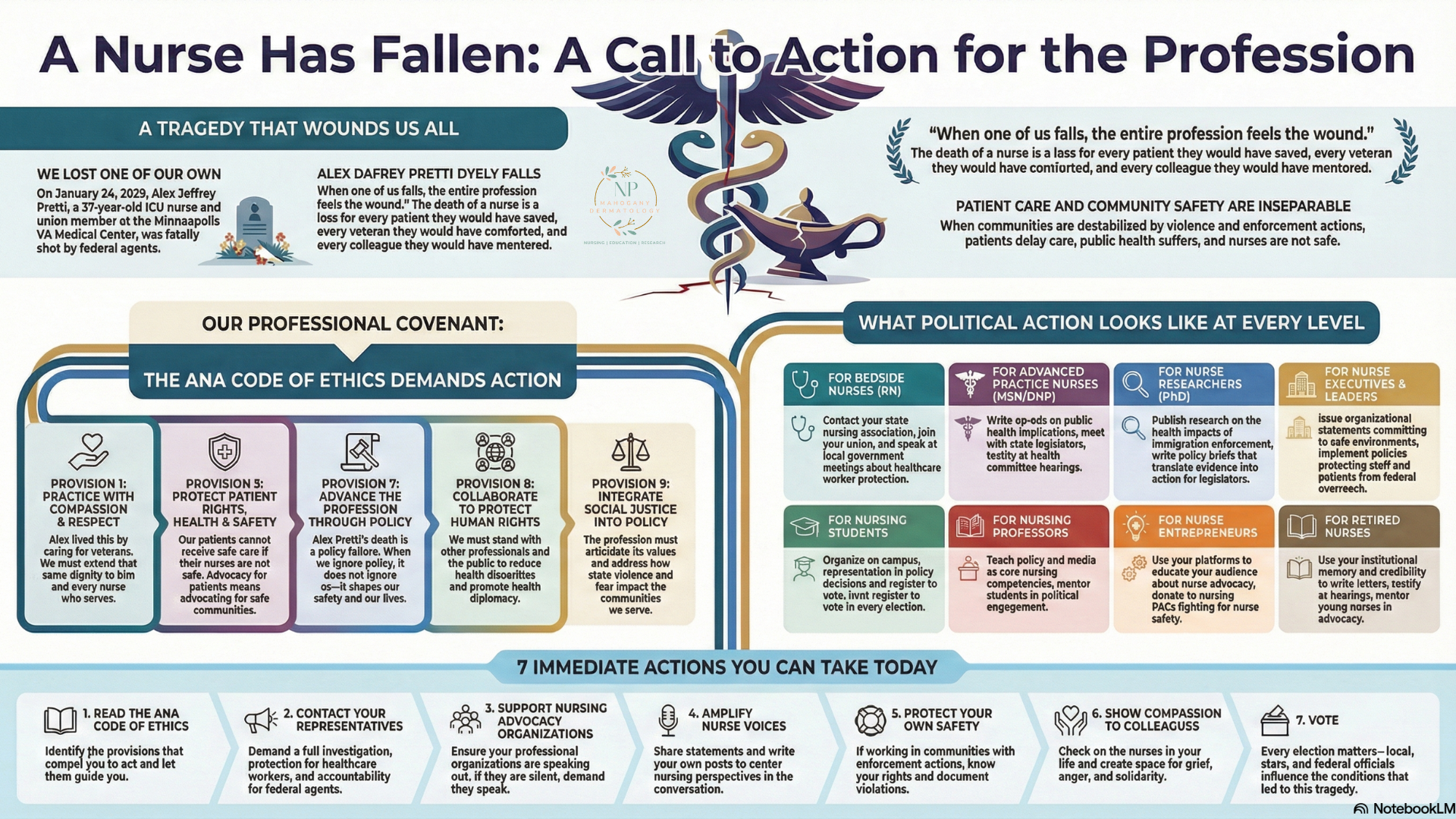
On January 24, 2026, ICU nurse Alex Jeffrey Pretti was fatally shot by federal agents during an immigration enforcement operation in Minneapolis. Alex, 37, dedicated his career to caring for veterans at the Minneapolis VA Medical Center. His death is not just a personal tragedy, it is a professional crisis that demands immediate political engagement from every nurse in America. This statement outlines why the ANA Code of Ethics compels us to act, what specific actions nurses at every level can take today (from bedside RNs to retired nurses), and how advocacy for our patients requires advocacy for safe communities. The same love and compassion we give our patients, we owe each other. After all, nurses are patients too.
On January 24, 2026, we lost one of our own. Alex Jeffrey Pretti, a 37-year-old ICU nurse at the Minneapolis VA Medical Center, was fatally shot by federal agents during an immigration enforcement operation. Alex was a member of the American Federation of Government Employees, a frontline healthcare worker who dedicated his career to caring for our nation's veterans in their most critical moments.
We grieve. We remember. We act.
Alex Pretti's death is not just a tragedy for his family and friends, it is a loss for every patient he would have saved, every veteran he would have comforted, every nurse he would have mentored. As nurses, we understand that when one of us falls, the entire profession feels the wound.
The same love and compassion we're taught to give our patients must be shared between one another. After all, nurses are patients too.
Our Code of Ethics Demands We Speak
The American Nurses Association Code of Ethics is not a suggestion, it is our professional covenant. And today, it calls us to action.
Provision 1: Practice with compassion and respect for the inherent dignity, worth, and unique attributes of every person.
Alex Pretti lived this provision. He cared for veterans in their most vulnerable moments, in the ICU where life and death hang in balance. He saw the inherent dignity in every patient. We must now extend that same dignity to him, and to every nurse who serves with courage and compassion.
Provision 3: The nurse promotes, advocates for, and protects the rights, health, and safety of the patient.
Our patients cannot receive safe care if their nurses are not safe. Our communities cannot heal if they are sites of violence. Advocacy for our patients means advocating for the conditions under which safe, dignified care is possible. When federal enforcement actions disrupt communities, create fear, and result in the deaths of healthcare workers, patient care suffers. Health equity suffers. Public health suffers.
Provision 7: The nurse, in all roles and settings, advances the profession through research, scholarly inquiry, and professional standards development, and the generation of both nursing and health policy.
Policy is not optional. It is survival. When we ignore policy, policy does not ignore us. Alex Pretti's death is a policy failure, a failure to protect healthcare workers, a failure to ensure community safety, a failure to value human life over enforcement quotas.
Provision 8: The nurse collaborates with other health professionals and the public to protect human rights, promote health diplomacy, and reduce health disparities.
We do not stand alone. We stand with physicians, social workers, public health officials, community organizers, and the people we serve. Alex Pretti was in his community. He was present. His presence cost him his life. We honor him by continuing to show up, for our patients, for our communities, and for each other.
Provision 9: The profession of nursing, collectively through its professional organizations, must articulate nursing values, maintain the integrity of the profession, and integrate principles of social justice into nursing and health policy.
This is our moment. Social justice is not abstract. It is Alex Pretti's life. It is the veterans he cared for. It is the immigrant families living in fear of enforcement. It is the Black and Brown communities disproportionately impacted by state violence. It is every nurse who goes to work wondering if their workplace, their neighborhood, their very presence could make them a target.
We are called, by our Code, by our conscience, by our colleague, to act.
Advocacy for Our Patients Means Advocacy for Our Communities
You cannot separate patient care from community conditions. When communities are destabilized by enforcement actions, patients delay care. When families fear deportation, children miss vaccinations. When federal agents kill civilians in residential neighborhoods, the entire community experiences trauma, and that trauma walks into our clinics, our hospitals, our practices.
We advocate for our patients by advocating for safe communities.
Alex Pretti understood this. He was present in his community not just as a nurse at work, but as a nurse in the world. We are taught that nursing is not just a job, it is a calling, a commitment, a way of being. That calling does not end when we clock out.
The Love and Compassion We Give Our Patients, We Owe Each Other
Nursing school teaches us to care for patients with compassion, dignity, and respect. We learn to see the whole person, not just the diagnosis, not just the procedure, but the human being with fears, hopes, families, and dreams.
We must offer that same compassion to each other.
When a nurse dies, we do not just issue a statement and move on. We grieve. We support their family. We investigate what happened. We demand accountability. We change the systems that allowed their death.
Nurses are patients too. We get sick. We experience trauma. We carry the weight of what we witness every day. We need the same advocacy, the same protection, the same fierce love that we give to those we serve. If we would fight for a patient's right to safe care, we must fight for a nurse's right to safe communities. If we would advocate for a patient's dignity, we must advocate for a nurse's dignity in death. If we would demand accountability for medical errors, we must demand accountability for state violence.
Why This Matters to Every Nurse
Whether you are an RN at the bedside, an MSN pursuing advanced practice, a DNP leading clinical innovation, a PhD conducting research, a nursing executive shaping policy, a student learning your craft, a professor educating the next generation, an entrepreneur building your practice, or a retired nurse who has given decades of service, this is your moment to engage politically.
Nurses are the most trusted profession in America for a reason. We show up. We speak truth. We protect the vulnerable. When our profession is under threat, when our colleagues are killed, when the systems we work within become sites of violence, we have both the authority and the responsibility to demand accountability.
What Political Action Looks Like at Every Level
Political action is not partisan. It is professional. It is the exercise of our collective power to shape the conditions under which we practice, the safety of our communities, and the integrity of our healthcare systems.
For Bedside Nurses (RN):
Contact your state nursing association and demand they issue statements on nurse safety and federal overreach in community health spaces
Join or strengthen your union, Alex was AFGE, and labor protections matter
Document and report any federal presence in your healthcare facility that compromises patient care or staff safety
Speak at city council and county board meetings about community safety and healthcare worker protection
Invoke Provision 3 of the Code of Ethics: you are protecting the rights, health, and safety of your patients by protecting their communities
For Advanced Practice Nurses (MSN, DNP, AGPCNP-BC, FNP, PMHNP, etc.):
Use your clinical authority to write op-eds for local newspapers about the public health implications of enforcement actions in communities
Meet with your state legislators, you have prescriptive authority, diagnostic authority, and policy credibility
Testify at state health committee hearings about how fear of enforcement impacts patient care and health outcomes
Leverage your business platforms to educate patients about their rights and your commitment to safe care environments
Invoke Provision 7 of the Code of Ethics: you are advancing the profession through the generation of health policy
For Nurse Researchers and PhD-Prepared Nurses:
Investigate and publish on the health impacts of immigration enforcement on community health outcomes
Submit testimony to federal agencies using your research to inform policy
Write policy briefs for legislators that translate evidence into action
Serve on advisory boards that shape federal health and enforcement policy
Invoke Provision 8 of the Code of Ethics: you are collaborating with the public to protect human rights and reduce health disparities
For Nurse Executives and Leaders:
Issue organizational statements committing to safe healthcare environments free from enforcement actions
Implement policies protecting staff and patients from federal overreach in clinical spaces
Allocate resources to legal support for nurses facing political retaliation for advocacy
Create coalitions with other healthcare systems to present unified policy demands
Invoke Provision 9 of the Code of Ethics: you are articulating nursing values and integrating principles of social justice into health policy
For Nursing Students:
Organize on your campuses, nursing students have historically been powerful political voices
Attend state nursing association meetings and demand student representation in policy decisions
Use your clinical rotations to understand the intersection of health, policy, and enforcement
Register to vote and vote in every election, local, state, and federal
Invoke Provision 1 of the Code of Ethics: you are practicing with compassion and respect for the inherent dignity of every person
For Nursing Professors and Educators:
Teach the 9 Pillars of Advanced Practice Nursing, including the policy and media pillars that most nursing schools ignore
Integrate the ANA Code of Ethics into every course, showing students how ethical nursing practice requires political engagement
Invite legislators to speak in your classes and hold them accountable to nursing concerns
Mentor students in political engagement as a core nursing competency
Publish curricula that integrate health equity, community safety, and political literacy
For Nurse Entrepreneurs:
Use your platforms, social media, podcasts, newsletters, to educate your communities about nurse advocacy
Donate to nursing PACs and organizations fighting for nurse safety and community health
Leverage your business networks to mobilize other healthcare entrepreneurs around policy issues
Model political engagement for your employees, clients, and followers
Invoke Provision 8 of the Code of Ethics: you are collaborating with the public to promote health diplomacy
For Retired Nurses:
You have institutional memory, professional credibility, and time, use all three
Write letters to the editor, testify at hearings, mentor young nurses in advocacy
Join or lead coalitions of retired healthcare professionals demanding accountability
Vote, phone bank, and organize in your communities
Invoke your lifetime of service: you have earned the right to speak, and the profession needs your voice
The 9 Pillars and Political Engagement
At the Alliance of Cosmetic Nurse Practitioners, we teach the 9 Pillars of Advanced Practice Nursing: patient care, personal well-being, professional development, financial literacy, research, policy, media, technology, and business.
Alex Pretti's death sits at the intersection of patient care, policy, and personal well-being.
Patient care: Our patients cannot receive safe care if their nurses are not safe, and their communities are not safe.
Policy: When we ignore policy, policy does not ignore us. It shapes our practice environments, our reimbursement, our scope, our safety, and, as we have seen this week, our lives.
Personal well-being: We cannot pour from empty cups. We cannot care for others if we do not care for each other. We cannot advocate for patients if we do not advocate for ourselves.
Immediate Actions You Can Take Today
Read the ANA Code of Ethics (https://codeofethics.ana.org/provisions) and identify which provisions compel you to act. Write them down. Let them guide your actions.
Contact your representatives: Call, email, or visit your city council members, state legislators, and federal representatives. Demand:
Full independent investigation of Alex Pretti's killing
Protection of healthcare workers and healthcare spaces from enforcement actions
Accountability for federal agents who kill civilians
Policies that prioritize community safety and public health
Support nursing advocacy organizations: American Nurses Association, AANP, National Black Nurses Association, DNPs of Color, the Society of Psychiatric Mental Health Nurse Practitioners of Color, the National Black Nurse Practitioner Association, National Association of Hispanic Nurses, Philippine Nurses of America, Network of Black Male Nurse Leaders, your state nursing association, make sure they are speaking on this. If they are silent, demand they speak.
Amplify nurse voices: Share statements from nursing organizations, write your own posts, use your platforms to center nursing perspectives in this conversation.
Protect your own safety: If you work in communities experiencing enforcement actions, know your rights, document everything, and do not remain silent if you witness violations.
Show compassion to your colleagues: Check on the nurses in your life. Ask how they are processing this. Create space for grief, anger, fear, and solidarity.
Vote: Every election matters. Local prosecutors, sheriffs, city councils, state legislators, governors, federal representatives, these are the people who directly influence conditions like those that killed Alex Pretti.
The love and compassion we give our patients, we give to Alex. We give to his family. We give to each other. We give to the profession that calls us to be more than we thought possible.
In solidarity, with love, and with determination,
Dr. Kimberly Madison, DNP, AGPCNP-BC, WCC
About the Author
Dr. Kimberly Madison, DNP, AGPCNP-BC, WCC, is a Board-Certified, Doctorally-prepared Nurse Practitioner, educator, and author dedicated to advancing dermatology nursing education and research with an emphasis on skin of color. As the founder of Mahogany Dermatology Nursing | Education | Research™and the Alliance of Cosmetic Nurse Practitioners™, she expands access to dermatology research, business acumen, and innovation while also leading professional groups and mentoring clinicians. Through her engaging and informative social media content and peer-reviewed research, Dr. Madison empowers nurses and healthcare professionals to excel in dermatology and improve patient care
.svg)

.svg)
.svg)