Do Hair Relaxers Cause Breast Cancer? What We Know and Don't Know
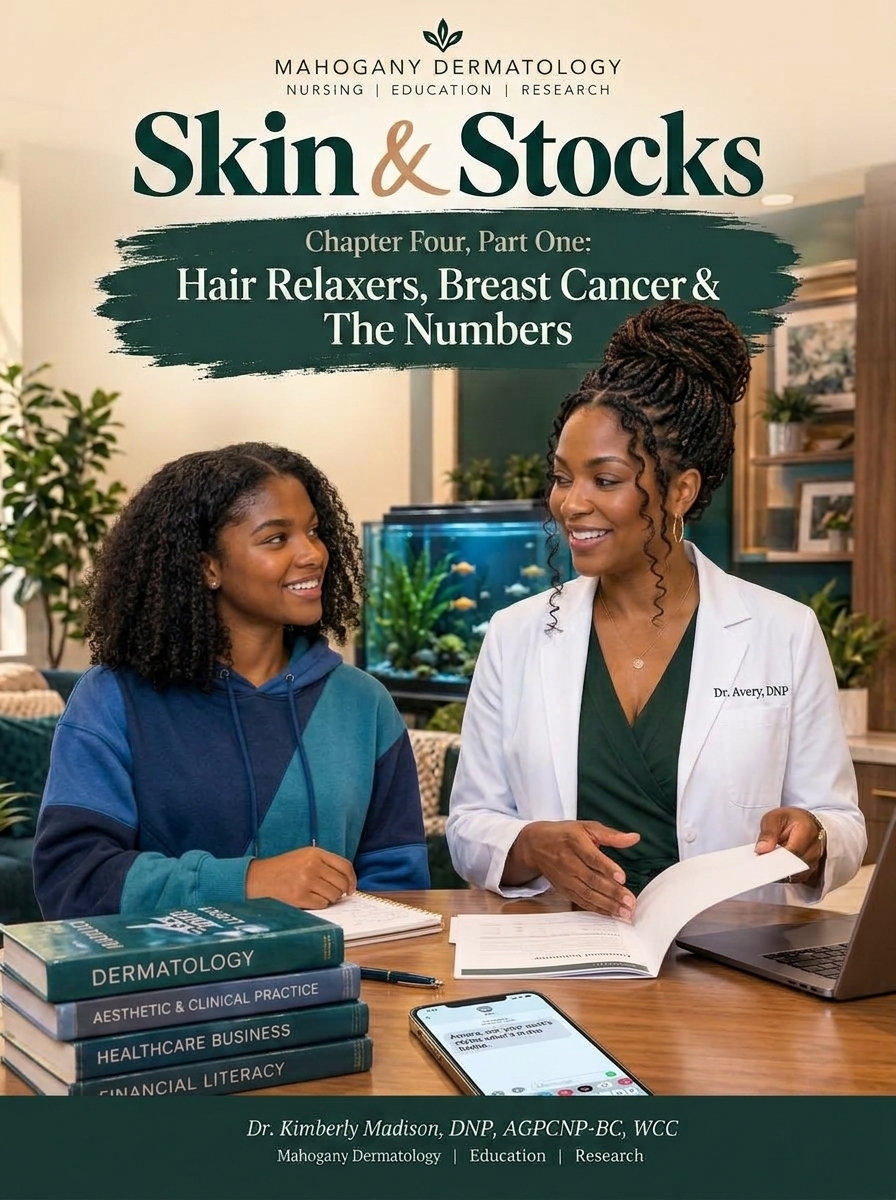
This October, during Breast Cancer Awareness Month, Nyla gets a question she can't answer yet. Her best friend's aunt asked at the hair salon whether relaxers cause cancer, and Nyla promised to find out. So she reads her first real research study, and Dr. Avery, DNP helps her make sense of the numbers, first on the page and then with a patient who asks the very same thing. Along the way, Nyla learns that reading a study and reading a stock take the same habit: ask what the number says, how sure we are, and what we still don't know.
Chapter Four, Part One
Nyla had been at Mahogany Dermatology Nursing long enough to know which chair in the waiting room squeaked and which exam room Dr. Avery, DNP liked to use for teaching. She did not expect the biggest question of her summer to arrive as a text message.
On Friday, Dr. Avery, DNP had handed her a printed research study with one instruction: read it, and bring me your questions. On Saturday, Amara texted. Her aunt had asked at the hair salon whether relaxers cause cancer, and Amara wanted to know what Nyla thought. Nyla typed the only answer she had, I'll find out.
She read the study twice over the weekend. She understood the title, the first paragraph, and almost none of the numbers. On Monday she walked into Mahogany with three lines highlighted in yellow and a question mark beside each.
Dr. Avery, DNP read the first highlighted line. "Hazard ratio, 1.13. Confidence interval, 0.96 to 1.33. Good place to start. A hazard ratio compares how often breast cancer showed up in one group of women to how often it showed up in another. 1.00 means the same. 1.13 means 13 percent more in the heavy-use group. The range, 0.96 to 1.33, is where the true number most likely sits. Because the range dips below 1.00, the study can't rule out that heavy use made no difference at all."
"So it isn't a real difference?"
"It means the study can't say it is. That's a different statement, and the second one is the one we can defend. Come with me. A patient is asking this exact question."
The woman in the exam chair was 38, and she had relaxed her hair every 7 weeks since she was 15. "I keep seeing posts about relaxers and cancer," she said. "Should I be scared?"
"That's a fair question to ask," Dr. Avery, DNP said. "Lifetime risk of breast cancer is similar for Black and white women in the United States, but Black women are more often diagnosed with aggressive subtypes and at younger ages, and they die of it at a higher rate. That's why researchers keep asking whether products many Black women use could play a part. Let me tell you what one of the largest studies in Black women found, and what it couldn't tell us. Researchers followed 50,543 Black women from 1997 to 2017, and 2,311 of them developed breast cancer. Women who used relaxers heavily, meaning 15 years or more at 7 or more times a year, had a 13 percent higher rate of breast cancer than women who used them lightly or not at all. That difference was small enough that it could be chance. A study like this can show whether two things travel together, but it can't prove that one causes the other. The authors called the overall results largely null."
The patient's shoulders dropped half an inch. "Largely."
"Yes. When the researchers looked only at relaxers containing lye, which is sodium hydroxide, and only at estrogen-receptor-positive cancers, the ones that use estrogen to grow, the numbers rose. Women using lye relaxers 7 or more times a year had a 37 percent higher rate in that group, and that range stayed above 1.00. But the overall trend test came in just short of the usual cutoff, and the researchers looked at many subgroups, so a result like that can show up by chance. Relaxers without lye showed no increase. The study also found no link between leave-in conditioners or oils and breast cancer. And studies don't all agree. A study in Ghana found the stronger signal with non-lye products, and the Sister Study found higher rates with frequent straightener use that didn't reach statistical significance."
"I don't know which kind I use," the patient said.
"You're in company. 13 percent of the women in that study didn't know either. Ask your stylist for the product name this week and bring it to me. Keep your screening mammograms on the schedule we set, and tell me about any scalp burns, because burns matter for your scalp whatever the cancer data show. What I give you is a number, a range, and a list of what the study couldn't tell us. It had no brand-level information, and it didn't track changes in use after 1997."
After the visit, Nyla stood in the hallway with the paper against her chest. "That was a better answer than yes or no."
"A yes or no would have been wrong either way," Dr. Avery, DNP said. "Come sit down. Bring the valuation report I sent home with you. I have a number and a range of my own to show you."
In the office, with the fish drifting behind the glass, Nyla set the second packet on the desk. Every page was covered in small letters. "I stared at r and g and P0 for twenty minutes and got nowhere."
"Most owners freeze at that exact spot, from nurse practitioners to medspa founders, the moment corporate finance vocabulary shows up," Dr. Avery, DNP said. "You don't need advanced math for any of it. You need basic algebra, practical logic, and the patience to let each idea build on the last. By the end of today you'll be able to value a share of stock, and that skill is part of what I call time freedom, the point where your money works so your hours don't have to."
She pulled the notepad close. "Start with one share. Say it costs $40 today. That price is called P0. A share owner earns in two ways. The company can pay a dividend, a slice of its profit in cash. Say $2 at the end of the year, called DIV1. And the share price itself can rise, which is a capital gain. Say investors expect it to be $42 next year, called P1. The total return, r, is the dividend plus the price change, divided by what you paid."
Nyla wrote it out. "$2 plus $42 minus $40 is $4. And $4 over $40 is 10 percent."
"10 percent. That's the return investors demand for the risk of holding the share, and it's also called the opportunity cost of capital, because it's what the money could earn somewhere else. Now flip the formula around. If I know the year-end payoff and the return investors demand, I can find the price today by dividing the payoff by 1 plus r."
"$2 plus $42 is $44. Divided by 1.1." Nyla paused. "$40."
"So today's price is the present value of next year's dividend plus next year's price. Now ask what sets next year's price. The same logic does. Next year's price is the present value of the year-two dividend plus the year-two price. Substitute that back in, and keep going year after year. The price today becomes the present value of every dividend through year H, plus the present value of the price at year H. Stretch H toward forever and the price at the end shrinks toward zero in today's money, and what remains is this." She wrote a sum sign with a small infinity above it. "A share is worth the present value of every dividend it will ever pay."
"Forever is a lot of dividends," Nyla said.
"It is, and we'll shortcut it in a minute. First, a rule that protects you from an expensive mistake. Cash flow forecasts come in two forms. Nominal cash flows are in actual future dollars, with inflation baked in. Real cash flows are in today's purchasing power, with inflation removed. Nominal cash flows must be discounted with a nominal rate, and real cash flows with a real rate. The two are linked." She wrote: 1 plus nominal equals 1 plus real, times 1 plus inflation. "With a 10 percent nominal return and 3 percent inflation, the real return is 1.10 divided by 1.03, minus 1, which is about 6.8 percent. If you forecast in today's dollars and then discount at the full 10 percent, you understate what your assets are worth, and the error grows when supply costs and service fees are rising."
Nyla underlined match them.
"Now the shortcut. If dividends grow at one steady rate, g, forever, the whole infinite sum collapses into the Gordon Growth Model. Price equals next year's dividend divided by r minus g, as long as r is bigger than g. $2, 10 percent, 5 percent growth."
"$2 divided by 0.05." Nyla smiled. "$40. The same $40."
"And $42 next year is $40 times 1.05, so everything agrees. Turn it around and you get the capitalization rate, r equals the dividend yield plus growth. $2 over $40 is 5 percent, plus 5 percent growth, is 10 percent. It's the same backward move I made on the laser last time, when a 2 percent yield and 6 percent growth told me investors wanted 8 percent."
Nyla looked at the page, then at the g in the middle of it. "But where does the growth come from? A company can't just announce it."
"That's the question the rest of this report answers, and it's where we start next time," Dr. Avery, DNP said. "Here's your homework. If a company keeps its profit instead of paying it out, what would you need to know before deciding whether that was a good move?"
Nyla wrote the question at the top of a clean page. Then she picked up her phone and started a text to Amara, in plain words, about what the study says and what it doesn't, with one line at the end. Ask your aunt's stylist what's in the bottle.
This installment is dedicated to my mom and my uncle, both breast cancer survivors. You can hear them share their story on The Melanin Initiative Podcast.
Behind this chapter: Written in recognition of Breast Cancer Awareness Month. The clinical content in this chapter summarizes Coogan PF, Rosenberg L, Palmer JR, Cozier YC, Lenzy YM, and Bertrand KA, "Hair product use and breast cancer incidence in the Black Women's Health Study,"Carcinogenesis, 2021, 42(7): 924–930. The patient counseling is educational and does not replace individual medical advice. The first half of the finance arc, covering expected return, discounted dividends, real versus nominal cash flows, the Gordon Growth Model, and the capitalization rate, comes from the common stock valuation framework in Brealey and Myers' Principles of Corporate Finance and the Master Class report from Trade for More Time Freedom, applied here with story numbers, in keeping with this year's whitepaper, Financial Literacy as a Clinical Competency. The mentorship model comes from Dr. Kimberly Madison's, DNP, book, Nursing Aesthetics: An Introductory Guide for Nurse Practitioners & Entrepreneurs.
Nyla just learned to ask how big a number is and how sure we are of it, and real students are asking the same questions about their own paths. Clarence Sams, MS4 at Charles R. Drew University, shares his on The Melanin Initiative's "Becoming a Physician" series, and Ijenna Adibe, a senior at Howard University, shares hers too. Wherever you're starting from, the door is already open.
About the Author
Dr. Kimberly Madison, DNP, AGPCNP-BC, WCC, is a Board-Certified, Doctorally-prepared Nurse Practitioner, educator, researcher, and author dedicated to advancing dermatology nursing education with an emphasis on skin of color, business acumen, and digital literacy. She is the founder of Mahogany Dermatology Nursing | Education | Research™ and the Alliance of Cosmetic Nurse Practitioners™, the first dermatology nursing organization in the country built at the intersection of clinical excellence, skin of color care, and financial literacy for nurses. A selected participant in the Harvard Business School Foundry Mindset Bootcamp, Dr. Madison continues to sharpen the entrepreneurial infrastructure behind her mission. Through peer-reviewed research, published books, and a growing community of nurse entrepreneurs, Dr. Madison is building the infrastructure that makes this profession sustainable for the people who choose it.