A New Hyperpigmentation Review: What it Means for Nurse Practitioners in Dermatology, Aesthetics, & Beauty
I have spent this week at AfroTech, volunteering with the African American Health Coalition to offer skin screenings. Two conversations came up more than any others. Stress was one, and hyperpigmentation was the other. So imagine how excited I was to see a new review in one of my favorite journals, the Journal of Drugs in Dermatology. The lead author is Dr. Susan Taylor, MD, a past president of the American Academy of Dermatology. When Dr. Taylor publishes, I have to read it, and then I bring it to you. The review, Fundamentals of Hyperpigmentation Disorders, brings research published from 2000 to 2026 into one clinical picture. It speaks to both of those conversations, because it covers the emotional weight that pigment changes can carry as well as the treatments. The authors also state clearly where more research is needed. This article looks at two things: what the review adds to the literature, and how nurse practitioners in dermatology, aesthetic, and beauty can support the work already underway.
Background and Significance
This review is a comprehensive look at the literature, not a new clinical trial. The six authors, all dermatologists, searched PubMed and MEDLINE for studies published from 2000 to 2026, with extra attention to work from 2015 onward. They gave priority to randomized controlled trials, meta-analyses, consensus statements, and large population studies. Pigmentary disorders, including hyperpigmentation, are among the most common diagnoses in patients with African, Asian, and Hispanic heritage. In one cross-sectional analysis of 41,283 patients, melasma, the condition that causes patches of darker skin on the face, was significantly more common in Asian and Hispanic populations and strongly linked to rosacea and atopic dermatitis.
Readers should also know that Beiersdorf, Inc. supported publication of the manuscript, and the authors disclose relationships with many companies in dermatology. Those disclosures are standard. They are a reason to read the treatment tables with care and to open the primary studies behind them.
Visible Light Belongs in Every Sun Protection Conversation
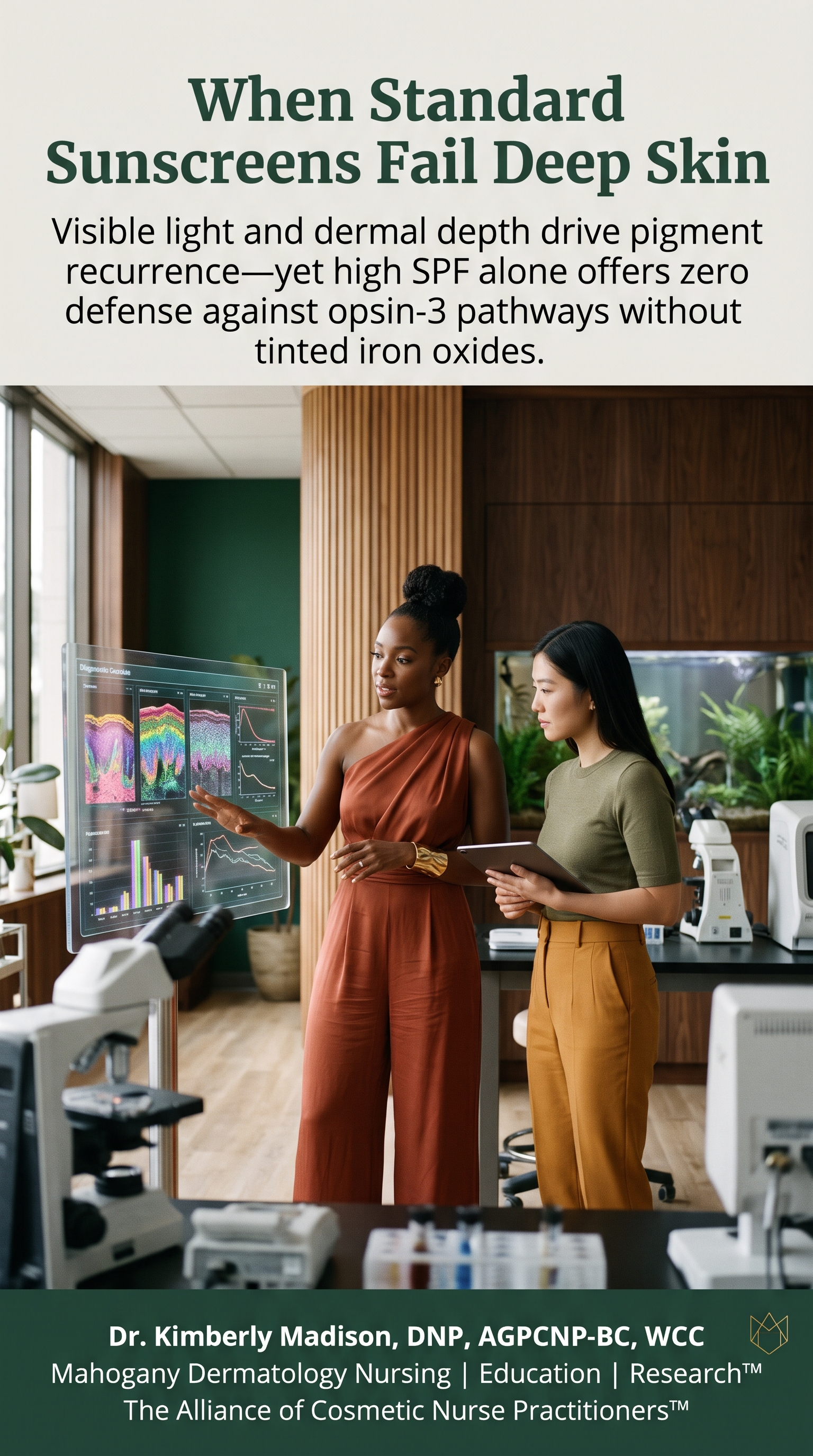
The review points to visible light as a driver of pigment, and it explains how. Visible light, especially the high-energy blue band, acts on a light-sensing protein in melanocytes called opsin-3. That sets off signals that keep pigment production running in medium to deep skin tones. Broad-spectrum sunscreens block ultraviolet light only, so a high SPF alone is not enough for these patients. The authors report that tinted sunscreens containing iron oxides or pigmentary titanium dioxide are the only formulations backed by randomized data showing they prevent visible-light-induced darkening. Early studies suggest that adding topical antioxidants may add protection.
Depth Decides Whether Treatment Works
The authors call depth the most consequential feature of hyperpigmentation. Pigment that sits in the dermis, or in both layers, resists topical treatment and accounts for most treatment failures when it is overlooked. In melasma, they describe damage to the basement membrane, which is the thin layer between the epidermis and the dermis, along with senescent fibroblasts, mast cells, and higher levels of vascular endothelial growth factor. These findings help explain why melasma is chronic, why it often rebounds after procedures, and why the authors support combining treatments.
Two conditions are easily mistaken for melasma. Maturational dyschromia appears as ill-defined patches on the cheeks, temples, and forehead of middle-aged and older patients, and a wrong diagnosis can lead to inappropriate hormonal counseling and overuse of hydroquinone. Acquired dermal macular hyperpigmentation, a group that includes lichen planus pigmentosus and Riehl melanosis, is concentrated in patients with deeper skin tones and needed international consensus statements just to align its names. The review also covers infectious causes that are often under-taught. Chikungunya, for example, can darken the center of the face and the nose, and one hospital series reported this sign in 37.5 percent of patients.
Patient-Reported Burden Counts as Much as Pigment
A 2022 meta-analysis of 14 studies and 1,398 people found consistent quality-of-life impairment in melasma across diverse populations, with emotional distress and impaired social functioning leading the list. The authors stress that improvement on a clinical severity score does not reliably match what patients report. A patient who still feels the impact after clinical improvement is not reporting in error. They also note that acne is linked to anxiety, depression, and suicidal ideation, and that in deeper skin tones the leftover pigment often outlasts the pimples. Their recommendation is to measure patient-reported burden at baseline and again at follow-up.
Diagnostic Tools Need Validation Across Skin Tones
The authors report that many of the tools we rely on were validated mostly in lighter skin. Wood lamp contrast fades as natural melanin increases, which limits its ability to sort subtypes in deeper skin tones, exactly where the distinction would most change treatment. Dermoscopy atlases lean toward lighter skin as well, and a 2022 review found widespread underreporting and underrepresentation of diverse skin types in machine-learning research. Without validation across skin tones, the authors say, claims that an algorithm performs equally well for everyone are unsupported.
What the Review Adds, and What It Leaves Open
A review does not report new data, so its contribution is synthesis. This one links biology to treatment choice, with a figure that maps each treatment class to the point in the pigment pathway it targets. It places patient-reported burden next to clinical scores. Its treatment table also shows how much still rests on consensus. Several agents, including the non-hydroquinone triple combination, cysteamine, arbutin, and topical tranexamic acid, are labeled as consensus-based rather than backed by randomized trials. Each is a research opportunity.
The conclusion lists where the remaining opportunities are concentrated: dermoscopy atlases, machine-learning training data, validated outcome measures, and trial populations that underrepresent patients with deeper skin tones. To close them, the authors call for inclusive trial design, validation stratified by skin tone, harmonized outcome measures, and attention to patient-reported burden. Until then, they say, the dermatology community must apply the existing evidence with awareness of the populations it came from, and must seek, document, and act on patient-reported burden in every consultation.
Implications for Dermatology and Aesthetic Nurse Practitioners
The review asks the dermatology community to apply the evidence carefully and to document what patients tell us. Nurse practitioners are positioned to do both, working alongside dermatologists.
Counseling is a nursing superpower, and the review gives us a specific counseling point. When a patient with dark spots says they wear sunscreen daily, the next question is whether it is tinted and whether it blocks visible light. That one question brings the review's strongest sun protection finding into the visit.
Follow-up visits are where the recommendation on patient-reported burden lives. We can ask the same structured questions at baseline and at each return, record the answers, and flag patients whose skin has improved but whose distress has not. That documentation is also data that other researchers can use.
Recognition and referral come next. The review identifies pigment depth as the feature that most often explains treatment failure. A careful medication history matters, because the review lists minocycline, antimalarials, amiodarone, and chemotherapy among the drug causes. A sun spot that does not look like its neighbors needs to be told apart from early lentigo maligna. When the pattern is dermal, mixed, or uncertain, a referral to dermatology is part of the plan, and shared follow-up serves the patient better than a handoff.
Aesthetic nurse practitioners carry a specific responsibility, because the review's procedure table lists cautions for deeper skin tones. It advises avoiding cryotherapy for sun spots, using caution with intense pulsed light, recognizing that multiple Q-switched laser passes raise the risk of rebound pigment, and keeping Jessner and low-concentration trichloroacetic acid peels with experienced operators. It also states that intravenous glutathione is not recommended at any line of therapy, because the efficacy data are insufficient and safety concerns remain. Patients may ask about it, so a clear answer helps. Where oral tranexamic acid falls within our scope of practice and state rules, the cited consensus calls for screening for clotting risk before treatment and regular monitoring afterward.
Clinical Pearls You Can Use This Week
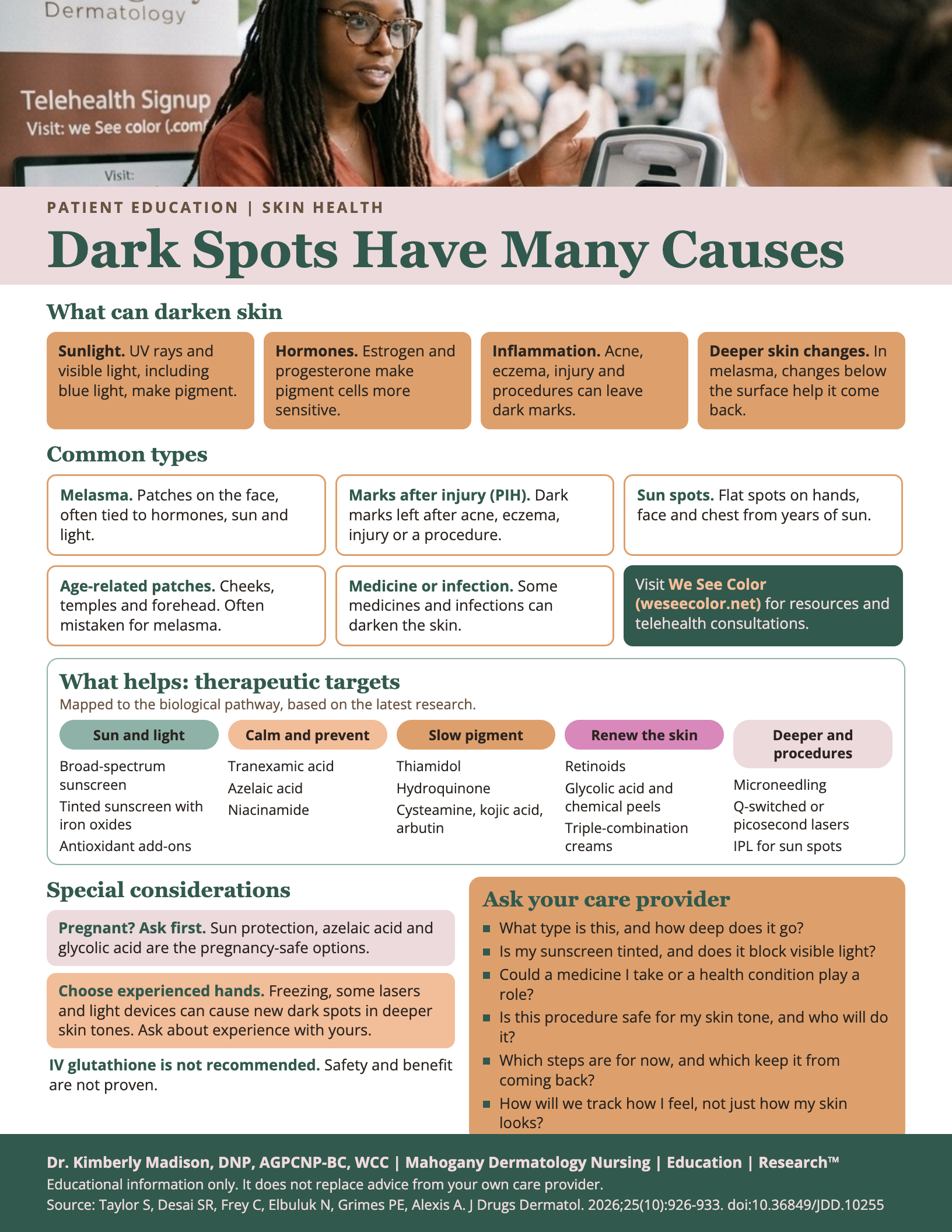
Diagnosis comes first. Dark spots have many causes, including melasma, marks left after injury, sun spots, age-related patches, medicines, and infections. Each type has its own plan, so naming the type is the first step in patient education.
Sunscreen for dark spots should be tinted. Visible light drives pigment, and the sunscreens with randomized data behind them contain iron oxides or pigmentary titanium dioxide. Ask patients to read the label, and ask whether the product they use blocks visible light. My earlier article on tinted sunscreen covers what to look for when choosing one, including broad-spectrum coverage, a tint that suits the patient, texture, active ingredients, and cost. My follow-up, The Best Tinted Sunscreens for Skin of Color: NP Approved, shares a list of favorites from dermatology nurse practitioners at the 2025 Society of Dermatology Nurse Practitioners conference, sorted by budget and skin type.
Marks can outlast their cause. Dark marks left by acne, eczema, injury, or a procedure often last longer than the original problem in deeper skin tones. Put the marks and what caused them in the same plan.
Treatment works in layers, and it takes time. The review supports combining sun protection, topical treatment, and procedures when needed, followed by a maintenance plan. Maintenance differs from active treatment, and long-term hydroquinone use should be limited or closely monitored.
Pregnancy changes the plan. The pregnancy-safe options named in the review are sun protection, azelaic acid, and glycolic acid. Patients who are pregnant or planning should ask before starting anything.
Intravenous glutathione is not recommended. The review finds the evidence for benefit insufficient and the safety concerns unresolved.
Patients can ask about experience and tracking. Good questions include who will perform a procedure on their skin tone, and how progress will be tracked in terms of how they feel, not only how their skin looks.
DNP Project Ideas
The review's own priorities translate into projects that a DNP student can finish inside a clinical setting. Each of the three below matches one project type.
Quality improvement. Add patient-reported burden to hyperpigmentation visits. The project places a validated measure at baseline and at follow-up, such as the Melasma Quality of Life scale or the Dermatology Life Quality Index that I recommended in my earlier article on tinted sunscreen. A plan-do-study-act cycle can track how often the form is completed, how often results are discussed in the visit, and how many patients are flagged because their distress stayed high while their skin improved.
Adherence and sample programs. Pair this review with my NP Approved tinted sunscreen article, which outlines a step-by-step DNP project on tinted sunscreen adherence. It also suggests a sample program for community clinics, where patients try a small tube of tinted sunscreen for about 30 days. Adding a visible-light message and a patient-reported burden score to that design would tie it directly to this review.
Evidence-based practice. Turn the review and the global consensus it cites into a written clinic protocol for melasma and post-inflammatory hyperpigmentation. The protocol would cover visible-light sun protection, first-line topical choices, escalation steps, and a maintenance phase. The project question could ask whether adults who receive a structured maintenance plan after active treatment have fewer relapses at six months than those who do not, with relapse defined before data collection begins.
Policy. Write and test a procedure-readiness policy for aesthetic services in deeper skin tones. The policy would set a documented consultation, a skin-tone-specific consent discussion, and a competency check before laser, intense pulsed light, or peel treatments. A second policy topic is a clear practice position on intravenous glutathione, based on the review's statement that it is not recommended.
A Five-Step Guide to Putting the Review Into Practice
Step one: name the type and the depth. Ask where the pigment started, what came before it, and what medicines the patient takes. Check whether the pattern fits melasma or one of its look-alikes, and note whether the patient is pregnant or planning a pregnancy. Refer to dermatology when the pattern is dermal, mixed, or uncertain, or when a spot looks unusual.
Step two: fix sun protection first. Recommend a tinted sunscreen with iron oxides or pigmentary titanium dioxide, and explain that visible light, not only ultraviolet light, drives pigment. Ask the patient to bring their product to the next visit.
Step three: build the layers. The review supports combining topical agents that act on different parts of the pigment pathway, then adding procedures only when the disease is refractory or deeper. Choose procedures with the skin-tone cautions in mind, and bring in dermatology early for refractory cases.
Step four: measure what the patient feels. Record a patient-reported quality-of-life score at baseline and at each follow-up, next to a clinical severity rating. Treat a high score with an improved rating as a signal for more support, not as a reporting error.
Step five: plan maintenance and document the outcome. Move from active treatment to a maintenance plan, limit long-term hydroquinone use, and write down what worked. Those notes feed quality improvement projects, case reports, and the research that the authors say is still needed.
PhD Research Opportunities
The authors list the remaining research needs themselves, which makes this review a ready map for doctoral candidates. Four opportunities stand out.
The first is validating the tools we use across skin tones. The review reports that Wood lamp contrast fades in deeper skin and that dermoscopy atlases lean toward lighter skin. Studies that test how well these tools estimate pigment depth in diverse patients would answer a question the authors raise directly. The same logic applies to machine learning, where the review calls for validation stratified by skin tone. That connects to the AI-assisted dermatology work I co-authored in the Journal of Clinical and Aesthetic Dermatology on provider shortage areas.
The second is outcome measurement. The review explains that clinical severity and patient-reported burden track each other inconsistently. A study that follows both over time, and asks patients what the difference means to them, would help build the harmonized outcome measures the authors request.
The third is trial representation. The review states that trial populations underrepresent patients with deeper skin tones, and an audit of who is actually enrolled in hyperpigmentation trials would put numbers on that statement.
The fourth is the evidence behind treatments labeled as consensus-based. Pragmatic trials of cysteamine, arbutin, and topical tranexamic acid in diverse populations would move them from expert opinion toward randomized evidence.
Each of these opportunities grows stronger when we pull a seat up to the same table for other disciplines. Biomedical engineers and computer scientists can build and test imaging and machine-learning tools on data that includes deeper skin tones, while we bring the clinical questions, the patients, and the follow-up. Cosmetic scientists can test whether sunscreens and skin care products perform as claimed on diverse skin, and my earlier article on tinted sunscreen featured one of them, Dr. Julian Sass, who has tested hundreds of sunscreens for white cast. Biostatisticians can strengthen trial design and sample size. Beauty professionals, including estheticians, cosmetologists, and hair care specialists, bring everyday knowledge of how people describe and care for their skin, which helps us write patient-reported measures in words patients recognize. Co-authored studies, shared data sets, and joint grant applications are practical ways to start.
My NP Approved article outlines a related research question for nurse scientists, which is why patients with deeper skin tones are less likely to use daily sun protection. It proposes a mixed-methods study that combines surveys with interviews or focus groups. It also suggests following visible light protection over time in melanin-rich skin and examining how many patients with deeper skin tones are enrolled in sunscreen trials. Each of these questions gets stronger with a cosmetic scientist, a statistician, and a beauty professional on the team.
Three dissertation topics follow from these opportunities. One could test the accuracy of depth assessment methods for pigment in deeper skin tones. Another could run a longitudinal mixed-methods study of the difference between clinical severity and patient-reported burden in melasma and post-inflammatory hyperpigmentation. A third could examine how skin tones are reported in hyperpigmentation trials and in the images used to train clinicians.
Entrepreneurial Opportunities
Evidence creates demand for people who can translate it. Three opportunities fit nurse practitioners who want to build around this review.
The first is patient education. Visible light, tinted sunscreen, and the difference between types of dark spots are topics that patients need explained in plain words, and the review gives us the content to do it accurately. Workbooks, group classes, and short video series can leverage our clinical experience and community trust to reach people before a visit, and they extend the reach of dermatology teams without competing with them.
The second is outcome tracking. The review asks clinicians to record patient-reported burden at baseline and at follow-up, which means practices need a simple way to do it. A nurse practitioner who builds a lightweight intake and follow-up process, and packages it for other practices, has a competitive advantage that rests on a documented need.
The third is training. The procedure cautions in the review, and the call for experienced operators, point to a demand for continuing education that covers skin tone considerations for lasers, light devices, and peels. Teaching that material well, with case review and competency checks, is a business built on the authors' own recommendations.
Collaboration changes what we can build. An engineer can turn a follow-up process into software that tracks patient-reported scores. A cosmetic scientist can help test a product claim before it reaches a label. A beauty expert can help design a plain-language routine that fits real life, such as how to layer tinted sunscreen with other products. Dermatologists review the clinical accuracy. My earlier article on tinted sunscreen highlighted two examples of this kind of partnership: a dermatologist who co-founded a teledermatology service with her brother, a physician who holds an MBA, and a cosmetic scientist who built a public sunscreen database. Put roles, data ownership, credit, and revenue in writing at the start, so the partnership holds up. A team that combines a clinician, a scientist, an engineer, and a beauty expert is a competitive advantage that a single-discipline team finds hard to match.
My NP Approved article lists more ideas that fit here: a private-label tinted sunscreen line for melanin-rich skin, continuing education modules on sun protection for advanced practice providers, curated tinted sunscreen collections stocked with medspas and clinics, and an app that matches patients with sunscreens by skin tone, concerns, and budget. Each one needs partners beyond nursing. A private-label line needs a cosmetic scientist to formulate and test it. The matching app needs an engineer or computer scientist. Product testing and packaging benefit from a beauty expert who knows what patients actually want to put on their skin, and our nursing voice supplies the clinical guidance and patient trust.
Thiamidol shows what a patient-focused research program can build. The review lists it as a selective human tyrosinase inhibitor, which means it blocks the enzyme that makes pigment. It reports a 90-day trial with blinded evaluators in which thiamidol worked at least as well as 4 percent hydroquinone for melasma, with a 43 percent drop in the severity score compared with 33 percent. It also cites a 24-week trial against a cream without the active ingredient, in patients with moderate to severe melasma. Beiersdorf describes more than 20 years of work behind it. Many earlier pigment blockers were tested on mushroom tyrosinase, which behaves differently from the human enzyme, so the company produced human tyrosinase to test against and screened 50,000 compounds before launching thiamidol in 2018. The pattern is worth noticing. They questioned the standard test, built a better one, and funded the work long enough to finish it. That is an infrastructure story, and nurses can write one too.
My Moneystruct INC framework has three parts, and this is action, not theory. Infrastructure is everything you need to start, run, and grow, including the technology, staff, research, and the other businesses that keep yours in business. Network is the partners who speak for you when you are not in the room, and also the people who give you contracts, open doors, and hold them open with warm introductions. Capital is knowing where the money is, who has it, and how to put it to work, and how we pool our own resources. A center of excellence brings the three together, with clinicians, scientists, lawyers, and media working at one table so products and protocols are validated with credibility built in. Dermatology, aesthetics, and beauty serve the same patients and customers but often work apart, and so do the founders in each. That table is where they can meet.
As the review models, a funding note belongs here. Beiersdorf supported publication of the review, and Dr. Taylor discloses consulting for the company, so read the thiamidol data alongside the primary trials.
Whatever you build, keep claims within what the evidence supports, stay within your scope of practice, and disclose any industry relationships. The review itself models that last step.
Carrying This Work Forward Together
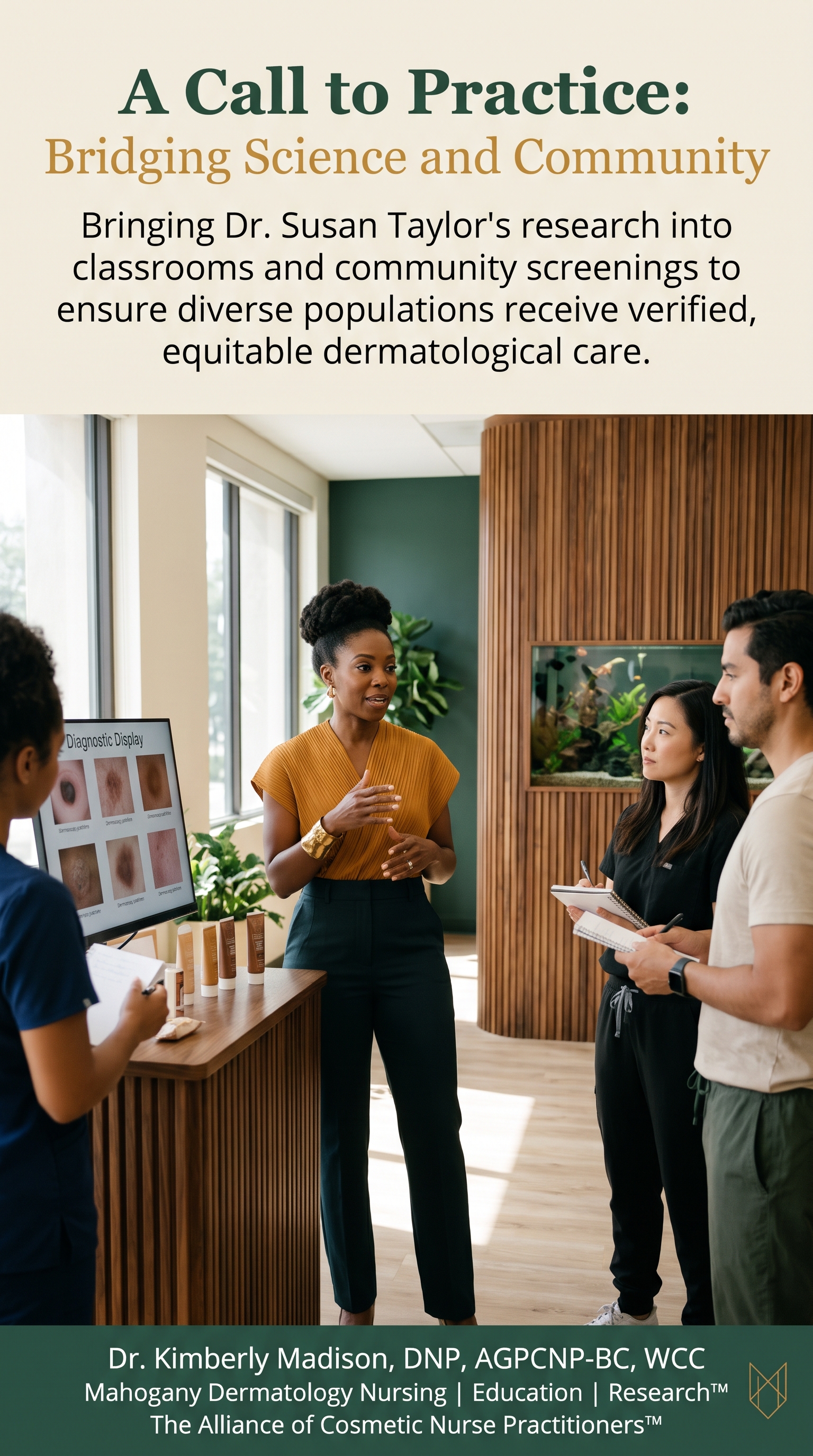
Dr. Taylor and her co-authors did what strong researchers do. They gathered the evidence, showed us how to use it, and told us where more is needed. Our part is to carry that work into the rooms where patients are waiting for answers, whether that room is a clinic, a classroom, or a community screening event. When we counsel carefully, measure what patients feel, and document what we learn, we support dermatologists and patients alike, and we hand the next generation of researchers better data. Mahogany Dermatology Nursing | Education | Research™ exists to support that work in global dermatology.
If you want to keep learning with us, join me tomorrow, Saturday, November 7, for the Opening Panel, What Clean Actually Means, at the California Black Health Network's virtual summit, Spreading the Beauty Truth. Save your seat today.
About the Author
Dr. Kimberly Madison, DNP, AGPCNP-BC, WCC, is a Board-Certified, Doctorally-prepared Nurse Practitioner, educator, researcher, and author dedicated to advancing dermatology nursing education with an emphasis on skin of color, business acumen, and digital literacy. She is the founder of Mahogany Dermatology Nursing | Education | Research™ and the Alliance of Cosmetic Nurse Practitioners™, the first dermatology nursing organization in the country built at the intersection of clinical excellence, global dermatology, aesthetics, and beauty, and financial literacy for nurses. A selected participant in the Harvard Business School Foundry, Dr. Madison developed Moneystruct INC: the entrepreneurial infrastructure women need to access the infrastructure, network, and capital needed to build sustainable businesses. Through peer-reviewed research, published books, and a growing community of entrepreneurs, Dr. Madison is building the infrastructure that makes this profession sustainable for the people who choose it.
References
Taylor S, Desai SR, Frey C, Elbuluk N, Grimes PE, Alexis A. Fundamentals of hyperpigmentation disorders. J Drugs Dermatol. 2026;25(10):926-933. doi:10.36849/JDD.10255
Sharma AN, Kincaid CM, Mesinkovska NA. The burden of melasma: race, ethnicity, and comorbidities. J Drugs Dermatol. 2024;23(8):691-693. doi:10.36849/JDD.8233
Zhu Y, Zeng X, Ying J, et al. Evaluating the quality of life among melasma patients using the MELASQoL scale: a systematic review and meta-analysis. PLoS One. 2022;17(1):e0262833. doi:10.1371/journal.pone.0262833
Eichenfield DZ, Sprague J, Eichenfield LF. Management of acne vulgaris: a review. JAMA. 2021;326(20):2055-2067. doi:10.1001/jama.2021.17633
Lyons AB, Trullas C, Kohli I, et al. Photoprotection beyond ultraviolet radiation: a review of tinted sunscreens. J Am Acad Dermatol. 2021;84(5):1393-1397. doi:10.1016/j.jaad.2020.04.079
Guo LN, Lee MS, Kassamali B, et al. Bias in, bias out: underreporting and underrepresentation of diverse skin types in machine learning research for skin cancer detection, a scoping review. J Am Acad Dermatol. 2022;87(1):157-159. doi:10.1016/j.jaad.2021.06.884
Passeron T, Desai SR, Abdallah M, et al. Global consensus on the management of melanin hyperpigmentation disorders. J Eur Acad Dermatol Venereol. 2026;40(5):760-772. doi:10.1111/jdv.70185
Lima PB, Dias JAF, Cassiano DP, et al. Efficacy and safety of topical isobutylamido thiazolyl resorcinol (Thiamidol) vs 4% hydroquinone cream for facial melasma: an evaluator-blinded, randomized controlled trial. J Eur Acad Dermatol Venereol. 2021;35(9):1881-1887. doi:10.1111/jdv.17344
Roggenkamp D, Sammain A, Furstenau M, et al. Thiamidol in moderate-to-severe melasma: 24-week, randomized, double-blind, vehicle-controlled clinical study with subsequent regression phase. J Dermatol. 2021;48(12):1871-1876. doi:10.1111/1346-8138.16080
Riyaz N, Riyaz A, Rahima, et al. Cutaneous manifestations of chikungunya during a recent epidemic in Calicut, north Kerala, south India. Indian J Dermatol Venereol Leprol. 2010;76(6):671-676. doi:10.4103/0378-6323.72466
Kumar R, Sharma MK, Jain SK, et al. Cutaneous manifestations of chikungunya fever: observations from an outbreak at a tertiary care hospital in Southeast Rajasthan, India. Indian Dermatol Online J. 2017;8(5):336-342.
American Academy of Dermatology Association. News release on Dr. Susan C. Taylor assuming the AAD presidency. March 7, 2025. aad.org
Madison K. Why dermatology nurse practitioners should recommend tinted sunscreen for skin of color patients. Mahogany Dermatology Nursing | Education | Research. mahoganydermatology.com
Madison K. The best tinted sunscreens for skin of color: NP approved. Mahogany Dermatology Nursing | Education | Research. mahoganydermatology.com